



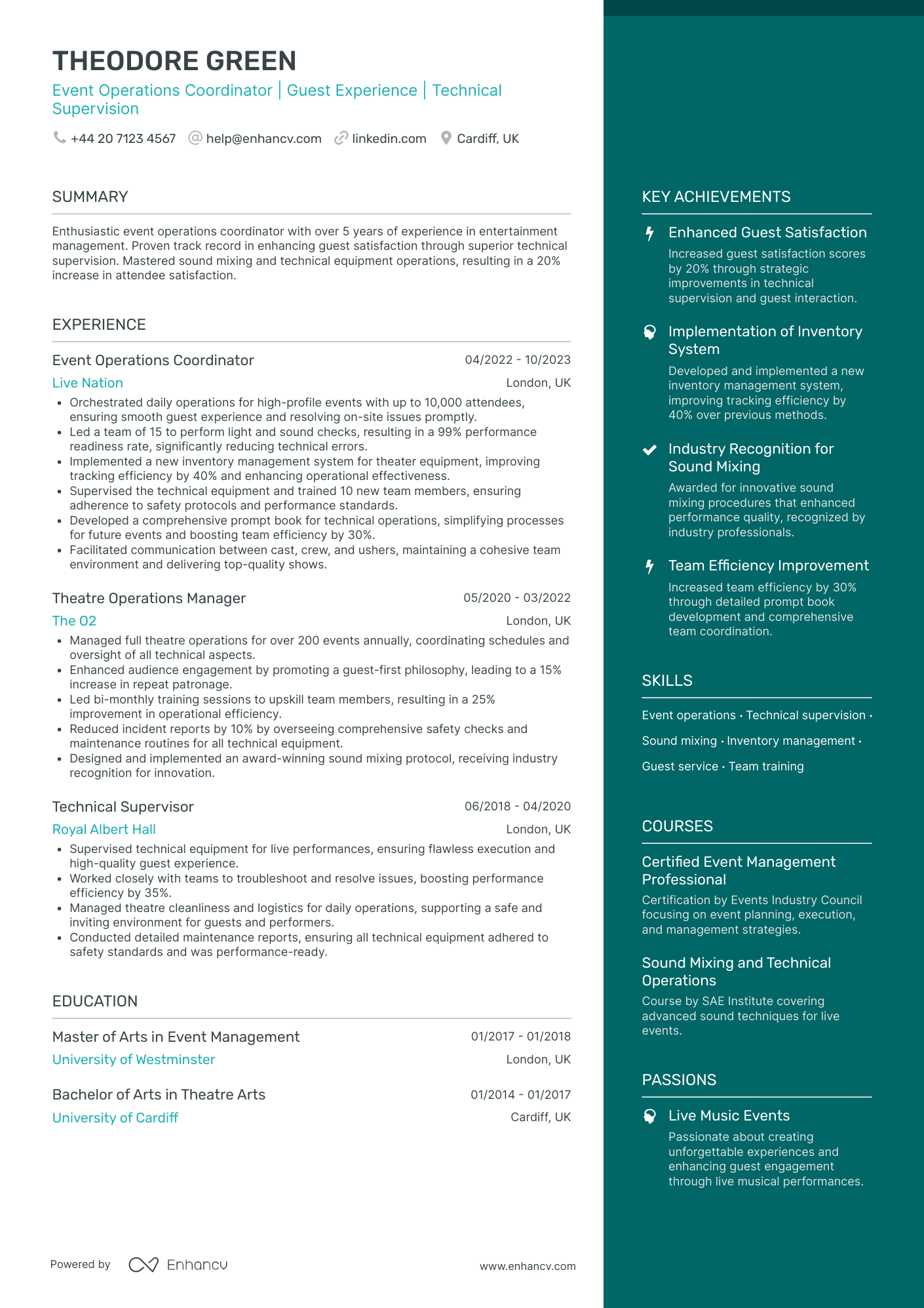
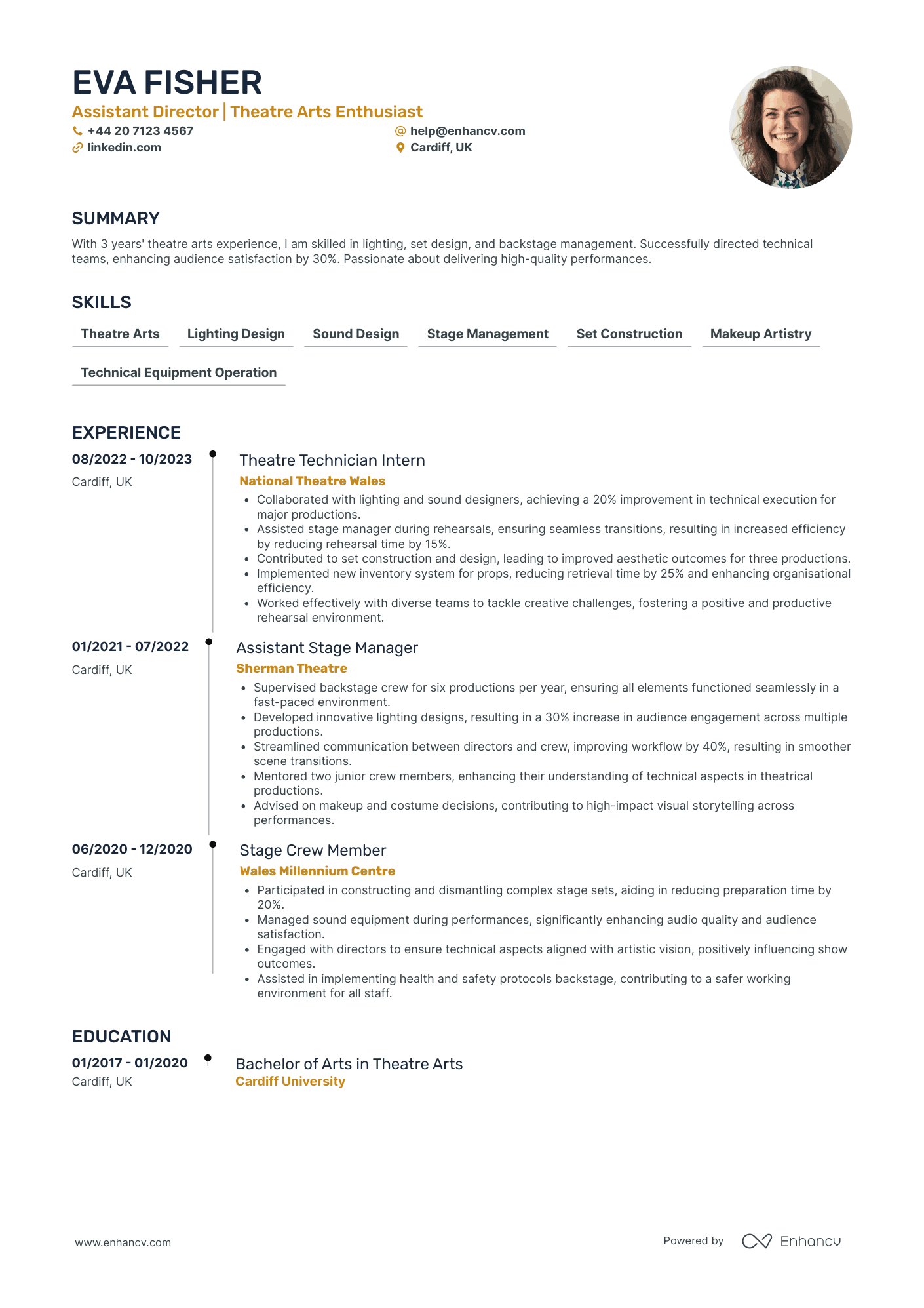
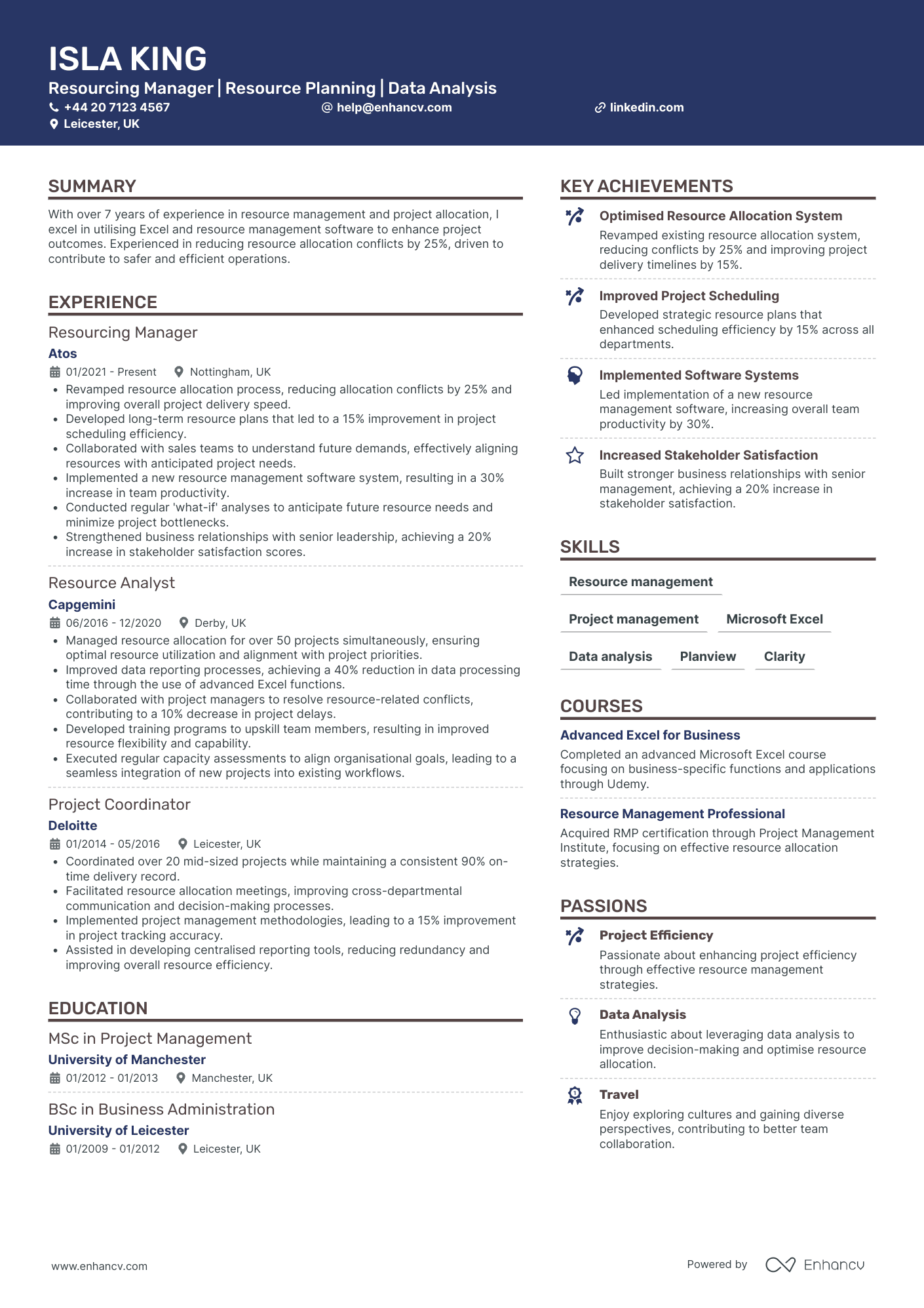
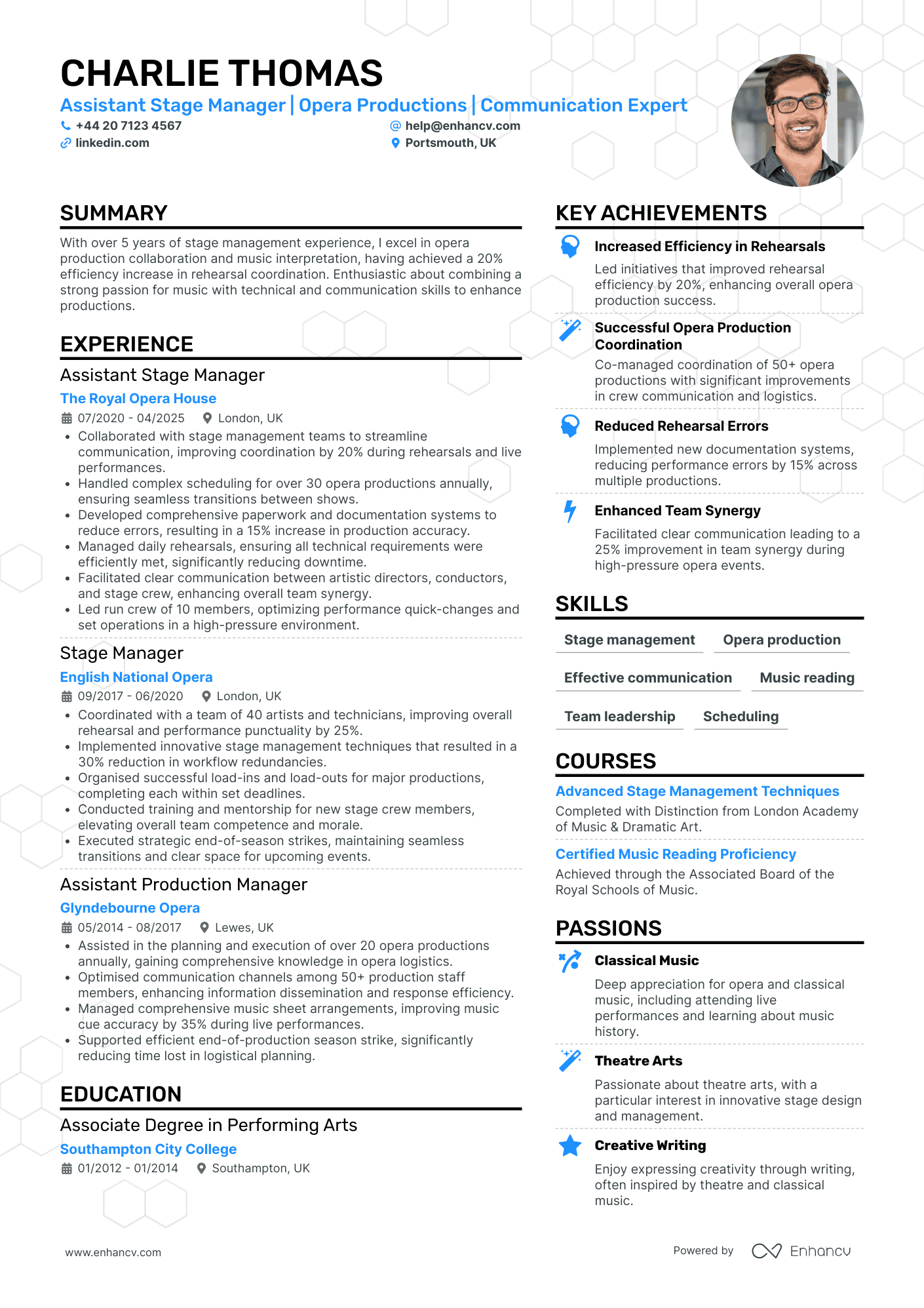
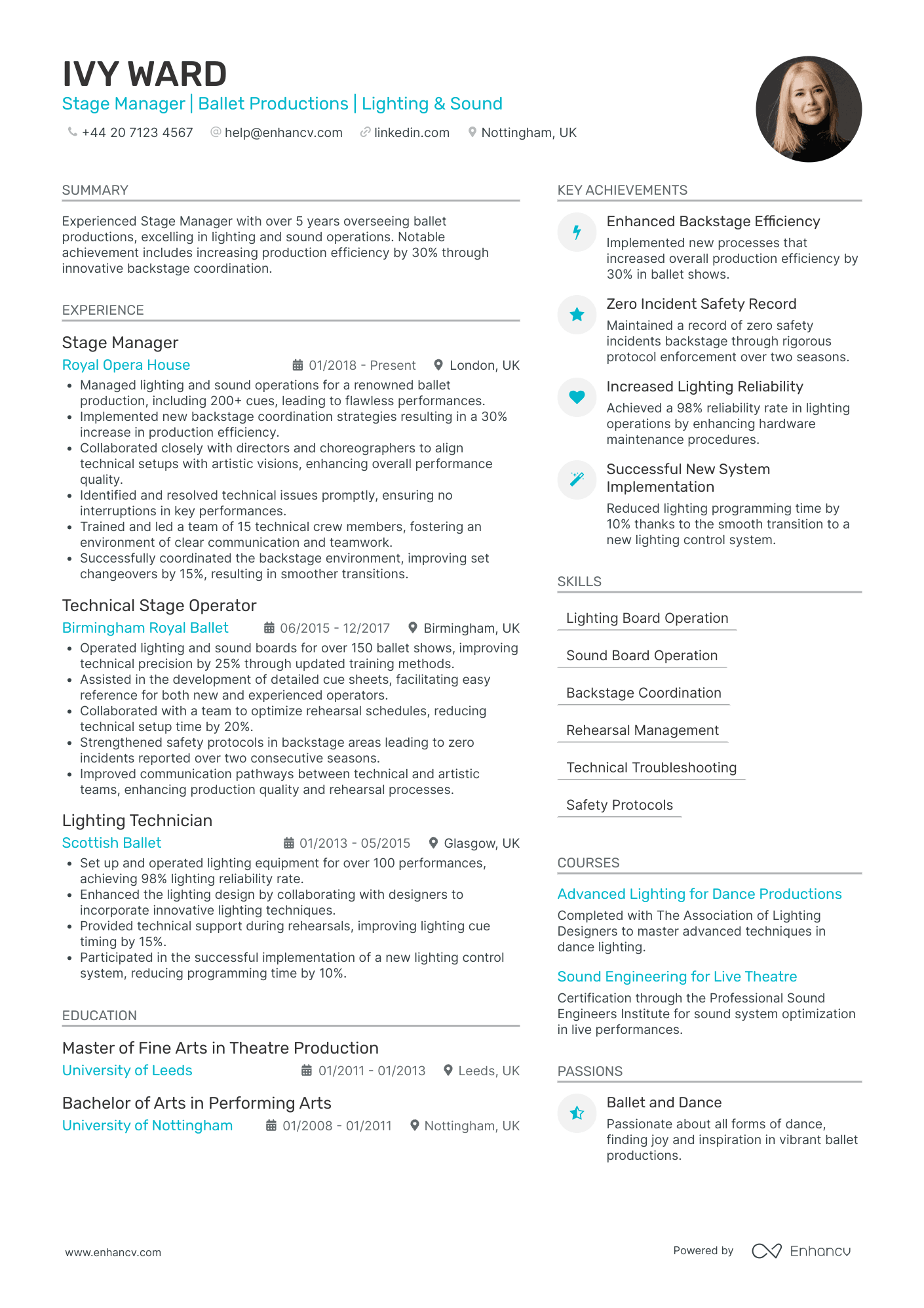
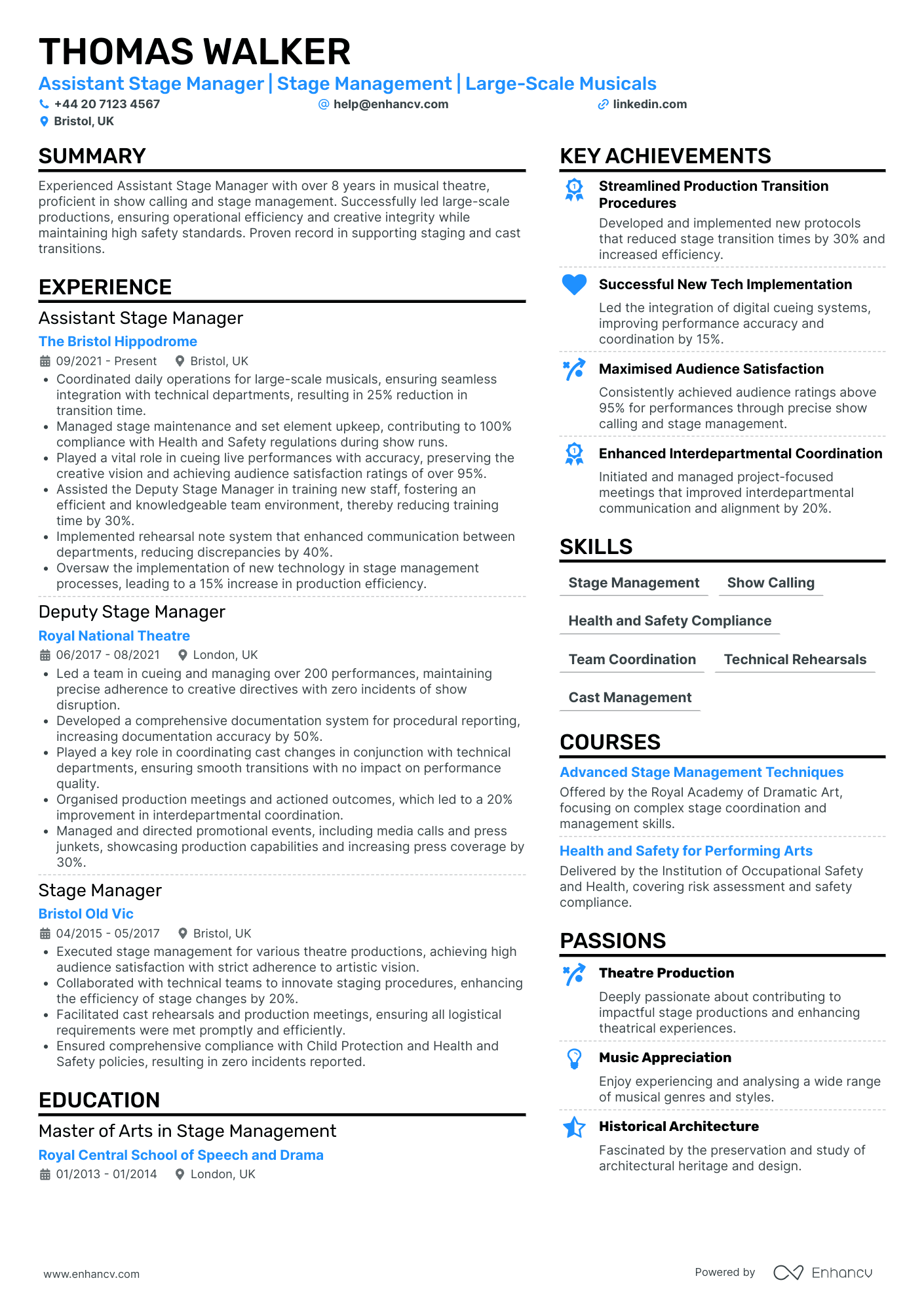
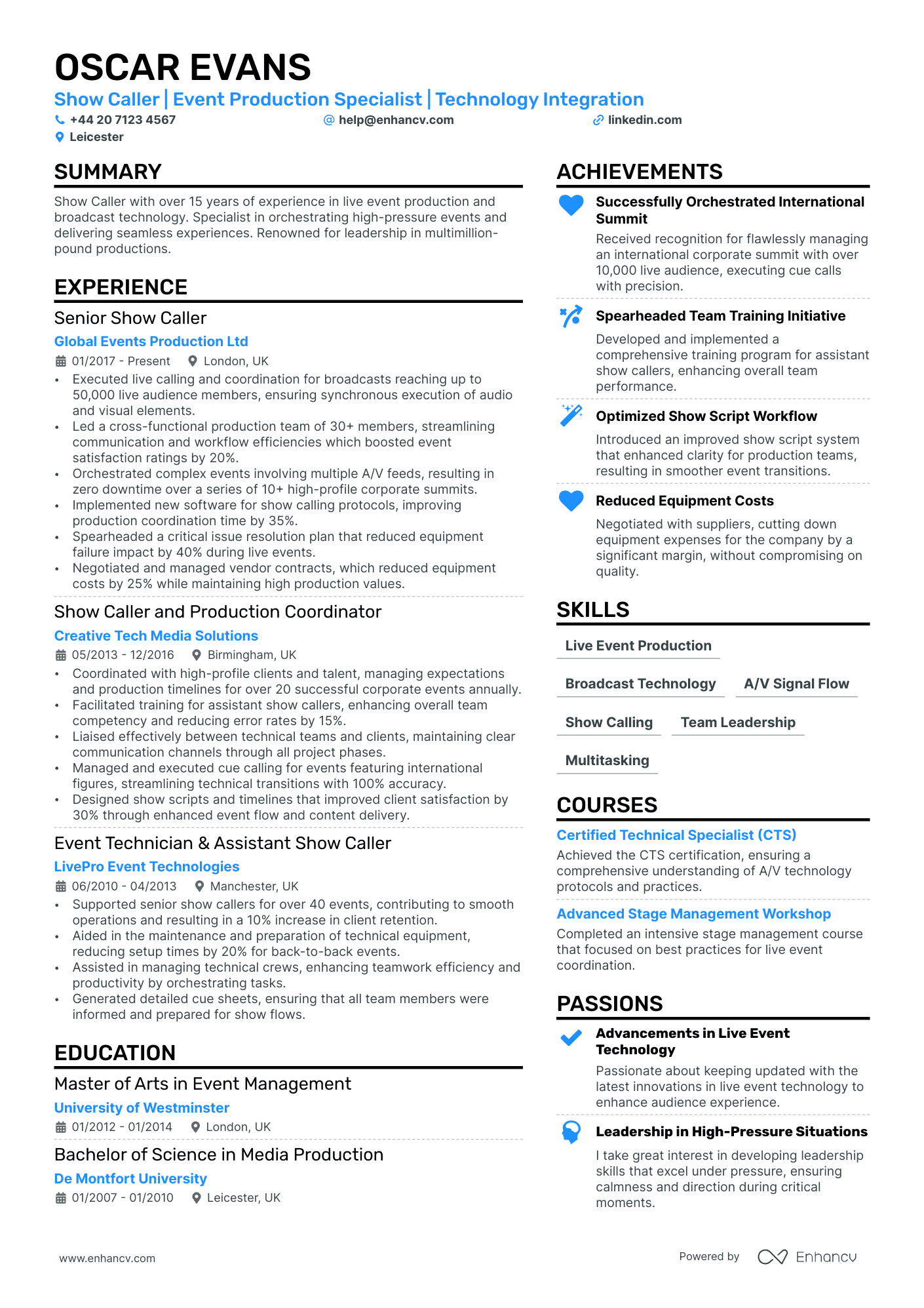
Most stage manager CVs read like a call sheet: a list of shows, venues, and dates with no sense of who kept the whole thing running.
A production manager scanning yours wants two answers fast. What have you already held together, and can you be trusted to run their show without drama. That means your training, your credits, and the tickets that keep a company safe and legal belong near the top, not buried under a paragraph of adjectives. If you want the fundamentals first, read how to write a CV.

Key takeaways
- Lead with qualifications and training. Drama school, an assistant-to-deputy track record, and current tickets are what a production manager screens for first.
- List your production credits like a professional, with role, production, company or venue, director, and year.
- Name the paperwork you own: prompt book, blocking notation, cue sheets, risk assessments, and calling the show.
- Open with a short personal statement built on what you have run, not a string of adjectives.
- Keep it to two pages, reverse chronological, sent as a PDF unless the advert asks for a Word file.
- Stage management is on-site and unsociable-hours work, so make your location and availability easy to find.
Qualifications and training UK stage management employers look for
There is no single licence you must hold to stage manage in the UK, so training and credits do the vouching instead. Lead with them.
Formal study still carries weight. A stage management or production arts course at a recognised drama school, whether that is RADA, Guildhall, Mountview, LAMDA, Royal Central, or the Royal Conservatoire of Scotland, tells a production manager you have been drilled in the paperwork and the discipline. A degree or diploma in technical theatre does the same. Put it in your education section with the year and, where it helps, the degree classification.
Show where you sit on the ladder. Assistant stage manager, deputy stage manager, stage manager, and company stage manager are distinct jobs, and a recruiter reads your level in seconds when you name it plainly. If you have deputised up, say so.
Weight the training to the level you are chasing. An assistant stage manager job leans on reliability, basic paperwork, and a willingness to learn, so a course and a first aid ticket go a long way. A stage manager or company stage manager job is a leadership post, so budgeting, staff management, and touring logistics matter as much as the theatre craft. Show the training that fits the job in front of you.
Then the tickets that keep a company safe and legal, because these are the ones that get checked. List first aid at work, manual handling, and working at height or IPAF and PASMA if you rig or run get-ins. Add an enhanced DBS check if the work involves children, and note any fire safety or personal licence a venue has asked you to hold. Keep these in a short training block or alongside your certificates on a CV.
For touring and receiving-house work, a full clean driving licence and clear availability function almost like a qualification. If you can drive a van or travel for a run, a recruiter wants to know that before they read your credits, so put it in the header.
If you are an Equity member, name it. It signals that you work to professional agreements and understand the conditions that come with them.

PRO TIP
Read the advert and mirror its exact language. If it asks for someone to run the book and call the show on QLab, use those words, not vague phrasing like managed technical cues. Stage management adverts are specific, and matching their vocabulary is the fastest way through an initial sift.
Skills to put on a stage manager CV
The job is half paperwork and half people, so your skills section should show both.
Your hard skills are the systems you actually run: preparing and maintaining the prompt book, blocking notation, calling the show, building rehearsal and production schedules, marking out a rehearsal room, and running QLab or the show-control desk. Coordinating get-ins and get-outs and writing risk assessments belong here too, because health and safety sits with stage management on most productions.
The soft skills that matter are the checkable ones. Communication across a company, staying calm when a cue goes wrong in front of an audience, discretion around cast welfare, and quiet leadership of a backstage team. Prove each in a credit or a bullet rather than just claiming it.
List only what you can stand behind on a first day. If you have called a show, say so. If you have only shadowed one, put it under training, not skills.
Top skills for your stage manager CV:
Prompt book preparation
Calling the show (cue calling)
Blocking notation
Rehearsal and production scheduling
Mark out and marking up
QLab and show-control software
Risk assessments and health and safety
Get-in and get-out coordination
Communication
Calm under pressure
Organisation
Leadership
Discretion and cast welfare
Listing your production credits on a stage manager CV
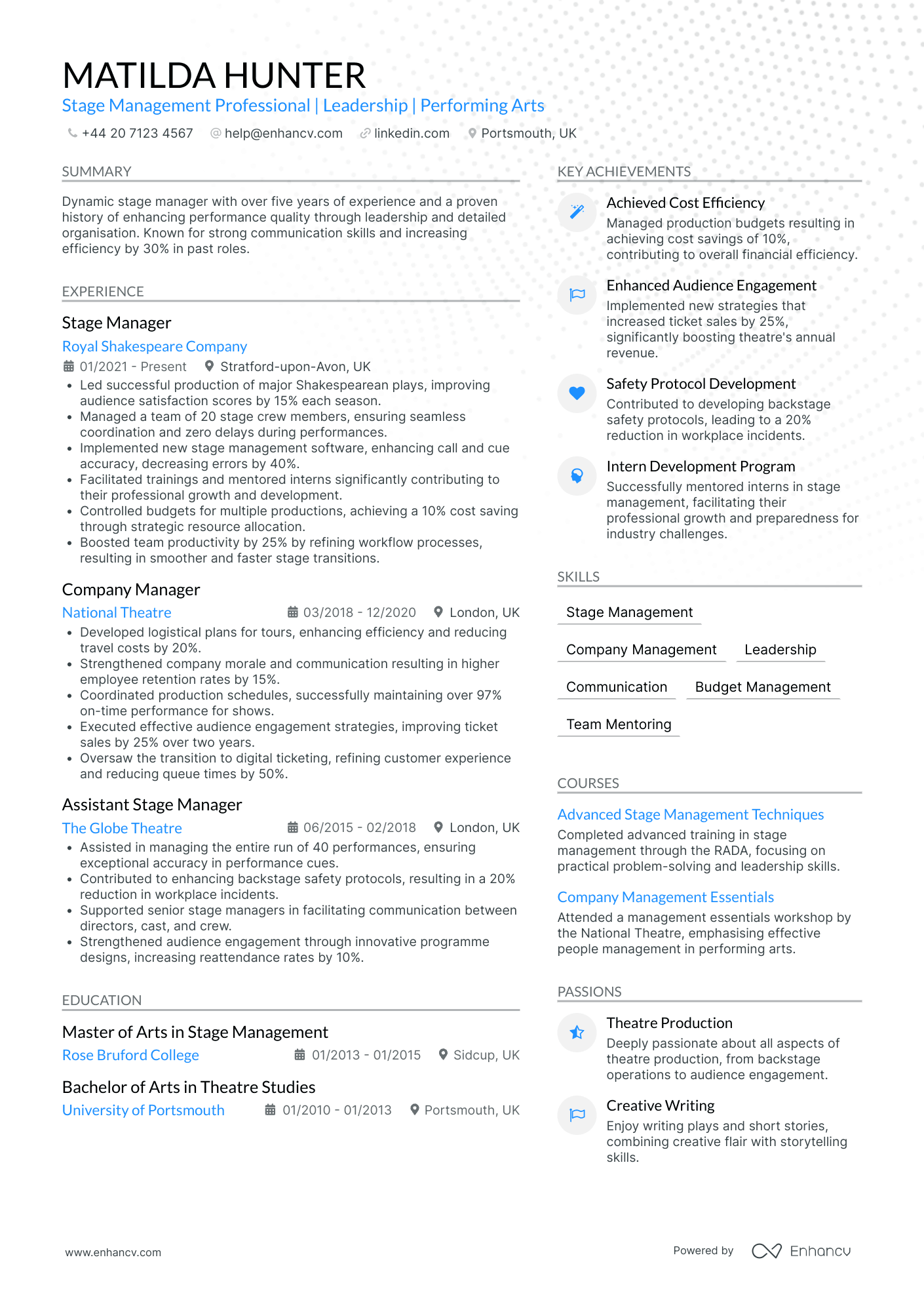
Your credits are your portfolio. They are the first thing an experienced production manager reads, so give them their own clearly labelled CV section and format every entry the same way.
For each credit, name the role you held, the production, the producing company or venue, the director, and the year. That five-part line lets a reader place the scale and seriousness of the work at a glance.
Signal scale where you can. A 900-seat main house, a national tour, a cast of 30, or a fast weekly rep turnaround all tell a reader something a job title cannot. Group credits by role level when the list is long, so your stage manager work does not sit muddled in with early assistant credits.
A clean credit line reads at a glance. Something like this does the work in one line: Deputy Stage Manager, Blithe Spirit, Northern Stage, dir. Sam Hughes, 2024. A reader knows your role, the show, the house, the director, and the year without hunting for any of it.
When your roles vary across productions, do not flatten them. If you were the deputy on some shows and an assistant on others, label each honestly, because a production manager is placing exactly what you have run at each level. A padded credit unravels in the first phone call.
Keep professional, training, and amateur credits honestly separated. If you keep an online credits list, a simple page or shared document, add the link to your header so a recruiter can see the full history without a third page.
Writing your stage manager personal statement
Three or four sentences at the top: who you are, the level you work at, what you have run, and your availability. Keep it concrete. If the opening line is where you stall, see more personal statement examples.
Skip the adjective soup. Passionate, organised, and hard-working sits on every other CV and tells a production manager nothing they can check.
Compare these two openings.
Stage manager personal statement to avoid
Passionate and hard-working stage manager with excellent organisational skills and a keen eye for detail. A strong team player and problem-solver looking for an exciting new opportunity to contribute to a dynamic and forward-thinking theatre company.
Stage manager personal statement example
Deputy stage manager with six years across UK receiving houses and one national tour, from studio runs to a 900-seat main house. I run the book, call the show, and keep a company of 20 to schedule and to safety standards. Based in Manchester, full clean driving licence, available for evenings, weekends, and touring.
When I pick up a stage manager CV, I go straight to the credits and the tickets. Tell me the production, the venue, the director, and the year, and I can place instantly whether you have run something the size of my show. A line like called 48 performances of a studio run, cast of 12, zero missed cues tells me more than a paragraph about being organised. Lead with what you have held together, and put your current first aid and DBS check where I can see them.
Writing your stage manager experience section
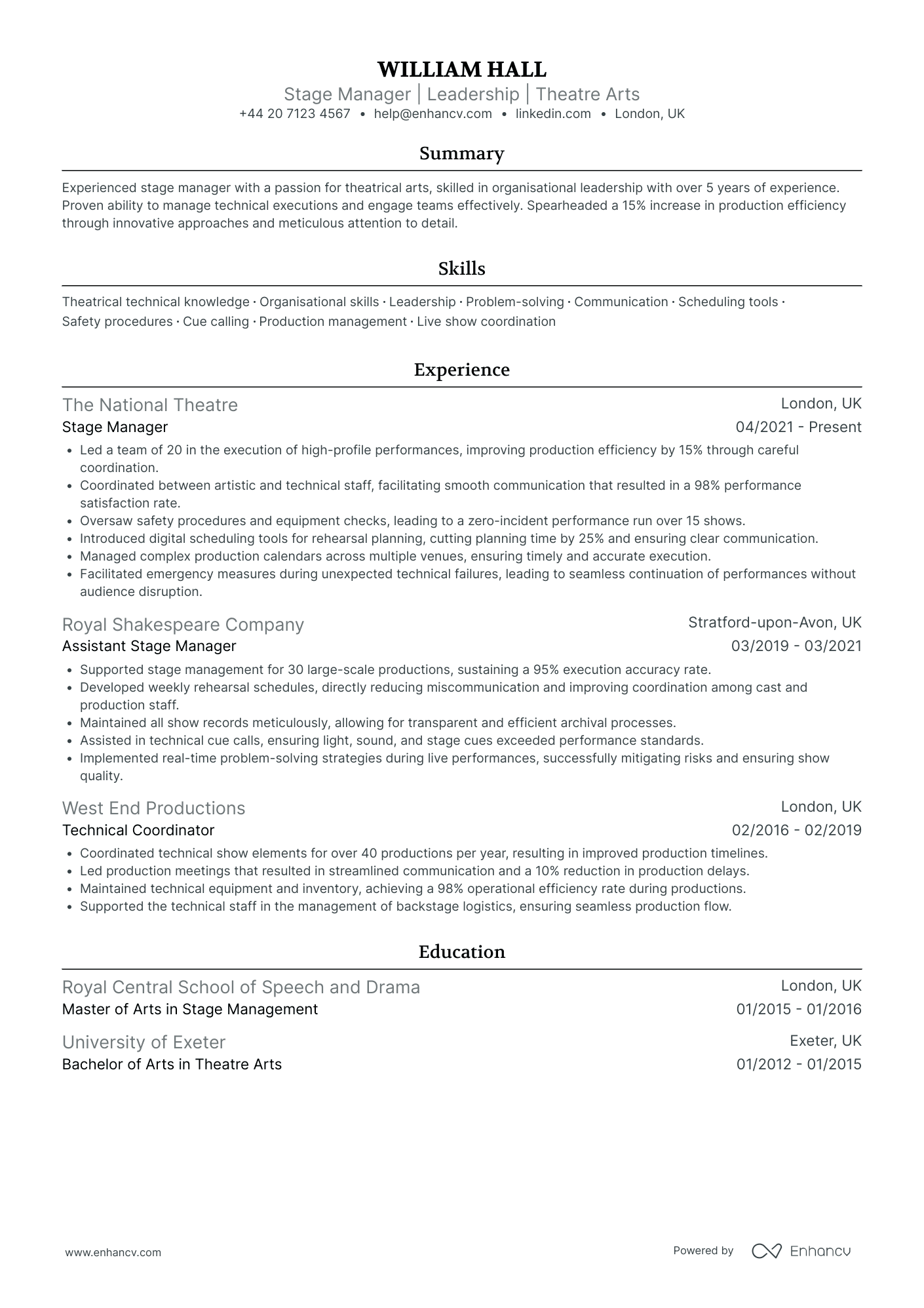
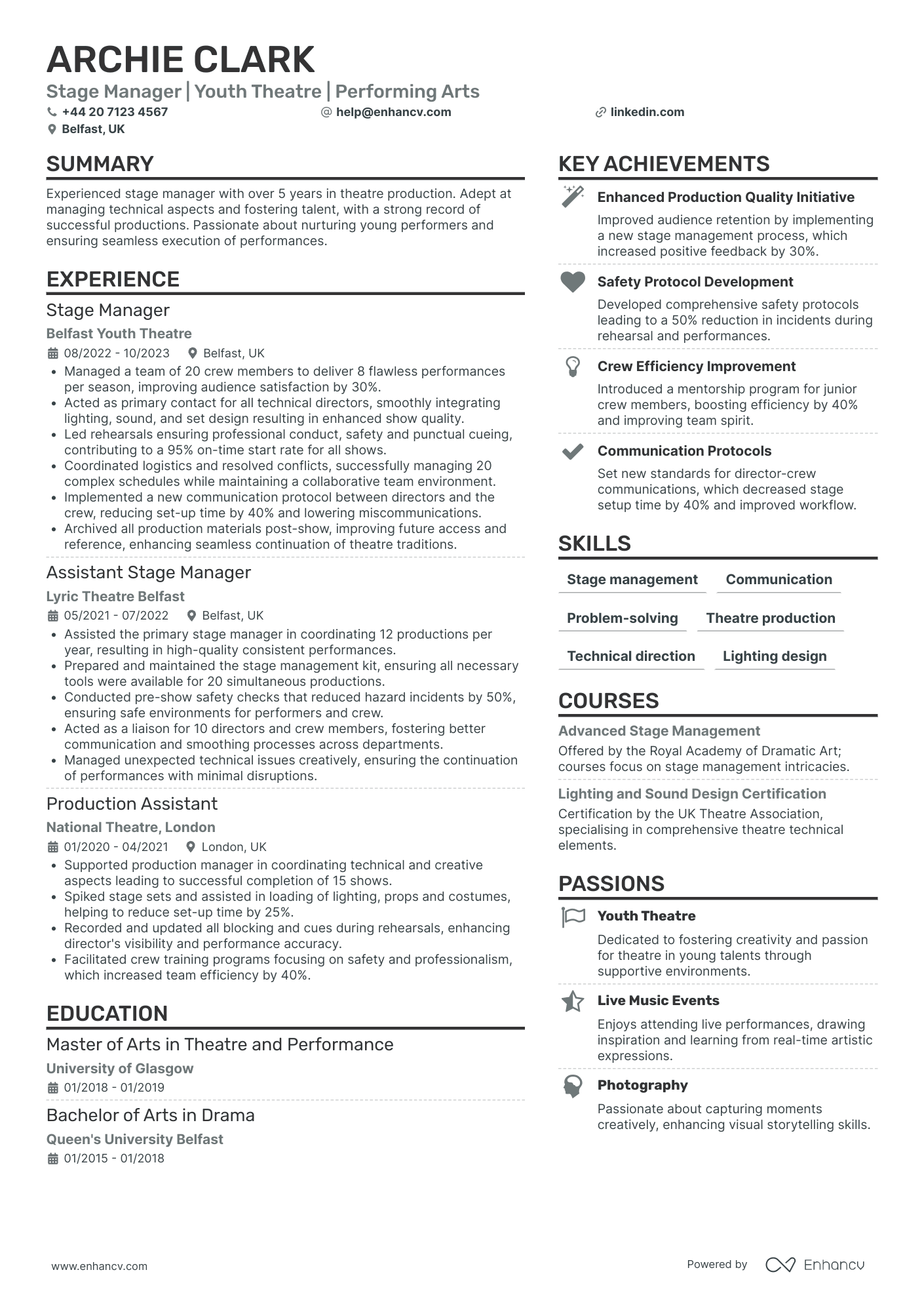
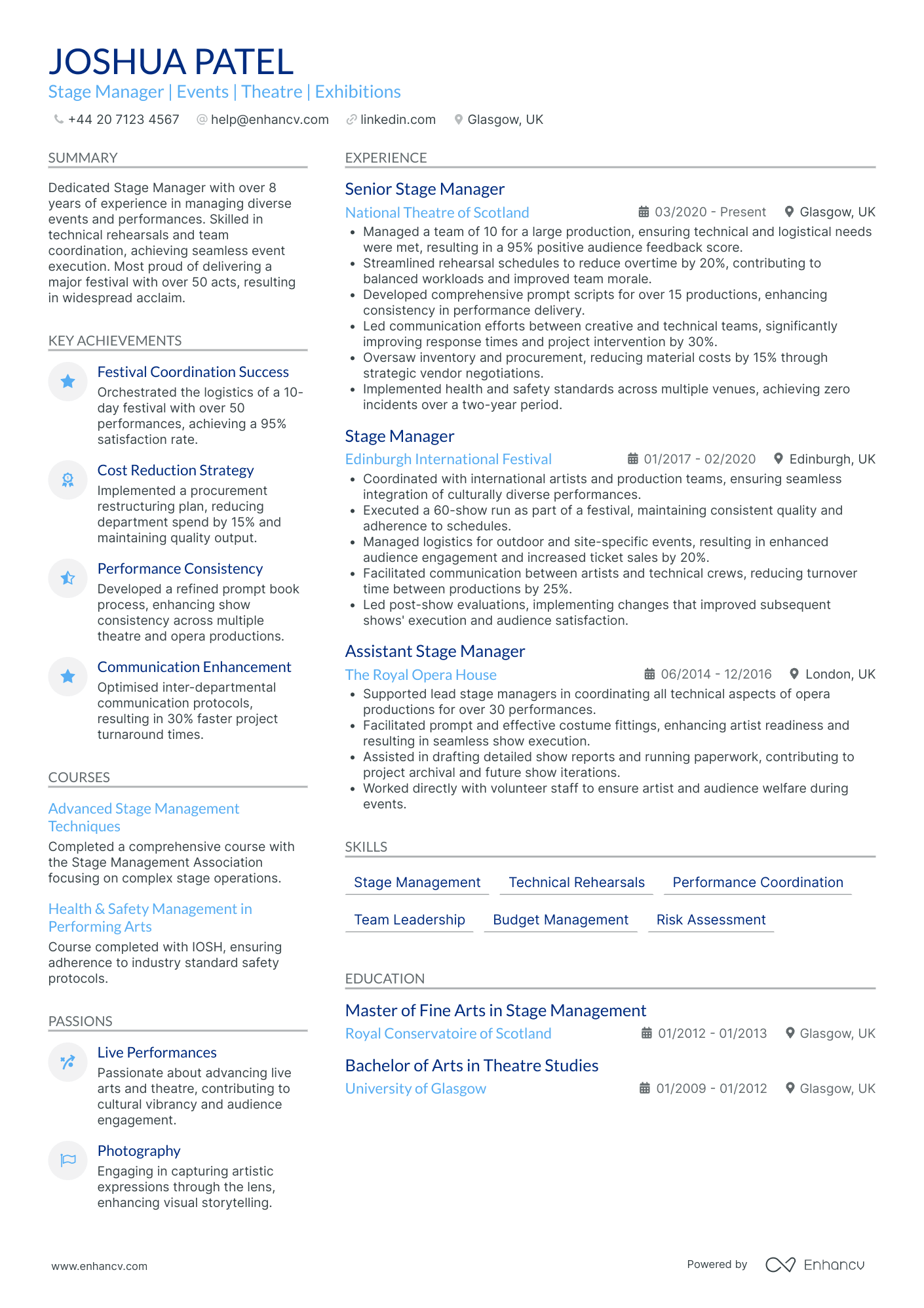
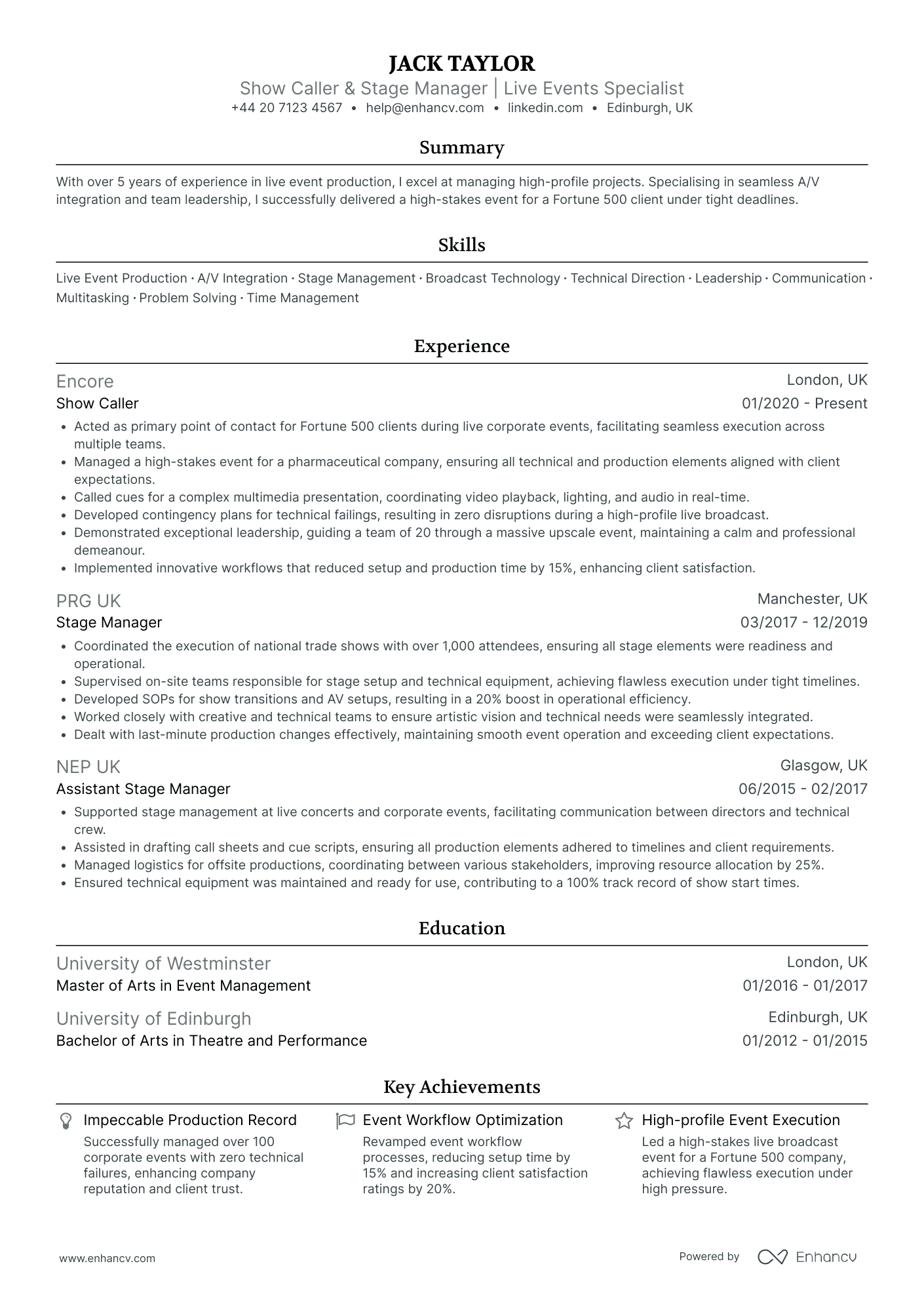
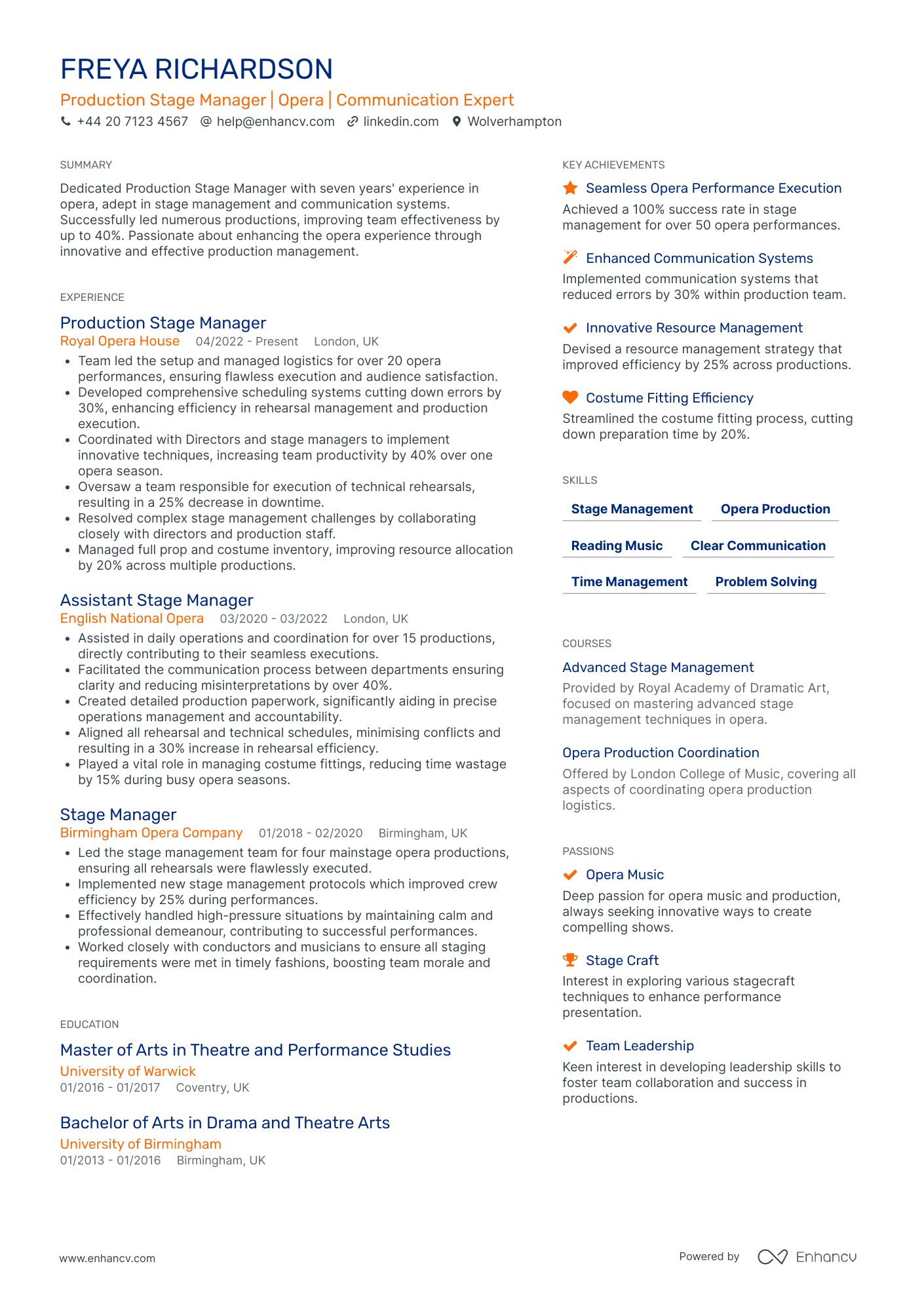
Write each entry with a dated heading, the role, the production or company, and the venue, then bullets that show what you ran and how it went. Start every bullet with a strong action verb.
Stage management is more measurable than it feels. Cast and crew numbers, performance counts, turnaround times, budgets you held, and a clean safety record are all achievements you can quantify. Numbers place your work far faster than adjectives do.
Short contracts are normal in this industry, so do not apologise for a run of them. Group a busy freelance year under a single heading if that reads more cleanly, and list the individual productions as the bullets. A dense season of work looks like exactly what it is, not like instability.
Tailor each application to the advert, pulling the terms and responsibilities it lists and mirroring the ones that are true of you. That mirroring is most of what a strong work experience section is doing. Enhancv's CV tailoring feature reads the ad and suggests the matching edits, which saves rewriting the whole thing for every show.
- Ran the prompt book and called 48 performances of a three-week run, cast of 9, with zero missed or late cues
- Managed the rehearsal schedule for a company of 18 across a five-week period, flagging clashes before they cost the room time
- Wrote and maintained the risk assessments and ran the get-in and get-out with a crew of 6, closing the run with no reportable incidents
- Kept the director, cast, and production team on the same information daily through clear rehearsal notes and a maintained cue sheet
- Sourced and tracked props and consumables for a 14-venue national tour against a fixed weekly budget
- Set and struck the stage to a 90-minute get-in and get-out at each venue, keeping the running order to time
- Covered the book for the deputy on four performances, calling the show without a rehearsal drop
- Managed cast welfare and travel logistics on the road for a company of 8, with no missed calls across the tour
Formatting your stage manager CV
Once you have professional credits, use a reverse chronological structure so your most recent and most senior work sits first. If you are still breaking in, lead with a skills-led format so training and transferable skills come before a thin credits list.
Keep it to two pages. Production managers read fast between meetings and a third page rarely gets there. One column, standard headings, and a readable font.
Send a PDF for direct applications so the layout holds, and keep a Word copy for agencies that reformat into their own template. Applications often pass through tracking software first, so keep the structure clean and the headings standard for an ATS-friendly CV.
Put the practical facts in the header where they get read first: your location, your phone number and email, your availability, a driving licence if you hold one, and the link to your online credits. A production manager should be able to work out whether you can do the run before they reach your first credit.
Build it from a tested layout rather than a blank page. Enhancv's CV templates export to a clean PDF and keep a long credits list readable.
What the UK stage management market looks like
Be careful with pay expectations. There is no reliable single salary figure for UK stage managers, because the work is costed by production rather than by an annual wage, and it swings widely between fringe, subsidised, and commercial theatre. Anchor your CV to your credits and your availability, not to a number.
A few features of the work should still shape the document.
| What | UK stage management roles |
|---|---|
| How pay works | Costed per production and usually set against industry agreements such as those Equity negotiates, so it is quoted weekly far more often than as a yearly salary. |
| Where the work happens | On-site and frequently touring, by the nature of the job. Put your location and your availability for evenings, weekends, and travel near the top. |
| How you progress | Along the assistant, deputy, stage manager, and company stage manager ladder. Make the level you work at obvious. |
| What gets you shortlisted | Relevant training, a clear credits list, and current safety and first aid tickets. |
Stage manager CV with no professional credits
Everyone starts without a professional credit, and the way in is to present the ones you do have properly. Student, fringe, and amateur productions all count when you write them up like real jobs, with dates, a role, and what you ran. See how strong first-job CVs handle a thin history.
Chase the assistant stage manager credit any way you can. Get-in crew, casual backstage shifts, festival and venue volunteering, and drama school placements all build the paperwork and the references that a first professional booking needs.
Write the skills in the language a working stage manager would use. If you have run a prompt book for a student show, marked out a rehearsal room, or called cues on a QLab file, say exactly that. Concrete craft on a first CV reassures a recruiter far more than a list of qualities.
Lead skills-led while the credits list is short. Put your training, the software and paperwork you can already run, and any tickets first, then your credits, then everything else. One booked assistant job changes the whole document, so make it easy for someone to take the risk on you.
Conclusion
Lead with your training and your credits, name the paperwork and the tickets you hold, and make the level you work at obvious in seconds.
Pair the CV with a short cover letter that says why this company and this show, and you give a production manager an easy reason to call you in.

Author's take - the Enhancv team
When I pick up a stage manager CV, I go straight to the credits and the tickets. Tell me the production, the venue, the director, and the year, and I can place instantly whether you have run something the size of my show. A line like called 48 performances of a studio run, cast of 12, zero missed cues tells me more than a paragraph about being organised. Lead with what you have held together, and put your current first aid and DBS check where I can see them.