



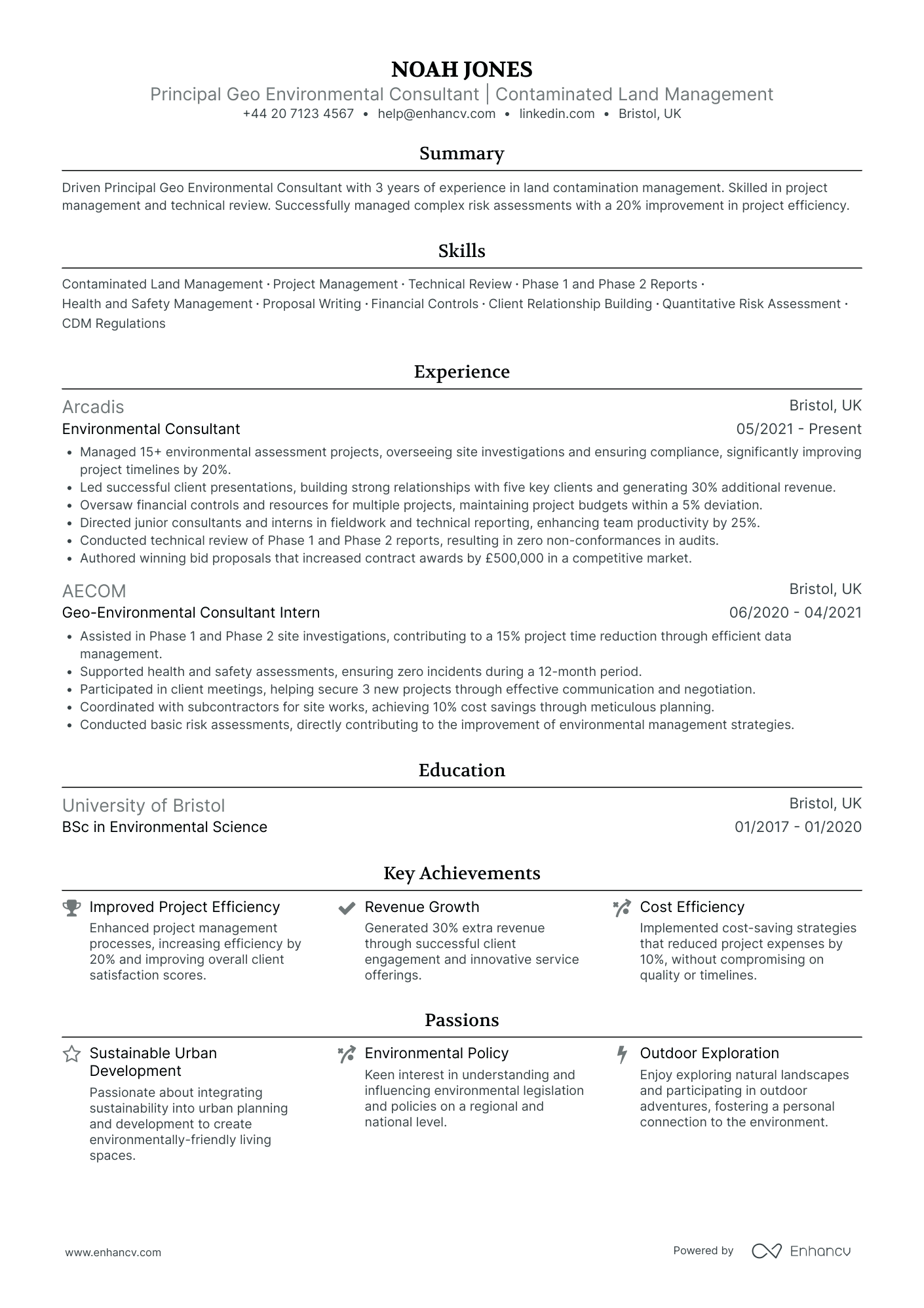
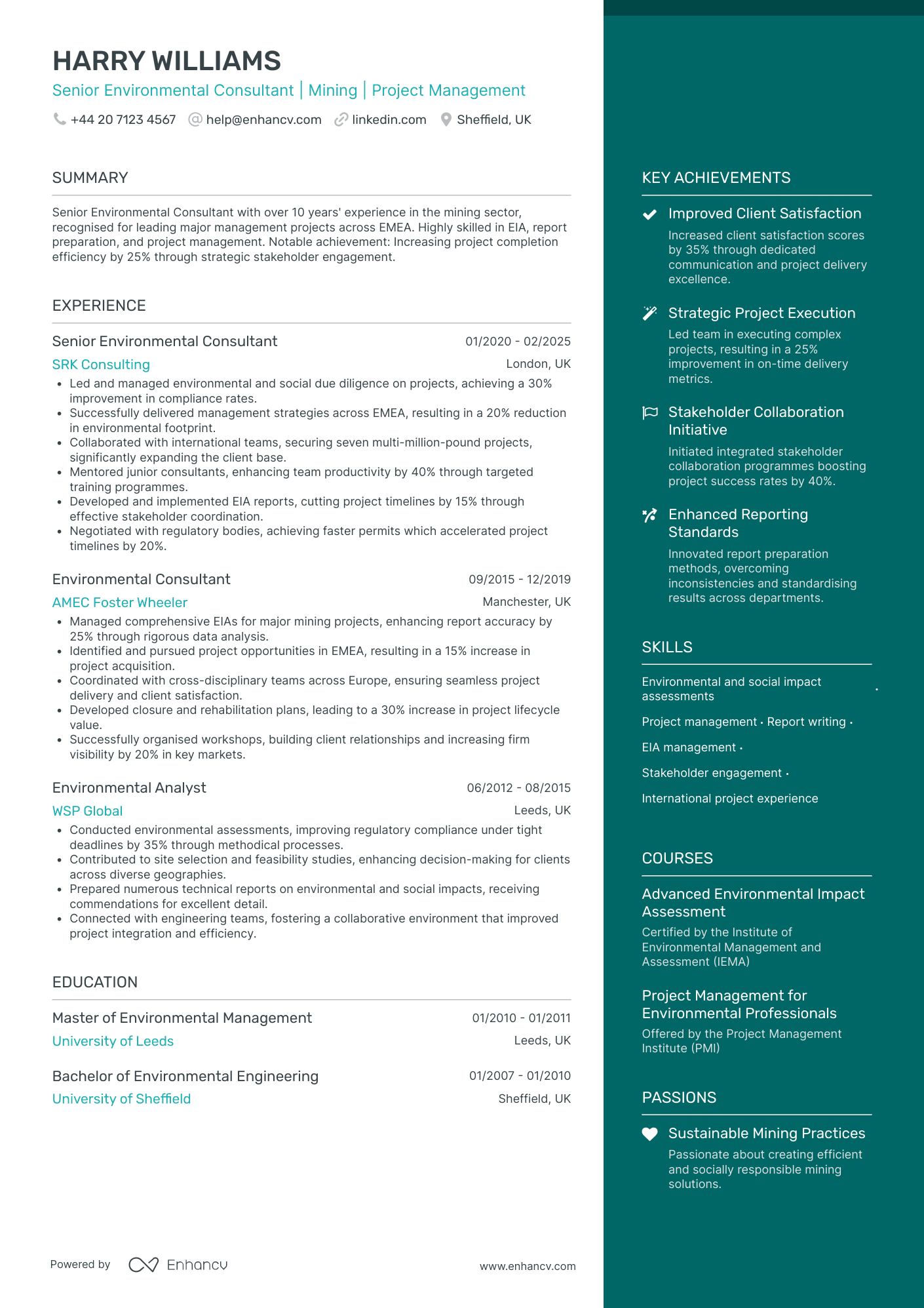
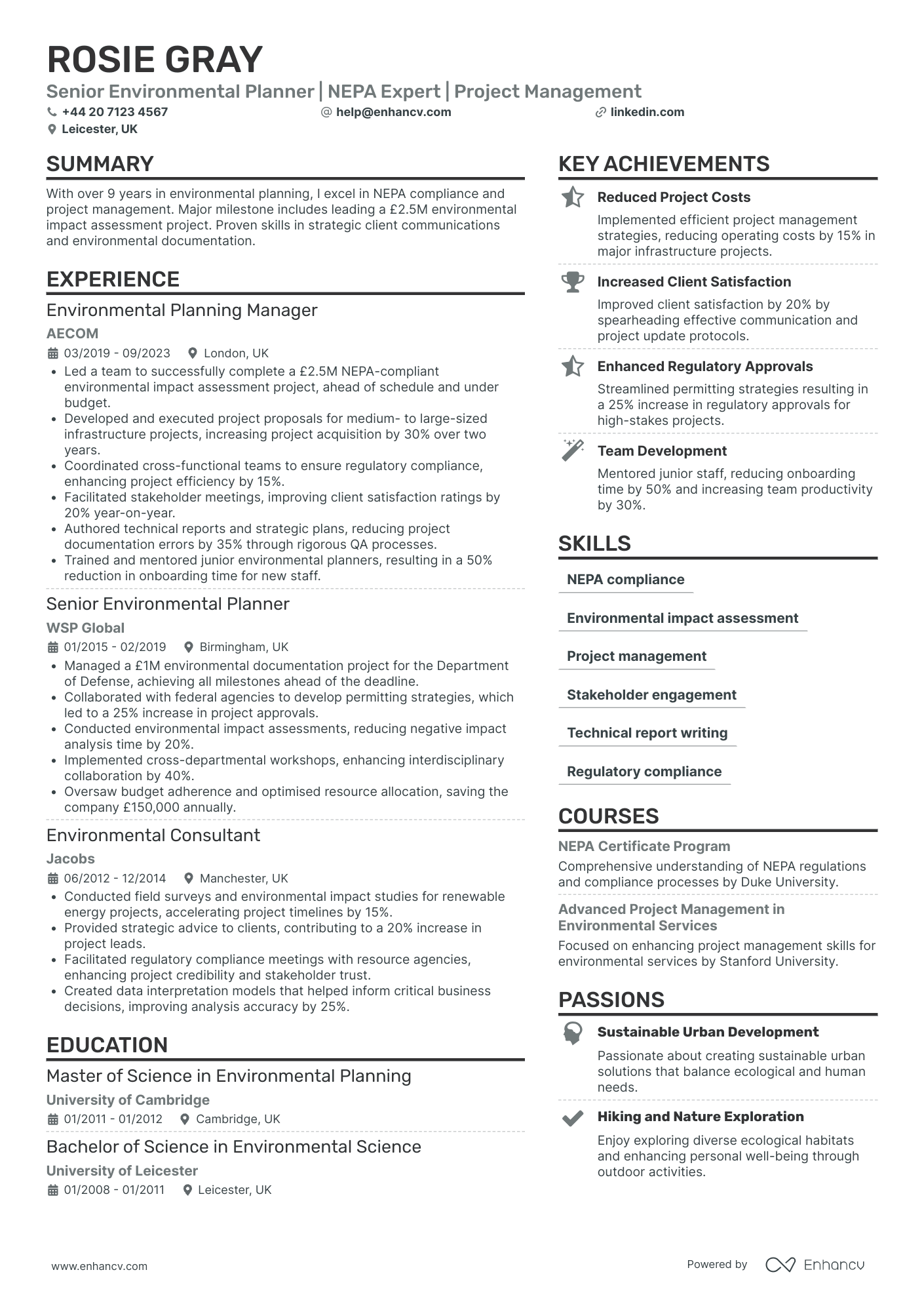
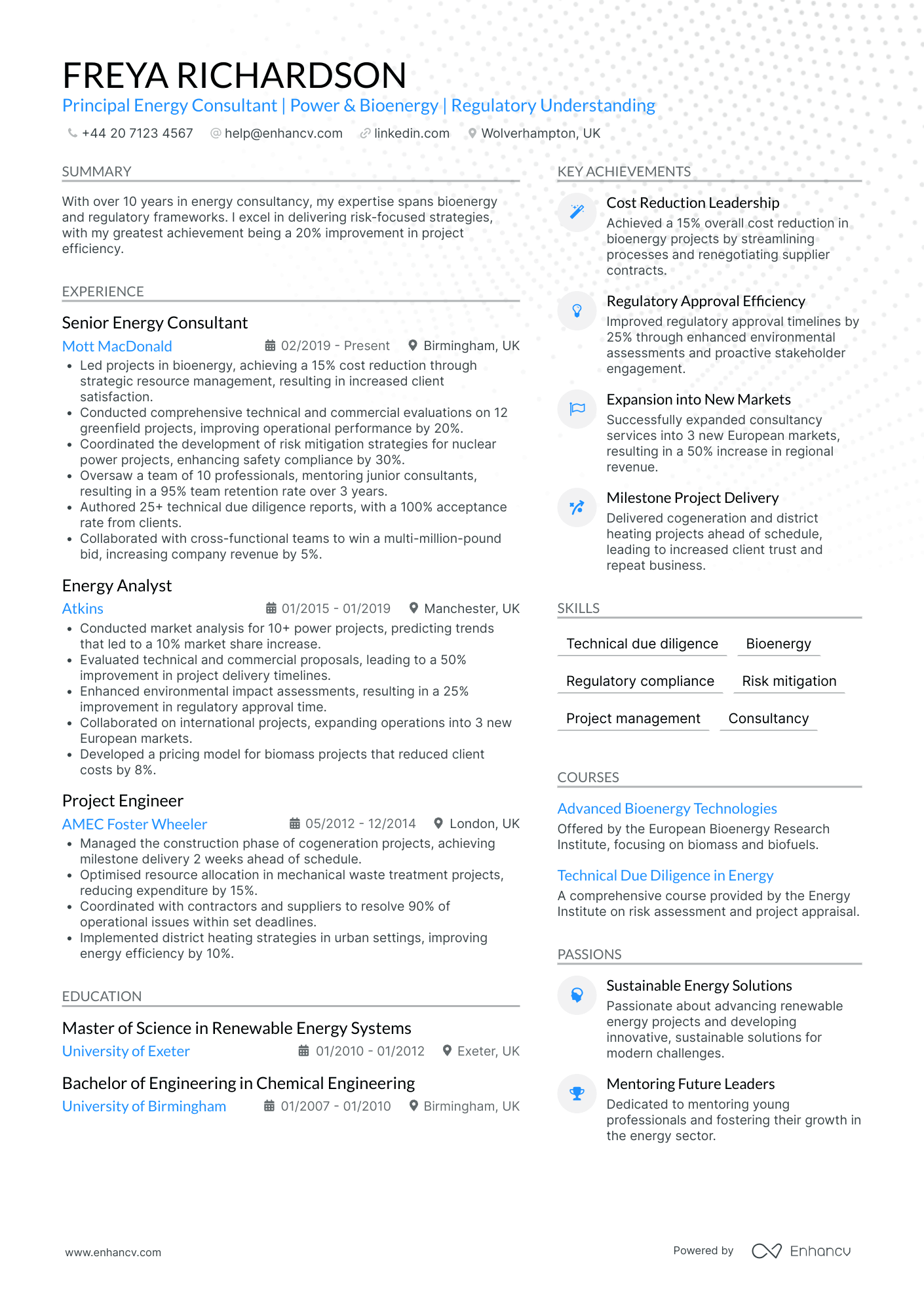
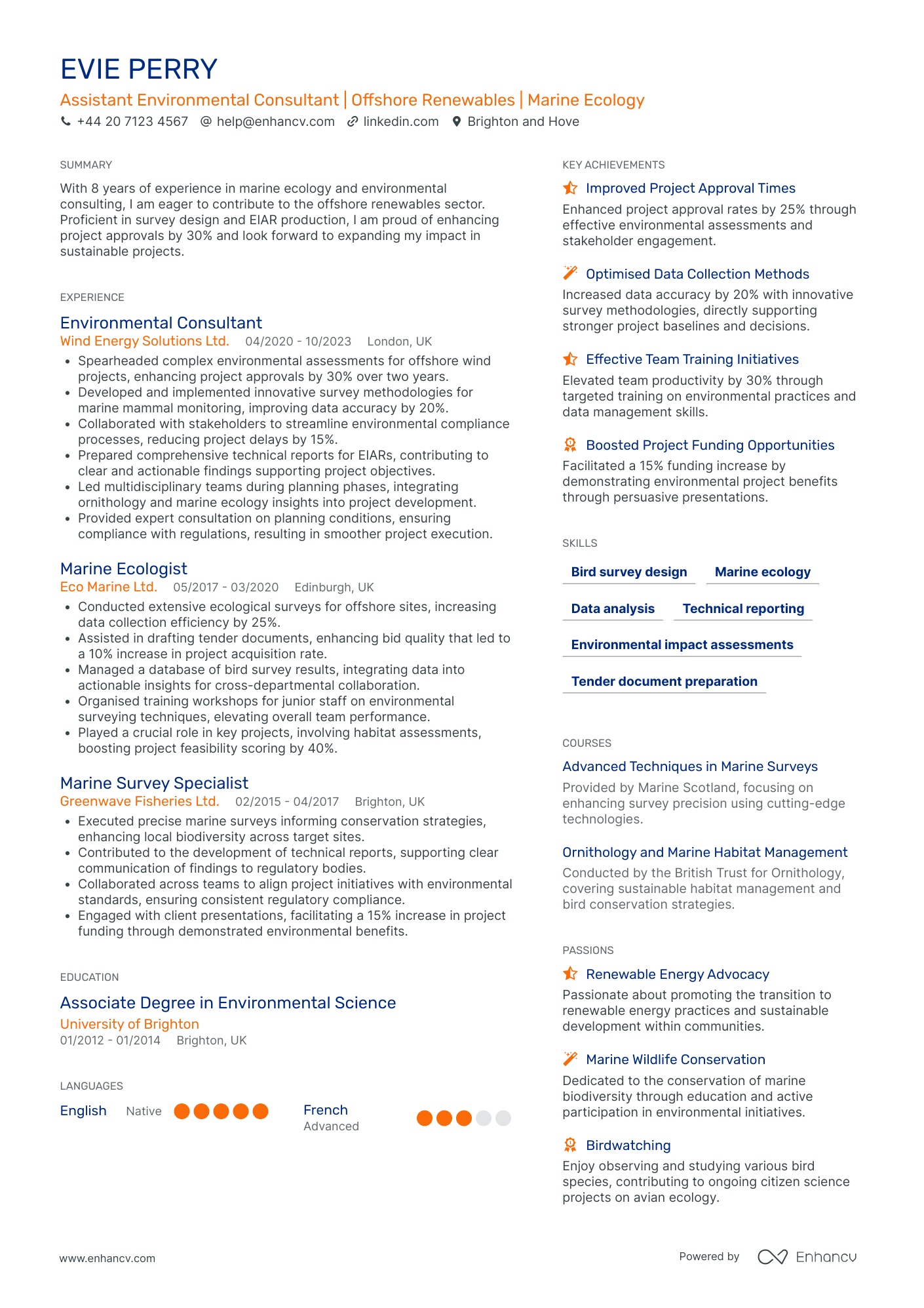
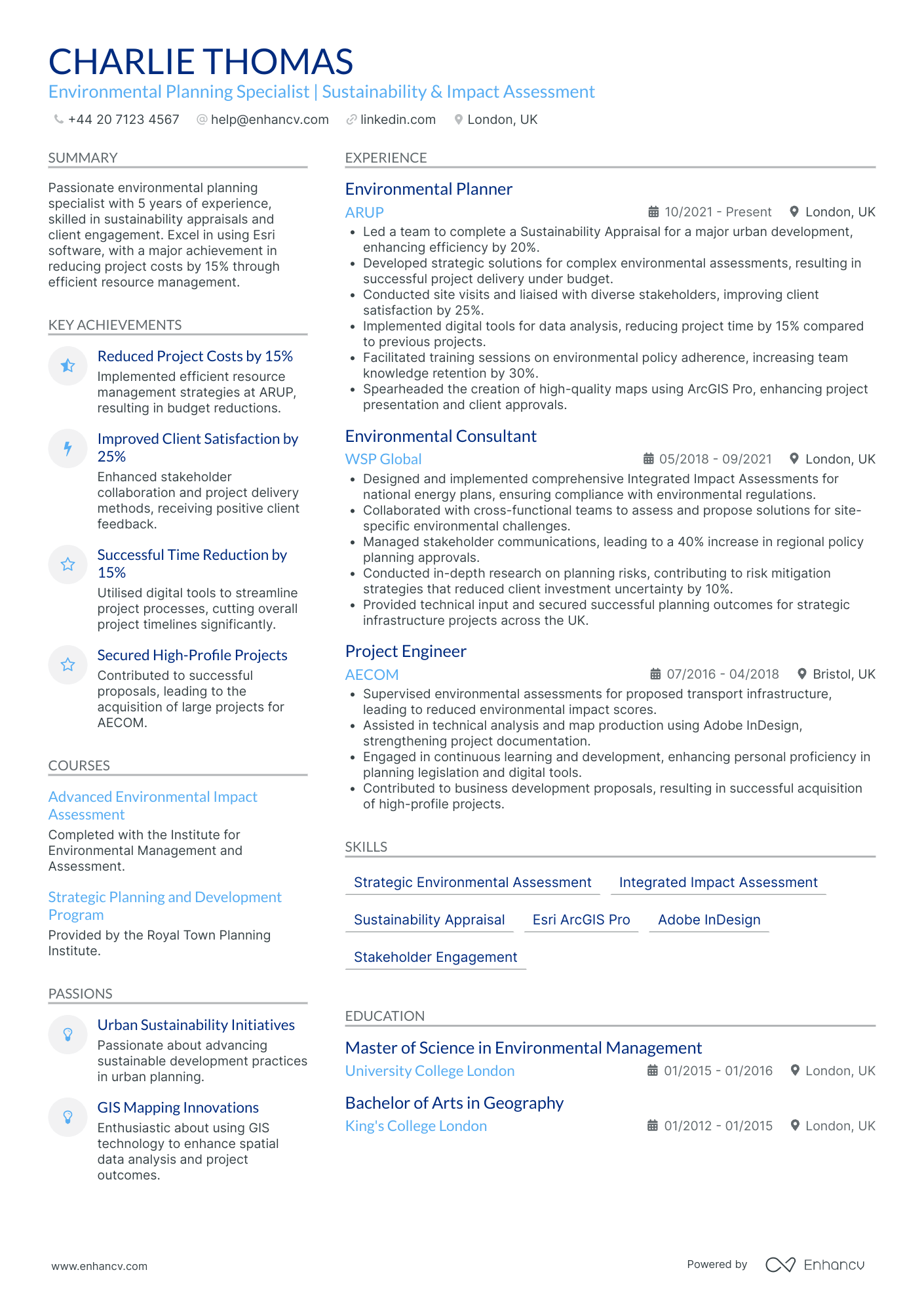
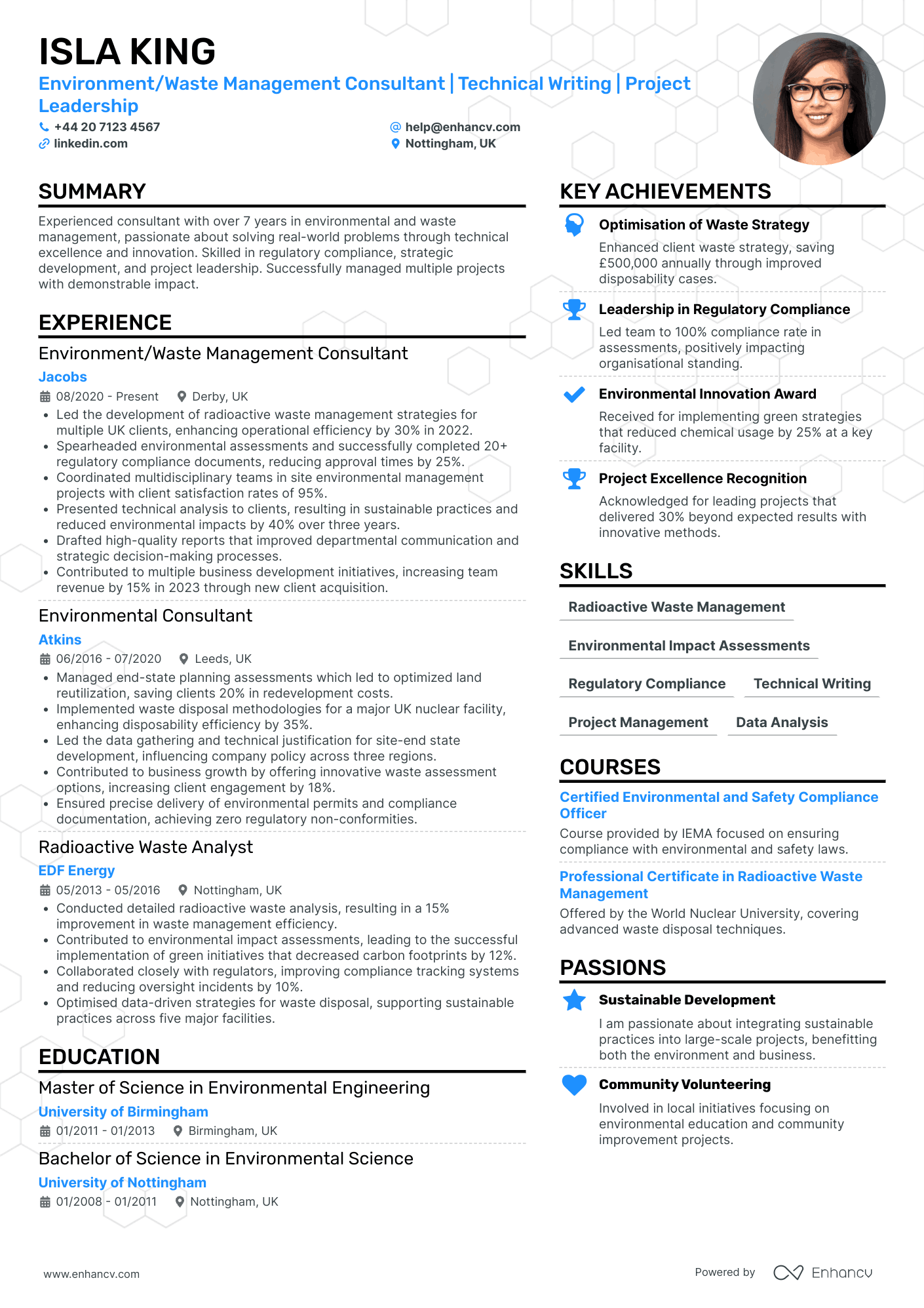
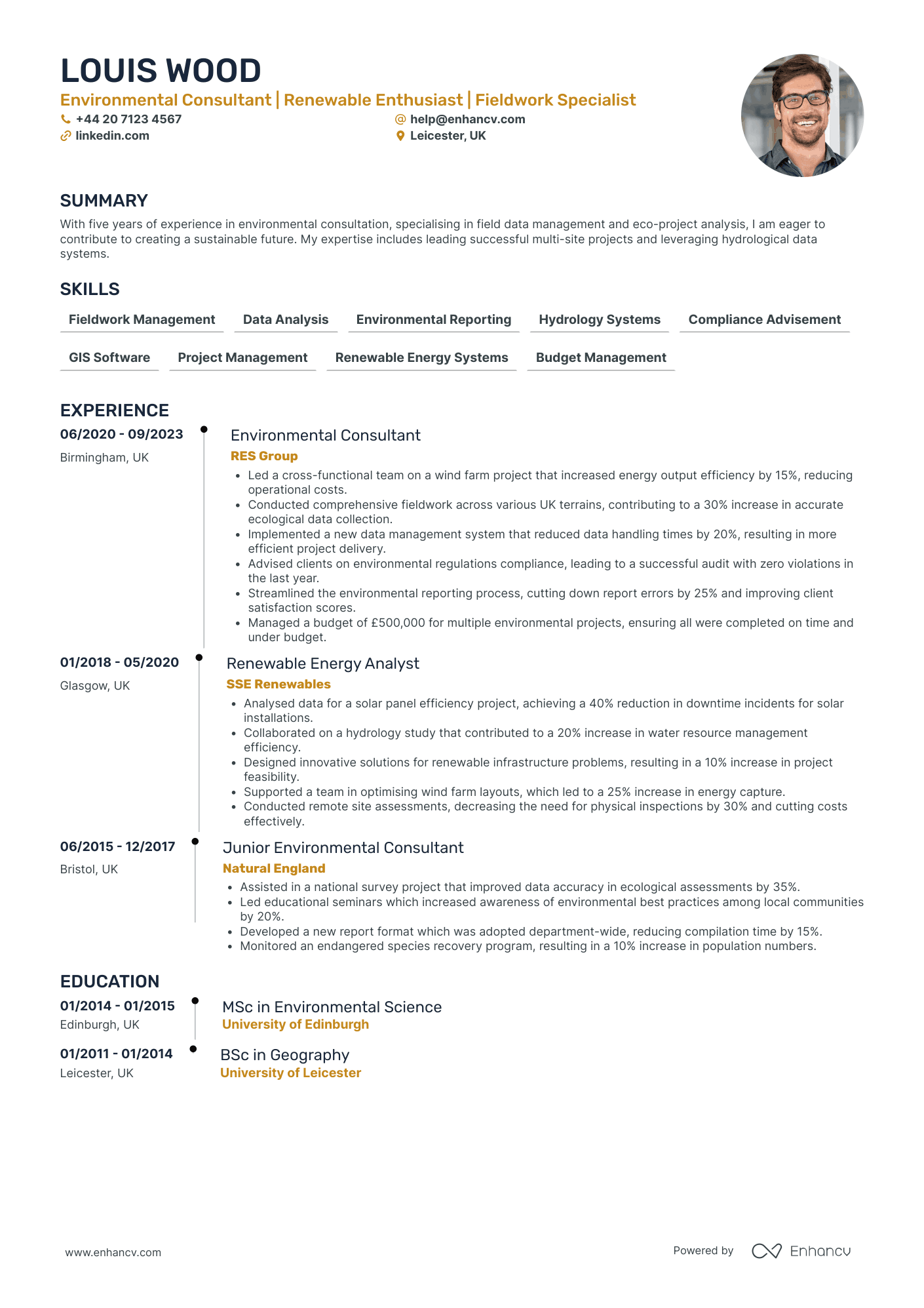
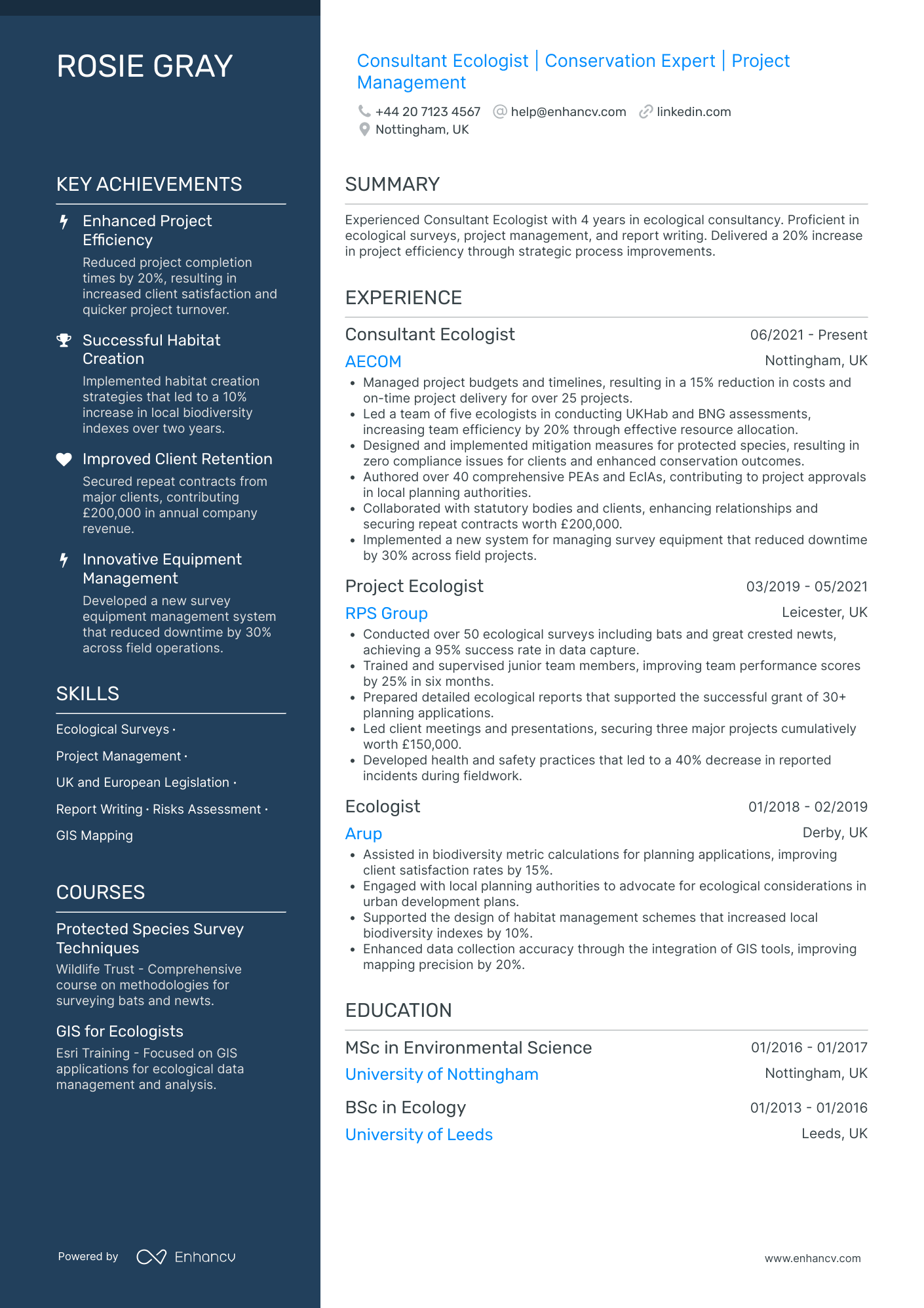
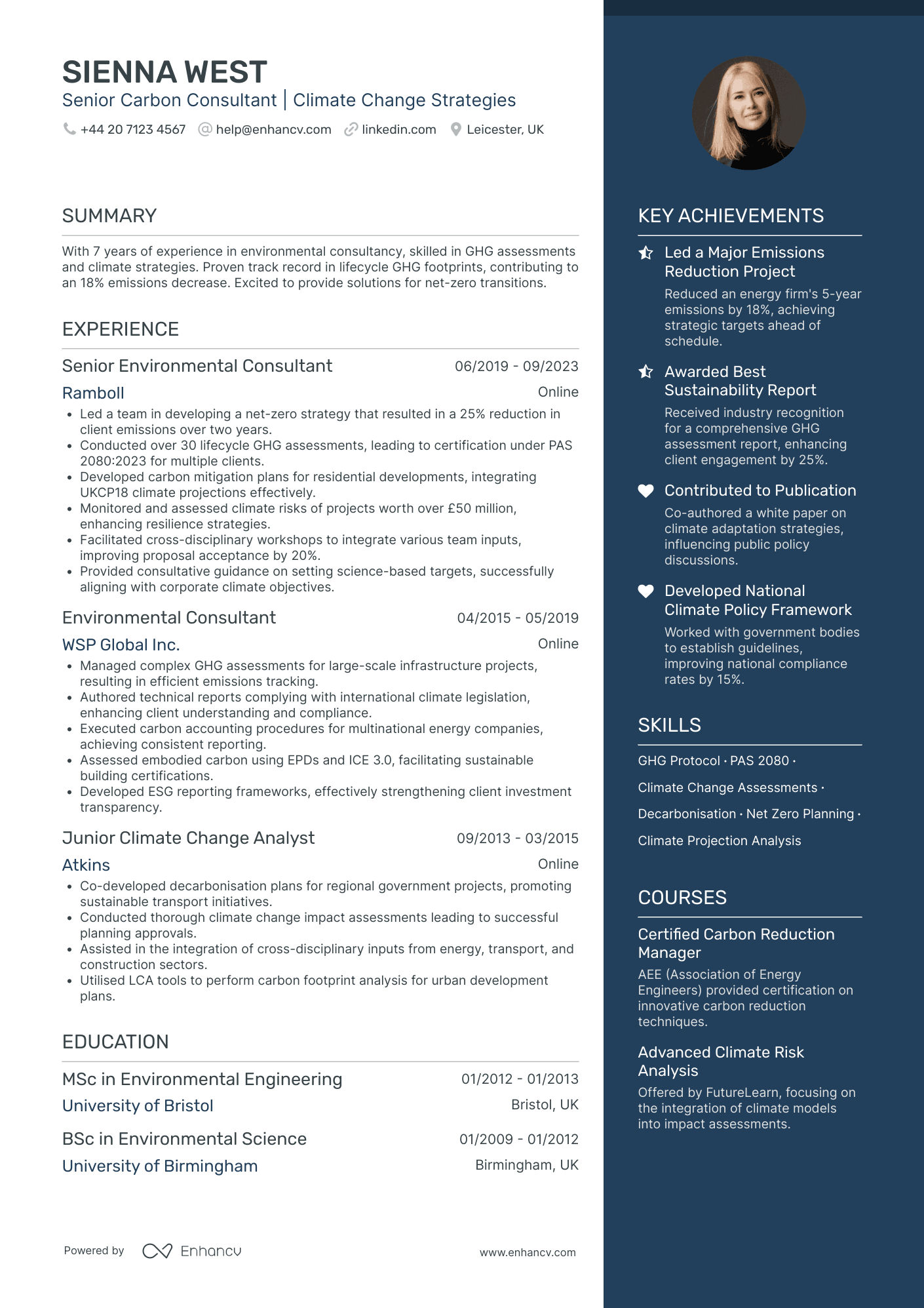
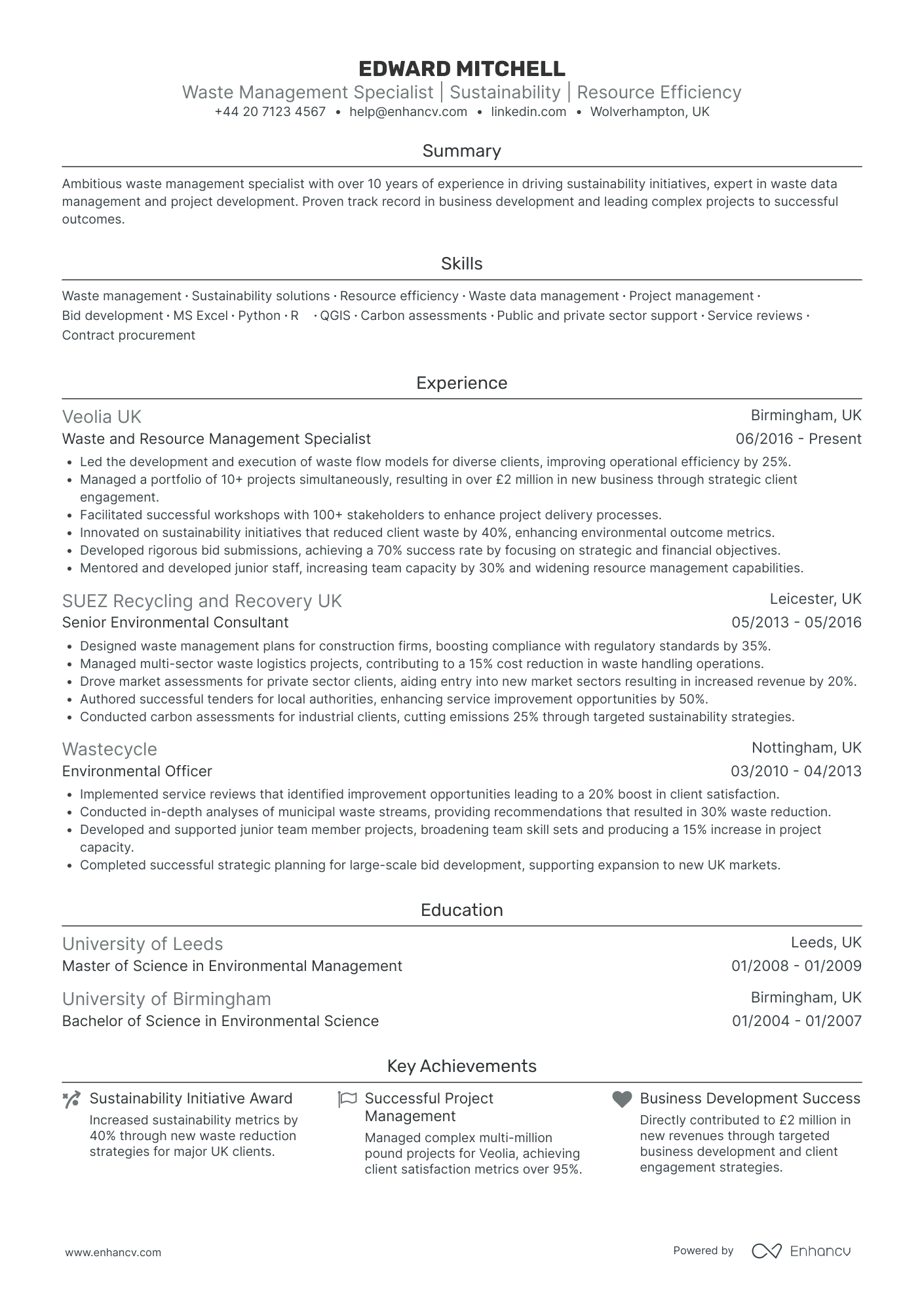
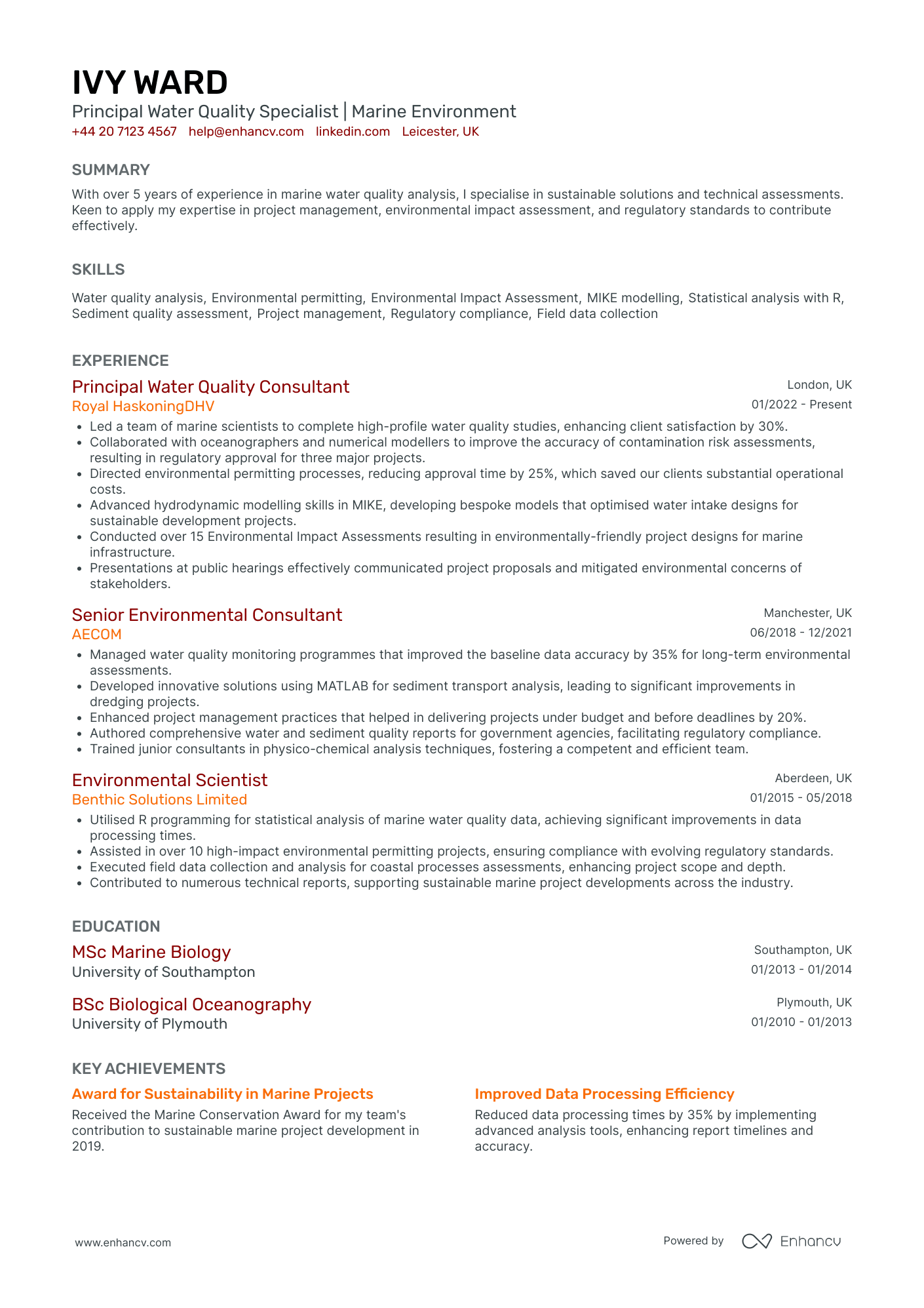
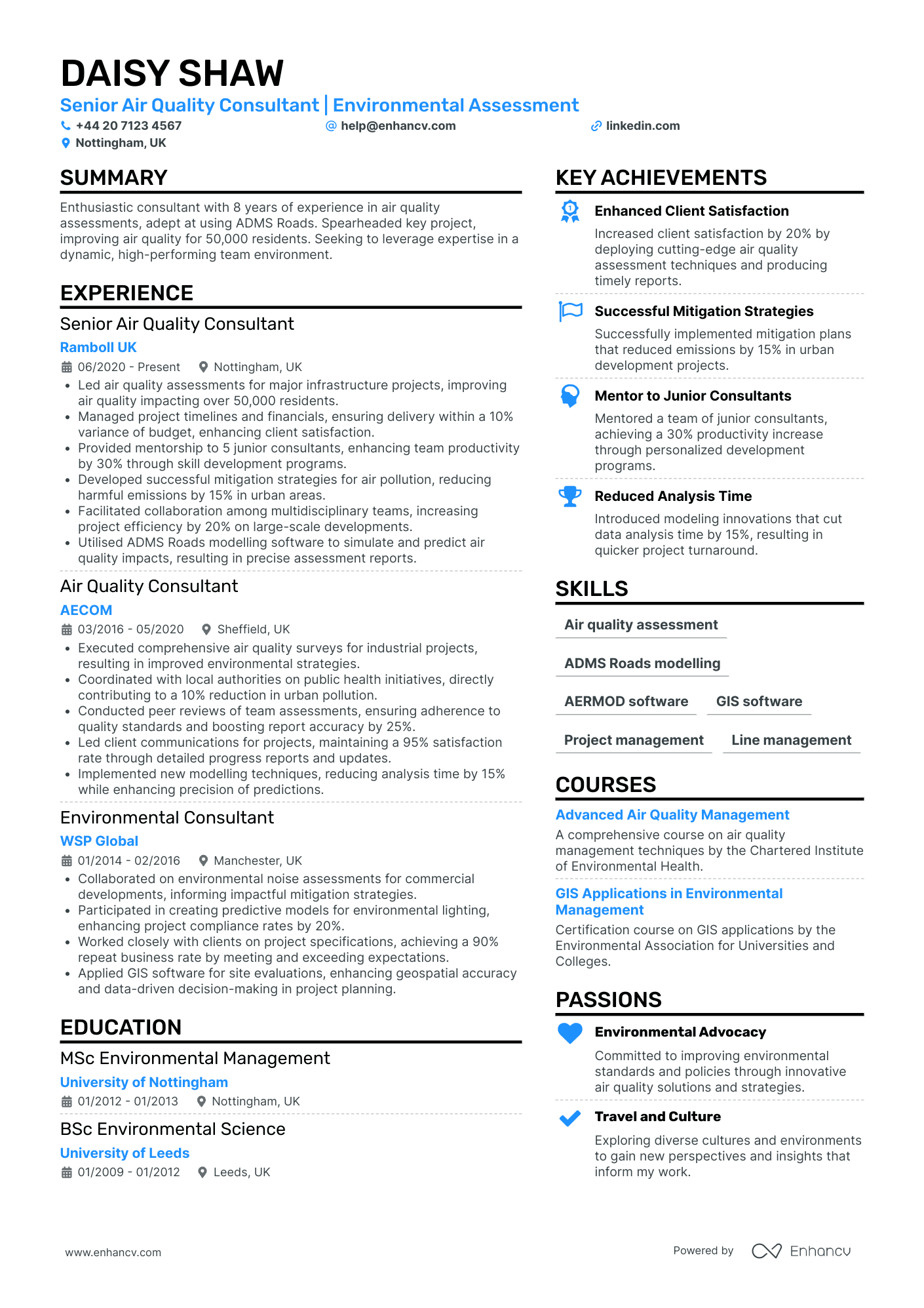
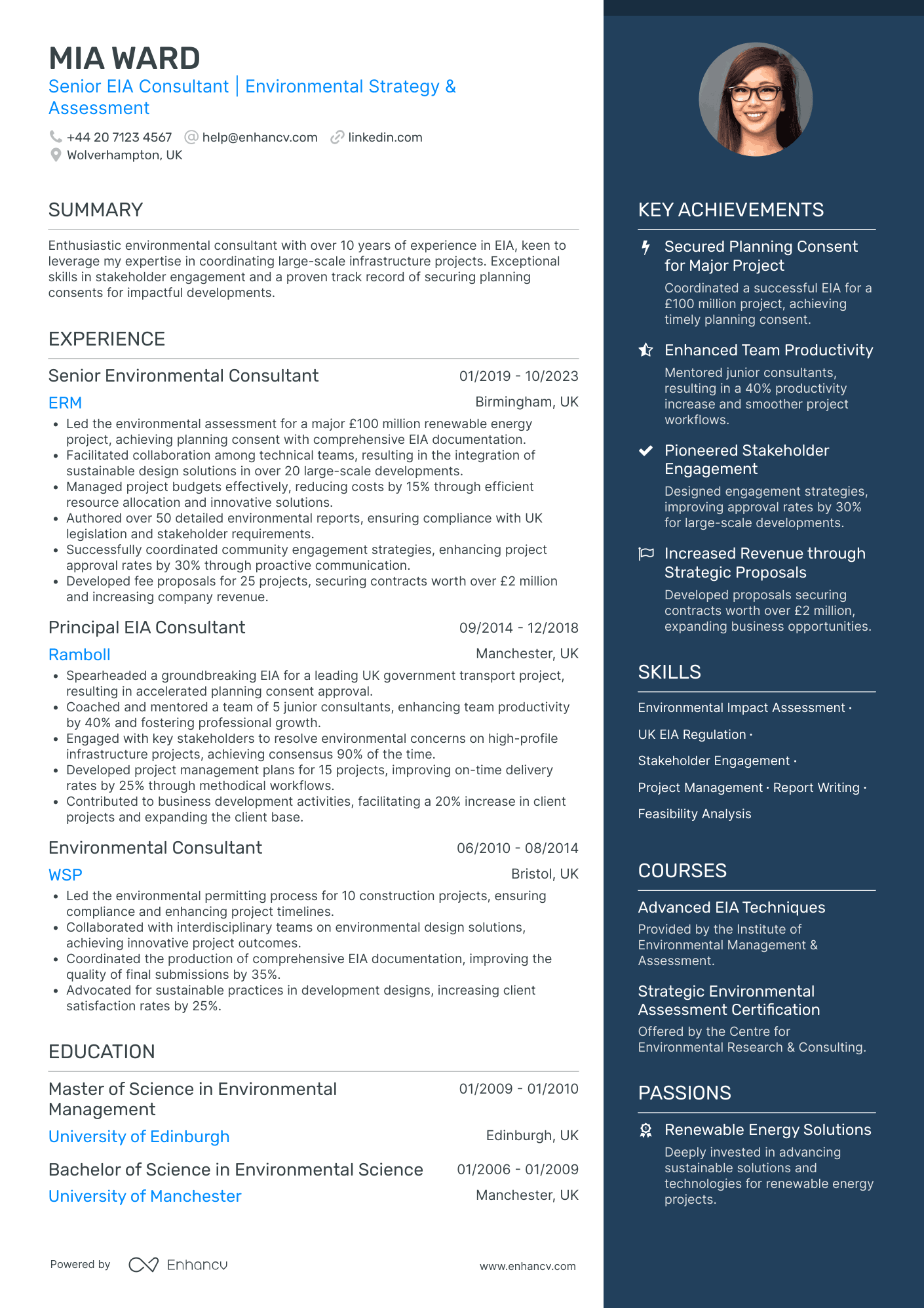
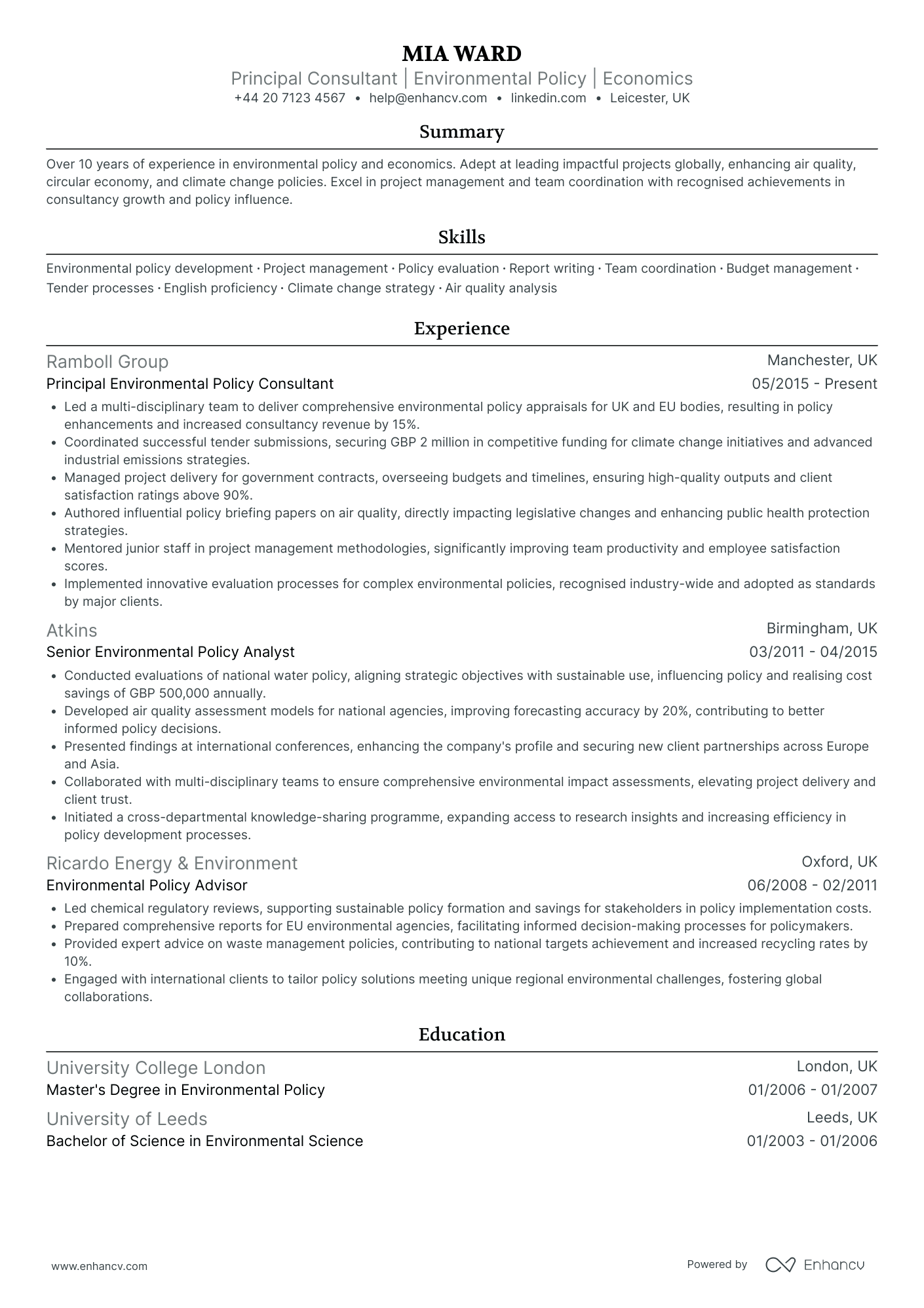
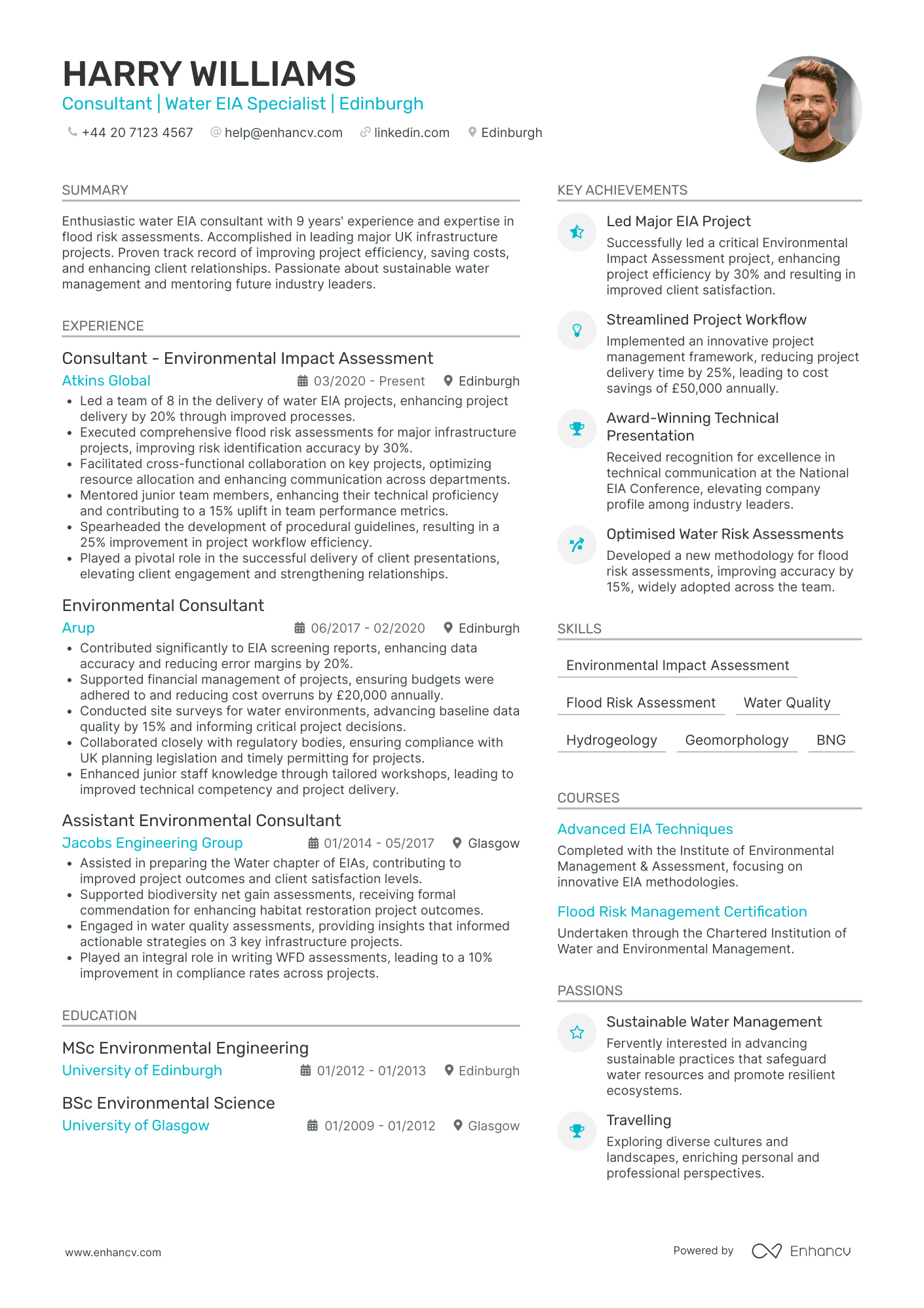
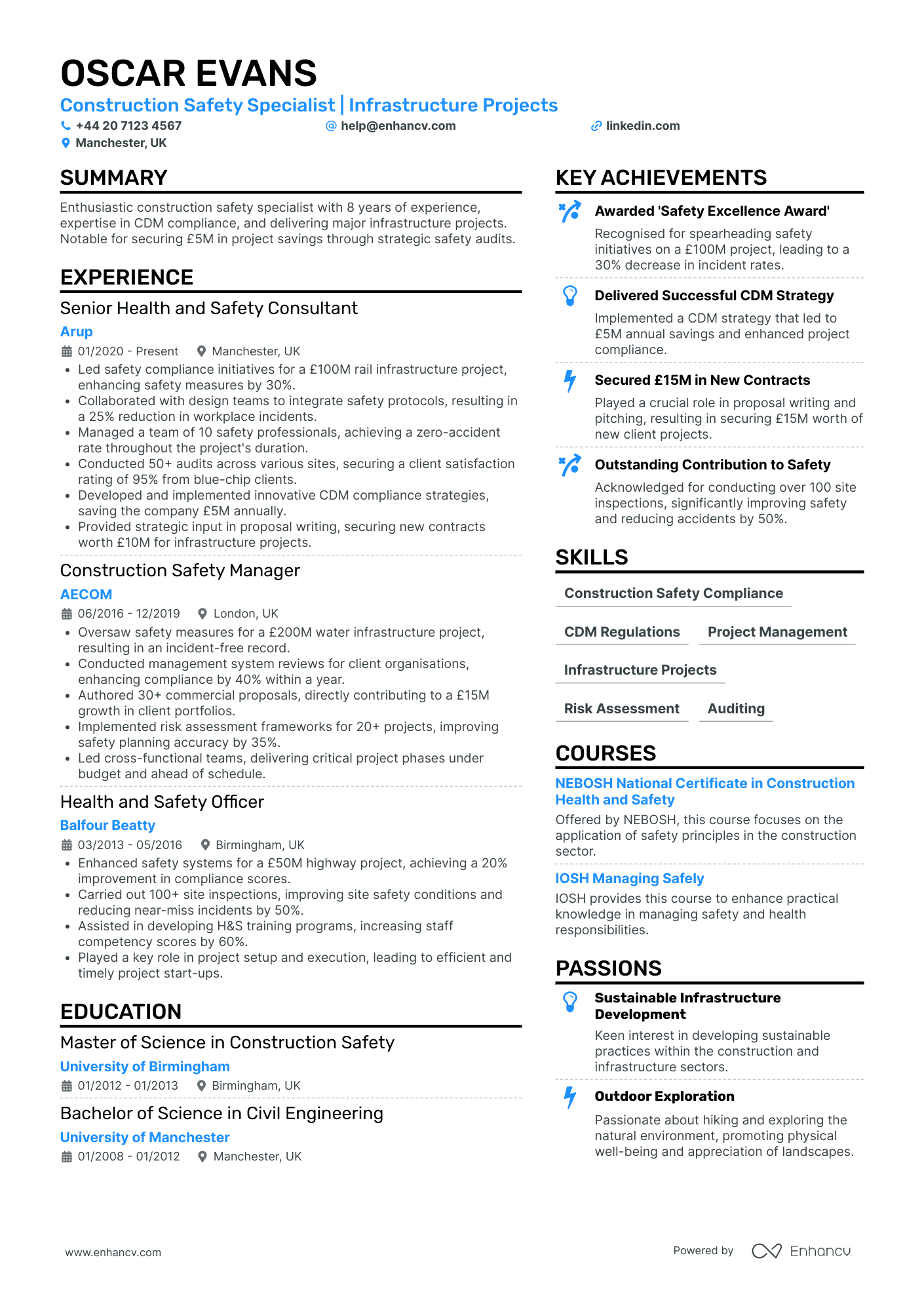
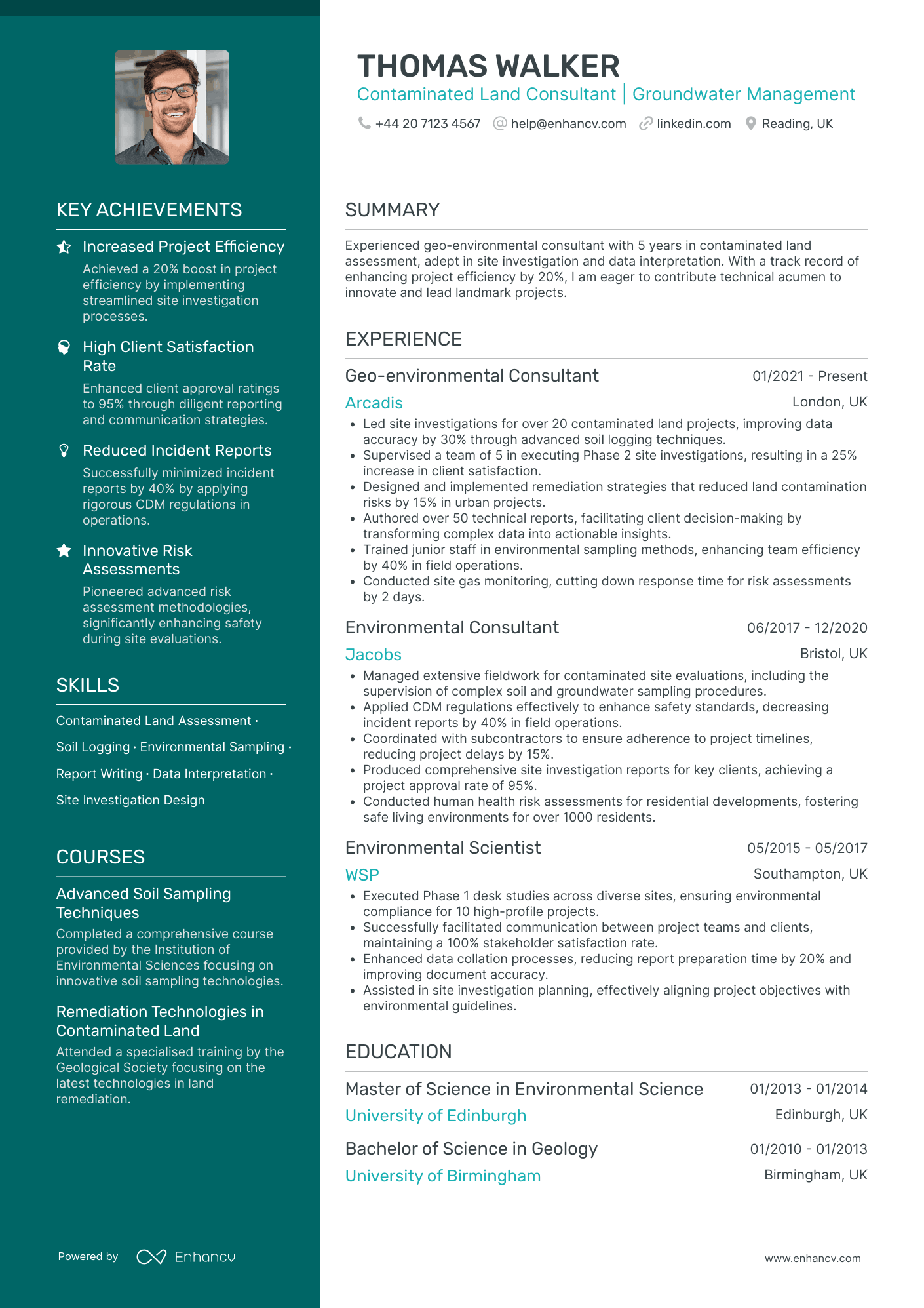
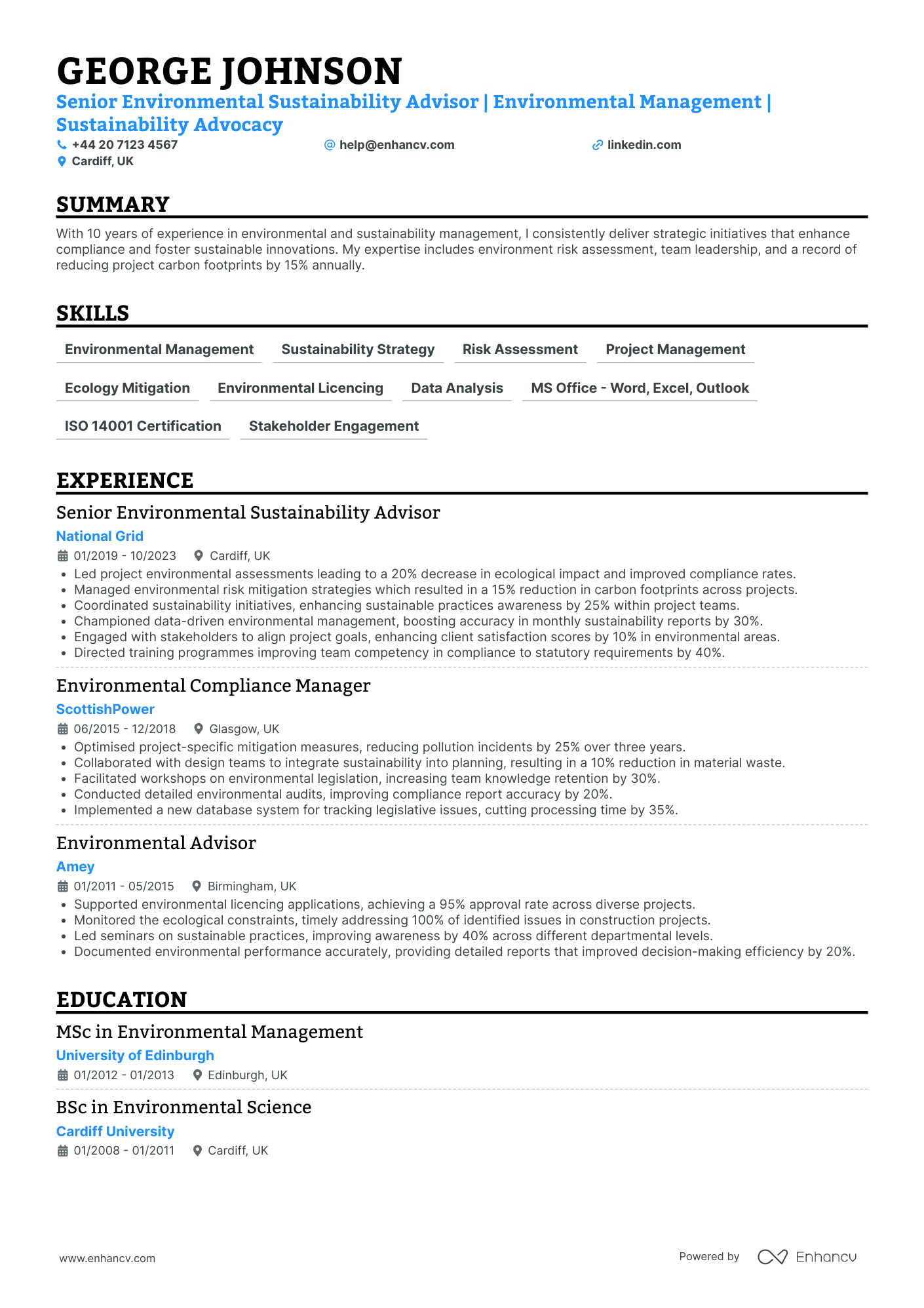
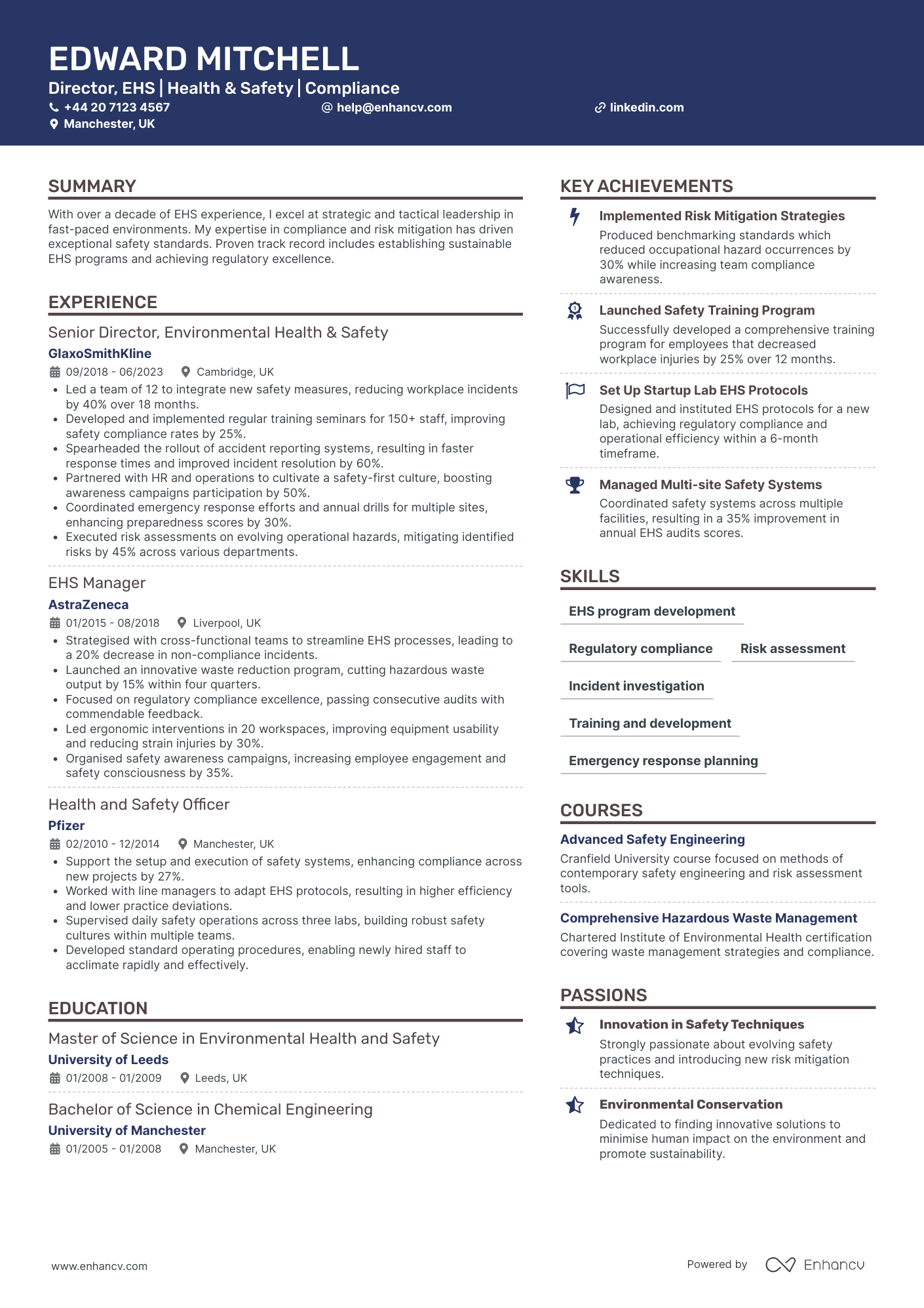
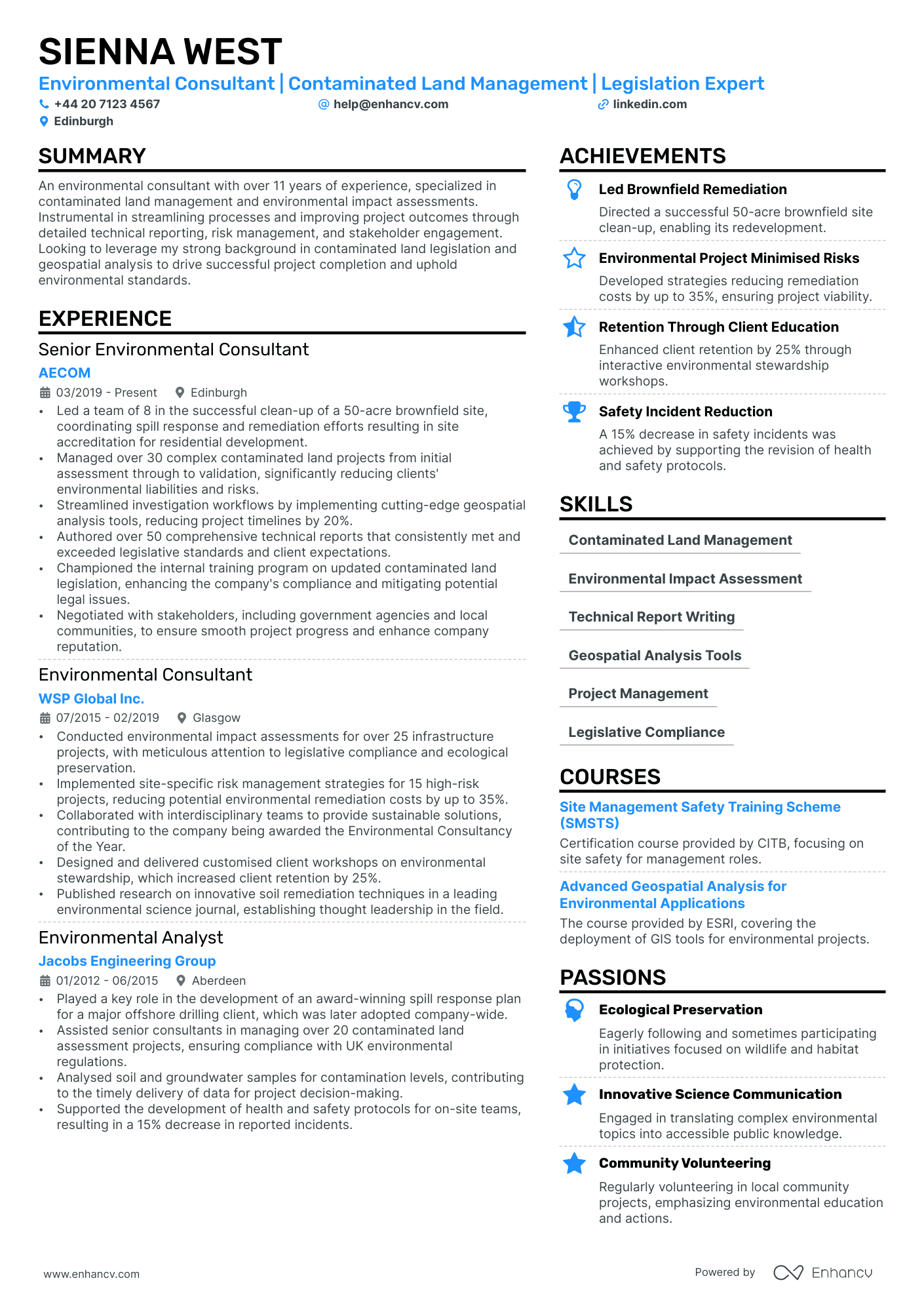
Most environmental consultant CVs list a discipline and a software stack, then trust the reader to picture the fieldwork behind them. Geology, risk assessment, hydrogeology, all present, none proven.
The CVs that reach interview do the opposite. They tie every technical skill to a site, a survey, or a regulator sign-off, so a hiring manager can see the work rather than just the label.

Key takeaways
- Lead with the technical disciplines recruiters name. Environmental science, project management, and geology top UK environmental consultant listings.
- Prove every skill with a site and an outcome. "Cleared eight brownfield sites through Phase 2 investigation" beats "experienced in risk assessment" every time.
- Put your chartership route front and centre. CEnv, CGeol, or CSci, even in progress, is a differentiator in a chartered profession.
- Signal mobility. Fieldwork means travel, so a base location and a driving licence belong in the header.
- Open with a short personal statement built on your strongest discipline, one project, and a result.
- Keep it to two pages, one clean column, and export a PDF so the layout survives the ATS.
Top skills for your environmental consultant CV
This is the question every applicant asks, so here is the direct answer. The skills that carry a UK environmental consultant CV are environmental science, project management, geology, risk assessment, groundwater sampling, hydrogeology, and ground investigations. Name them near the top, and name them the way the advert does.
That order is not arbitrary. Environmental science, project management, and geology are the skills that recur most often across UK environmental consultant postings, with risk assessment, groundwater sampling, and hydrogeology close behind.
A recruiter scans the skills line first because it is the fastest way to sort a consultancy inbox. A CV that lists the discipline but never evidences it gets filed, not shortlisted.
So treat each skill as a claim you have to back with a site, a survey, or a report. "Logged and interpreted groundwater sampling data across a 12-borehole network" proves more than the word "hydrogeology" ever will.
Environmental science is the spine of the role, covering contamination, ecology, air and water quality, and the regulations that govern them. Tie it to a deliverable, such as "authored Phase 1 desk studies to Environment Agency standards for 30-plus development sites".
Project management is what turns a technical specialist into a consultant. Show that you have run budgets, timelines, and subcontractors, not only fieldwork, because it recurs as often as the science itself.
Geology and hydrogeology underpin most ground and groundwater work. Name the ground models you have built, the conceptual site models you have written, and the investigations you have logged.
Risk assessment is where consultancies earn their fee. Reference the frameworks you work to, such as the Land Contamination Risk Management (LCRM) guidance, and the decisions your assessments unlocked.
Groundwater sampling and ground investigations are the hands-on core. Quantify the monitoring rounds, the boreholes, and the sampling regimes you have run, because scope is evidence.
Project lifecycle management signals you can carry a job from tender to sign-off. If you have taken a site from desk study through to remediation validation, say so plainly.
Two disciplines sit just outside the top of the feed but earn their place on most consultant CVs. Contaminated land assessment is the bread and butter of ground work, so name the Phase 1 and Phase 2 stages you have delivered and the standards behind them. Environmental impact assessment (EIA) matters for infrastructure and planning roles, so if you have contributed chapters or coordinated specialists, spell out your part.
Do not forget the tooling that carries the technical work. GIS mapping, laboratory scheduling, and data interpretation are what turn raw survey results into a report a client can act on, and a line naming the software you use reads as current.
Split the list into hard skills and soft skills, and treat them differently. The hard skills are the technical disciplines above, copied in the exact spelling the advert uses so both the reader and the parser find them.
The soft skills that matter in consultancy are checkable: report writing that a client will pay for, communication with regulators and stakeholders, and the time management to juggle several live sites. Prove each one inside an experience bullet rather than parking it in a list.
Keep the skills section of a CV honest. If you shadowed a task once, it is not yet a skill. List what you can defend in a technical interview.

PRO TIP
Mirror the advert's exact terminology. If it asks for "contaminated land" write that, not "brownfield". If it names "LCRM" or a "Phase 2 intrusive investigation", use those words. Matching the phrasing helps the recruiter and the ATS tick the same box.
Top skills for your environmental consultant CV:
Environmental Science
Project Management
Geology
Risk Assessment
Groundwater Sampling
Hydrogeology
Ground Investigations
Contaminated Land Assessment
Environmental Impact Assessment (EIA)
Project Lifecycle Management
GIS and data analysis
Environmental permitting
Report writing
Client communication
Stakeholder management
Problem-solving
Attention to detail
Time management
Teamwork
What the UK environmental consultant market looks like
Knowing what UK consultancies ask for tells you what belongs at the top of the CV.
| What | UK environmental consultant roles |
|---|---|
| What the role pays | £25,000 to £50,000 a year (National Careers Service) |
| Where the work happens | Mostly hybrid, outnumbering fully onsite roles (across 32 UK postings in the last ~30 days, Enhancv's internal job feed) |
| Experience level asked for | Weighted towards senior and lead, with fewer mid and entry openings |
| Skills that recur most | Environmental science, project management, and geology |
Two of those numbers should shape your CV.
Hybrid roles outnumber fully onsite ones, but fieldwork is still central to the job, so a consultancy needs to see you can travel to sites. Put your base location and a driving licence in the header.
The market also leans towards senior and lead roles, with fewer mid and entry openings, so an early-career applicant is competing for a real but narrower set of jobs. That makes a sharp, evidence-led CV matter even more.
If you work across contaminated land, hydrogeology, and impact assessment, make that breadth obvious. Consultancies value people who can move between disciplines and carry a project end to end.
Formatting your environmental consultant CV
Consultancy reviewers skim fast, so structure the CV to be read in a hurry. Once you have roles behind you, use a reverse chronological CV, starting with your latest position.
If you are moving in from a related field or straight out of a degree, a skills-based CV lets your technical disciplines and projects lead instead of a thin work history.
Keep it to two pages, one clean column, with standard headings and a readable type size. A project list can run long, so summarise it rather than logging every site.
Put your location and right-to-work status in the header. Fieldwork means travel, so a driving licence and a willingness to work across sites are worth signalling early.
Export a PDF so your layout holds on any screen. Keep a Word copy only if the advert or an agency names that format.
Most consultancies screen applications through tracking software, so keep the layout clean and the headings standard for an ATS-friendly CV. Set your contact details as live text, not inside an image the parser cannot read.
Build it from a tested layout rather than a blank page. Enhancv's CV templates export to a clean PDF and keep the structure ATS-safe, which frees you to spend your energy on the evidence.
Is your CV good enough?
Drop your CV here or choose a file. PDF & DOCX only. Max 2MB file size.
Writing your environmental consultant personal statement
Your CV headline and personal statement are the two lines doing the heavy lifting at the top of the page. The headline is the label under your name, the statement is the short paragraph beneath it. Get both specific and a technical lead keeps reading.
A headline should name your discipline and level, not stop at "Environmental Consultant". Pair the role with the work you want to be hired for.

CV headline examples for environmental consultants
Senior Environmental Consultant, contaminated land and hydrogeology, working towards CEnv. Graduate Environmental Consultant, MSc Hydrogeology with a placement year in ground investigation. Principal Consultant specialising in EIA and environmental permitting for major infrastructure. Each one names a specialism and a proof point instead of stopping at the job title.
The statement itself is three or four sentences: who you are, your strongest technical area, one project with a result, and the kind of consultancy you want to join.
Match it to the role. A statement aimed at a contaminated-land team should not read the same as one aimed at an EIA or air-quality practice, even where the projects overlap.
Skip the adjective soup that opens most CVs. "Passionate, hard-working, environmentally minded" is unprovable, and every other applicant has typed it. Lead with something a hiring manager can picture instead. For more openings that work, see these personal statement examples.
Environmental consultant personal statement example (mid-weight)
Environmental consultant with five years across contaminated land and ground investigation, fluent in Phase 1 and Phase 2 assessment and LCRM risk work. Managed a 40-borehole monitoring programme on a former gasworks and wrote the validation report that cleared the site for a 120-home development. Working towards CEnv through IEMA. Looking to bring hands-on ground and groundwater experience to a consultancy in the North West.
What to avoid
A passionate and hard-working environmental consultant with a strong interest in sustainability and a keen eye for detail. A dedicated team player who thinks outside the box and is committed to protecting the environment and delivering results for clients every single time.
The second version names no discipline, no site, and no regulation. It could describe any applicant at any level, which is exactly why a hiring manager skims past it.
Give the reader one concrete project and the result it drove. That single detail does more than a paragraph of adjectives.
Writing your environmental consultant experience section
List each role with a dated heading, then bullets that open with a verb and close with an outcome. This is where "I understand risk assessment" becomes proof.
A bullet like "Responsible for a range of environmental tasks" is a shrug in bullet form. The same job written like it mattered names the site, the method, and the result: "Ran Phase 2 intrusive investigations on 15 brownfield sites and cleared eight for redevelopment". Same role, one version disappears and the other gets read.
Consultancy work is more measurable than it feels. Sites cleared, boreholes logged, monitoring rounds completed, budgets managed, programmes hit, permits secured. Those are your CV achievements, and they belong in the bullet, not the appraisal.
Open each line with a strong action verb: managed, investigated, logged, assessed, remediated, secured. Then attach the method and the result. See the mechanics of a strong work experience section if you are starting from scratch.
Tailor every application to the advert, mirroring the disciplines and standards it names where they are true of you. Enhancv's CV tailoring feature reads the advert and suggests the matching edits, which saves rewriting each version from a blank page.
- Managed contaminated land investigations on 25-plus development sites a year, from Phase 1 desk study through Phase 2 intrusive works to remediation strategy, keeping projects to budget and programme
- Designed and supervised ground investigations across brownfield sites, logging boreholes and trial pits and interpreting the data into conceptual site models for planning submissions
- Ran quarterly groundwater and gas monitoring across a 40-borehole portfolio, and wrote the risk assessments that cleared three sites for residential development
- Led client liaison and Environment Agency correspondence, securing sign-off on a remediation validation report that unlocked a stalled 120-home housing scheme
- Carried out Phase 1 and Phase 2 site assessments under a chartered supervisor, building the fieldwork and reporting foundations for chartership
- Collected and interpreted soil and groundwater samples to WAC and LCRM standards, coordinating laboratory schedules for 60-plus samples a month
- Produced factual and interpretative reports that passed internal QA first time, cutting review cycles for the wider team
PRO TIP
One quantified project beats five vague bullets. No hard number to hand? Scope is evidence too: name the scale, such as a 40-borehole monitoring round or a 15-site programme. A bullet with no site, method, or scale is a job title, not your work.
Chartership and qualifications for an environmental consultant CV
This is a chartered profession, so your qualifications carry real weight next to the experience. Put them where a technical reviewer can find them fast.
Most consultants hold a relevant degree. List it in full with the classification: BSc (Hons) Environmental Science, 2:1, or an MSc in Hydrogeology, Contaminated Land, or Environmental Management, with the institution and dates in your education section.
Chartership is the differentiator. Name where you sit on the path, even if you are still working towards it: Chartered Environmentalist (CEnv) through IEMA or the Society for the Environment, Chartered Geologist (CGeol) through the Geological Society, or Chartered Scientist (CSci). Membership grades such as PIEMA or MIEMA belong here too.
If you are pre-chartership, say so directly. "Working towards CEnv, competency report in progress" tells a hiring manager you are on the recognised route, which reads as momentum rather than a gap.
Site-based roles often ask for a CSCS card, first aid, and specific tickets such as confined-space or SHEA training. List the qualifications and certificates on a CV that match the advert, and leave off the ones that do not.
Environmental consultant CV with no experience
Most graduate consultant roles are won on your degree, your fieldwork, and your grasp of the regulations, not a long work history. A thin experience section is normal at this stage.
Build evidence the way a working consultant would. A dissertation on groundwater contamination, a university field course, a placement year, lab and GIS work, and any volunteering with a wildlife trust or river charity all count. Give each one a dated entry with your role, the methods, and the result, exactly like the entry below.
First-project entry that reads like real experience
MSc research project, 2024. Assessed heavy-metal contamination across a former industrial site for a dissertation, designing the sampling regime, collecting and analysing 45 soil samples, and interpreting the results into a risk assessment against LCRM guidance. Presented the findings to the department and a partner consultancy.
Unpaid and volunteer work on a CV counts as real experience, because it is. A river restoration day or a habitat survey shows you can apply method in the field.
Then lead with a skills-led layout, a strong education section, and any chartership route you have started. See more CV examples for a first job if you are staring at a blank page.
The market leans senior, so a sharp graduate CV has to work harder. Tailor it to each role and make your fieldwork and regulatory knowledge impossible to miss.
Conclusion
Lead with the technical disciplines employers name, prove each one with a site and an outcome, and let your chartership route and degree carry the rest.
Get the fundamentals right the way any strong CV starts, by studying how to write a CV, then pair it with a short cover letter that says why this consultancy. Do that and you turn a list of disciplines into interviews.
Author's take - the Enhancv team
When I read an environmental consultant CV, I skim for two things: the disciplines the advert asked for, and the evidence behind them. A line like "logged 40 boreholes and wrote the risk assessment that cleared the site" tells me more than a skills bar ever could. The CVs I remember name the site, the standard, and the result, then show where the writer sits on the chartership route. Get that combination down and the technical interview becomes a formality, because the CV has already done the arguing.