



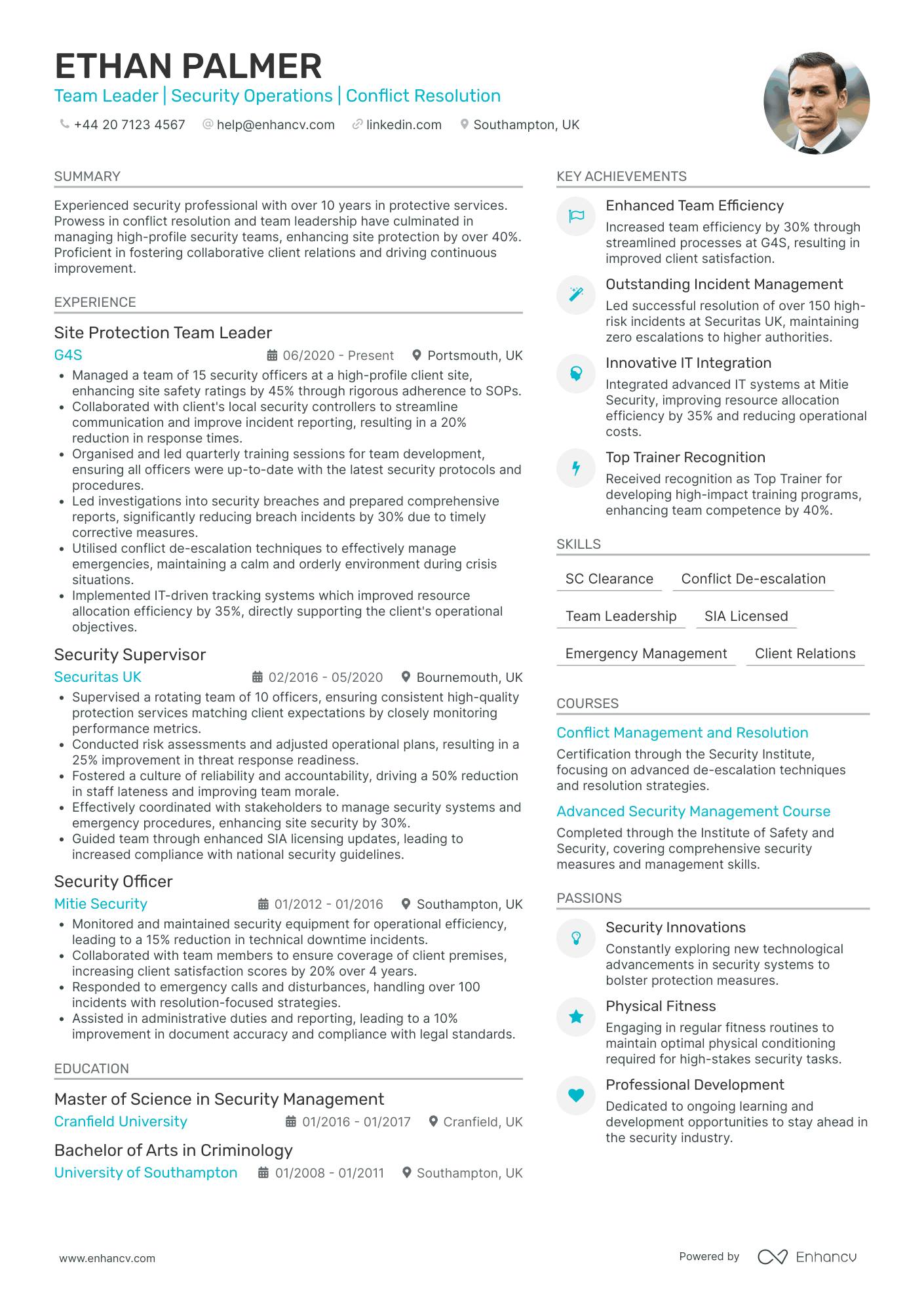
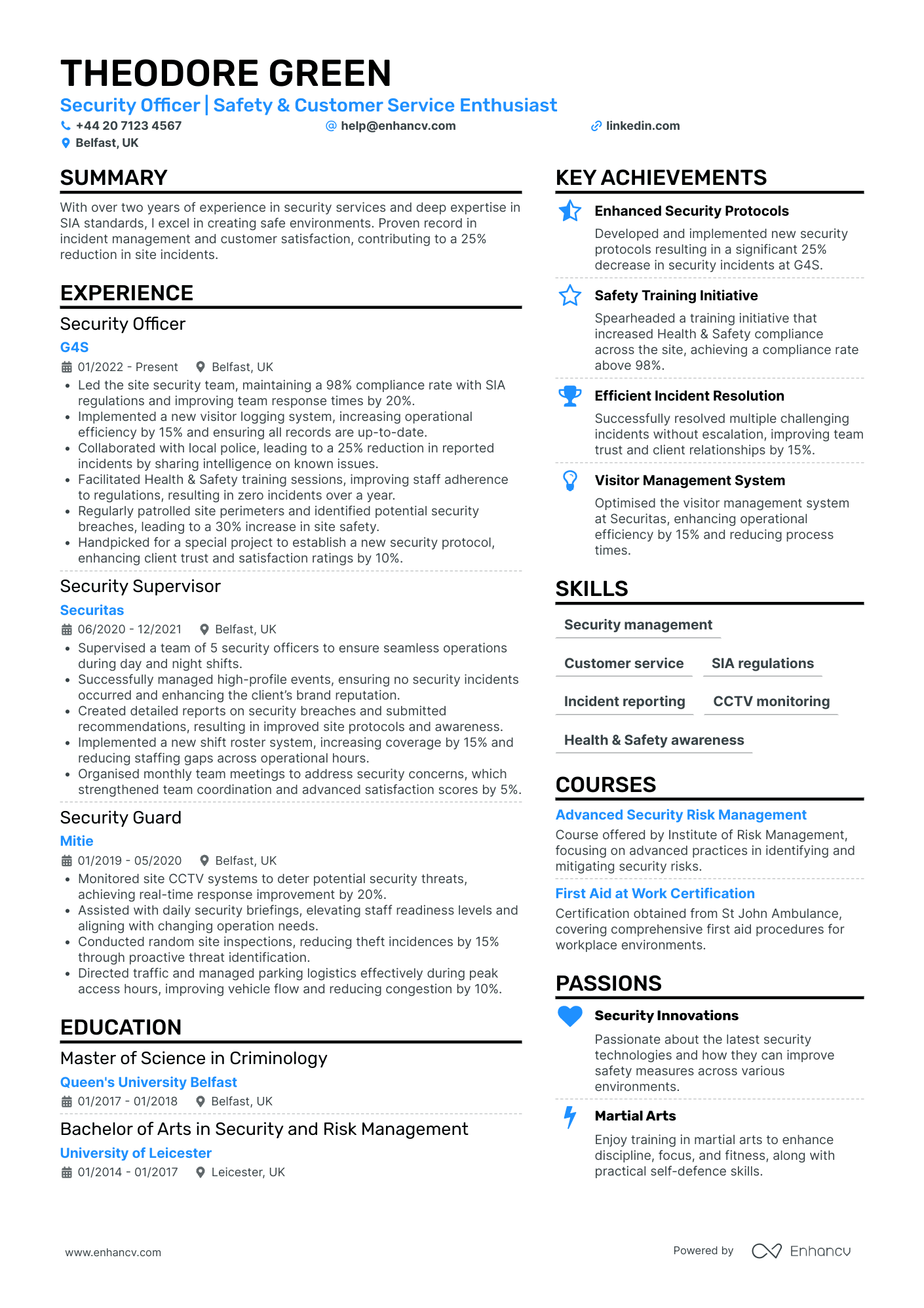
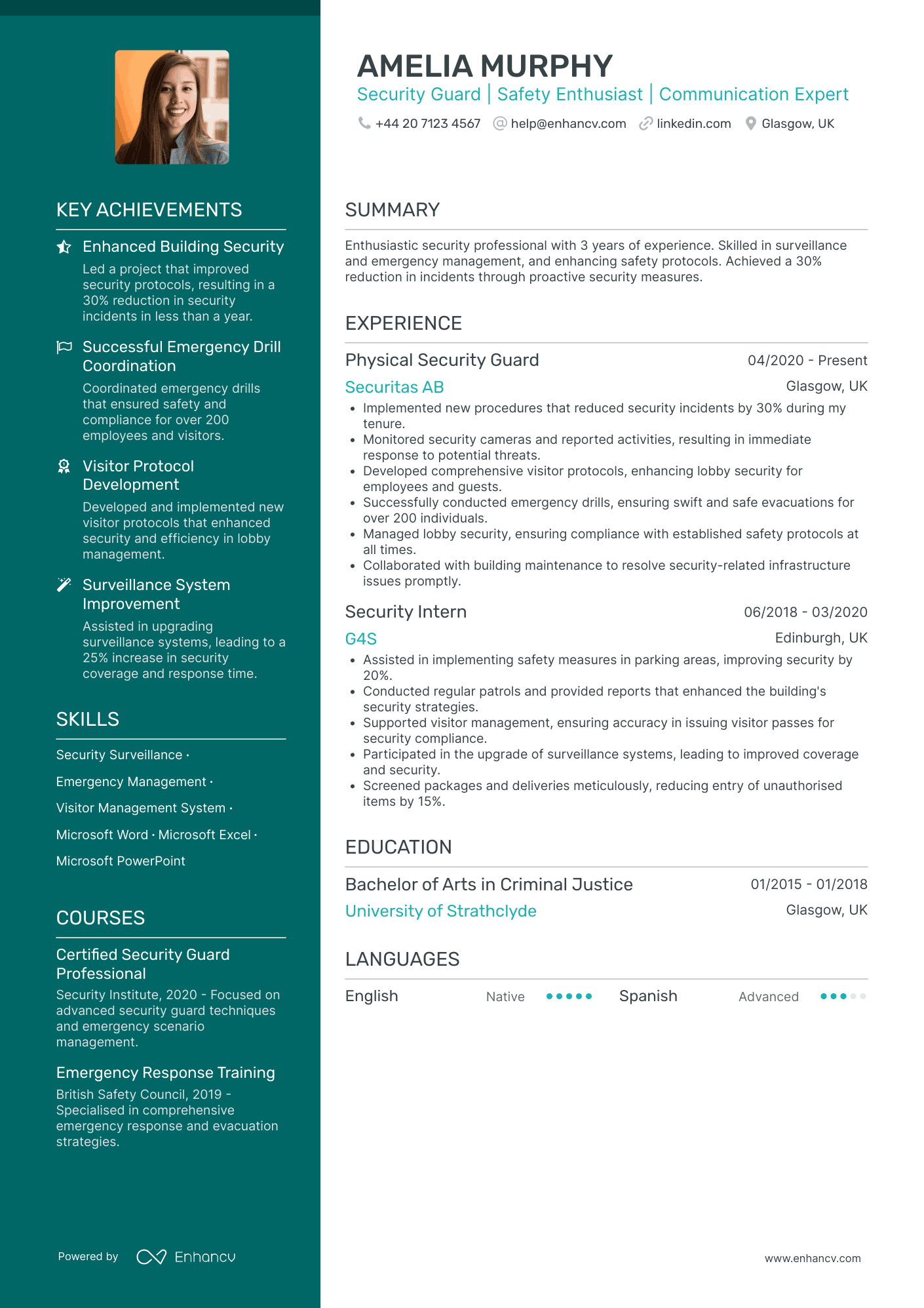
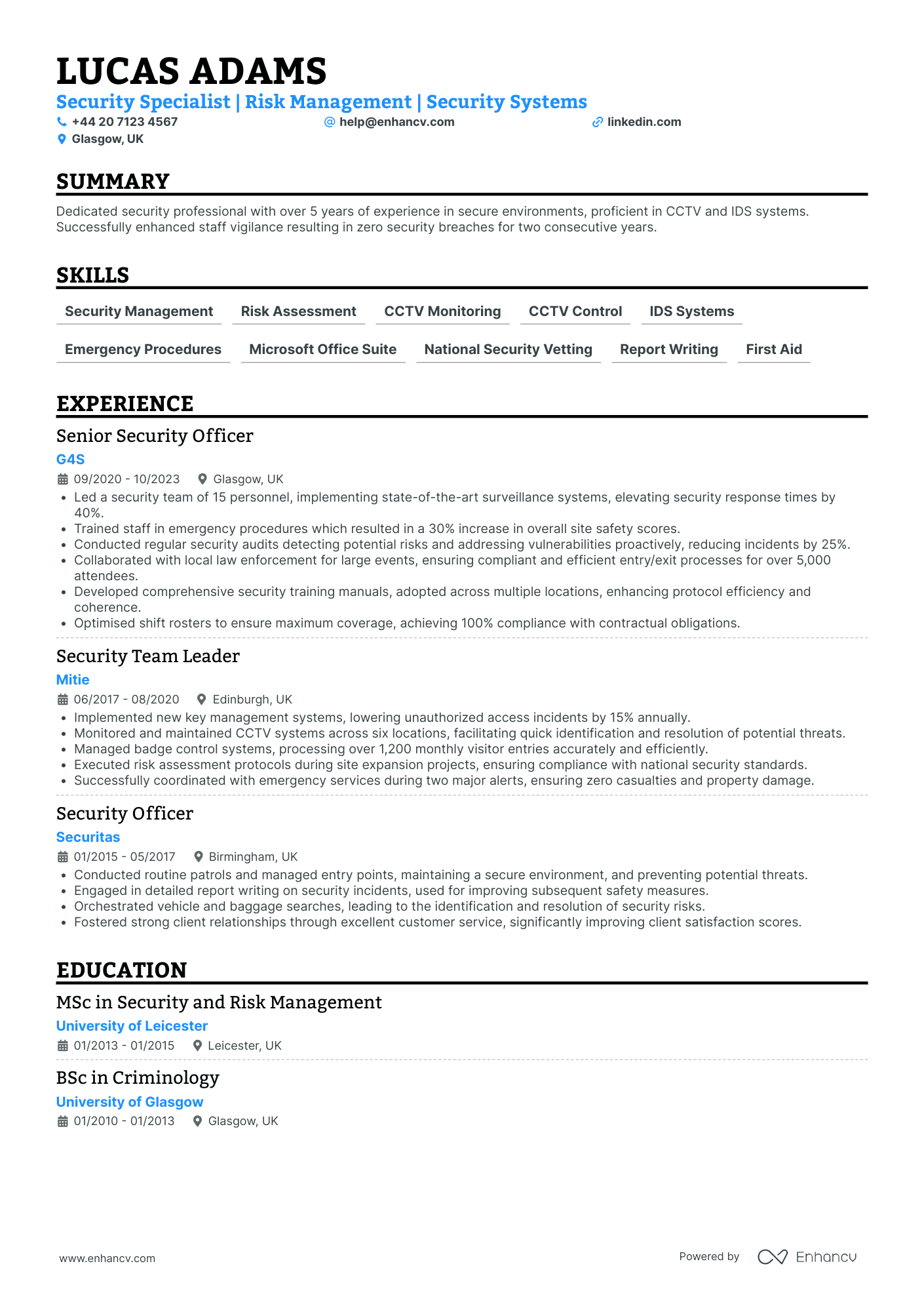
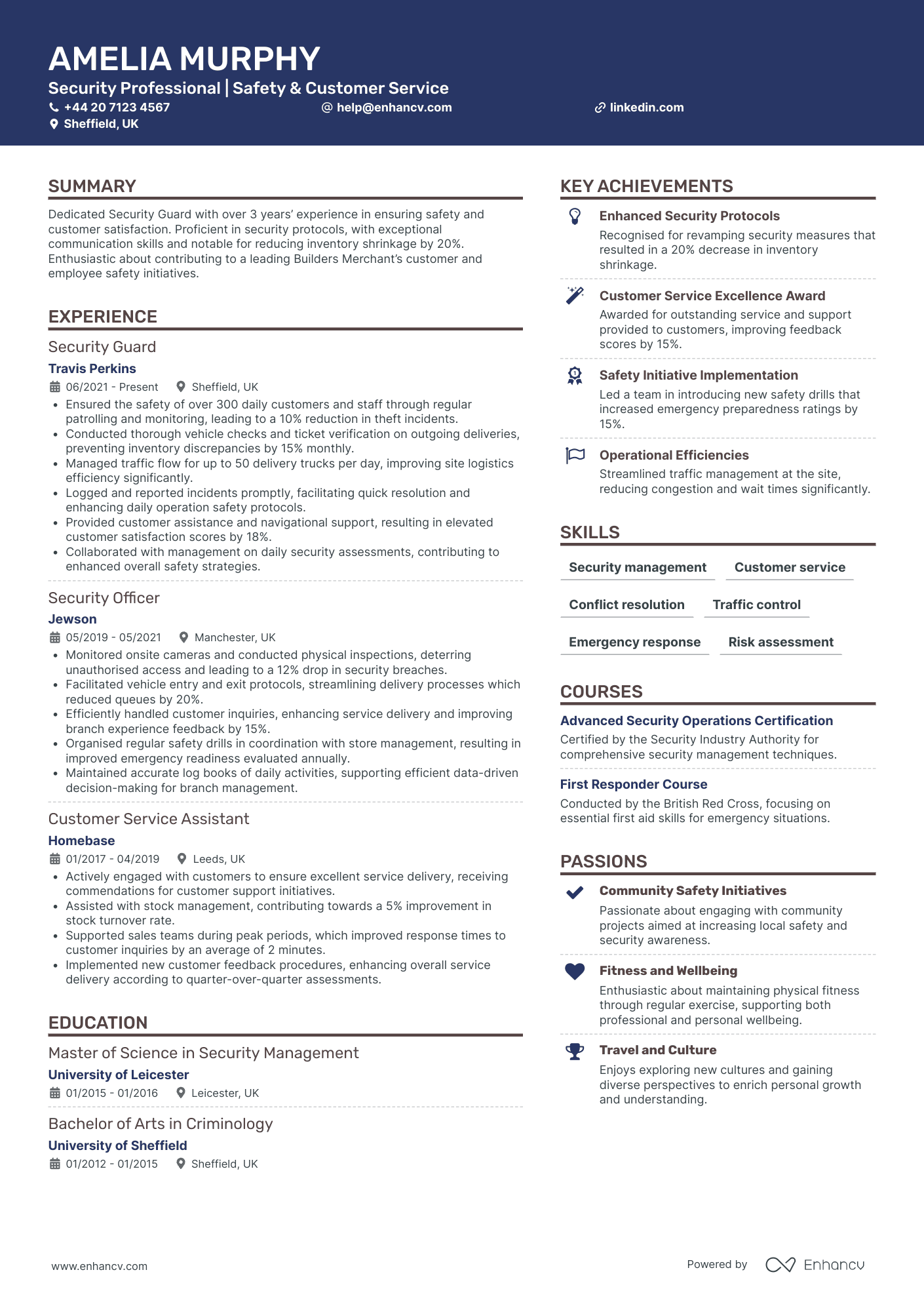
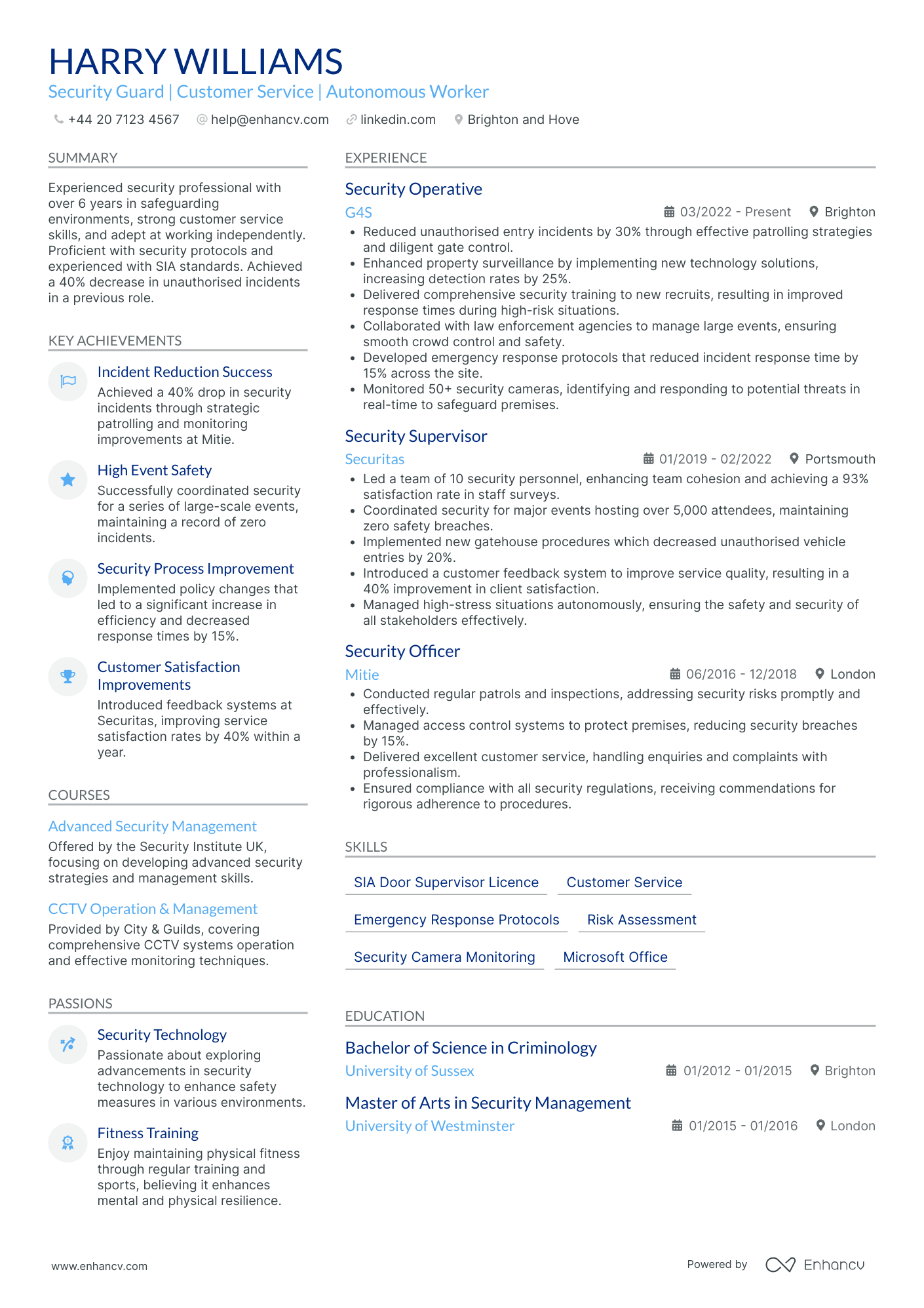
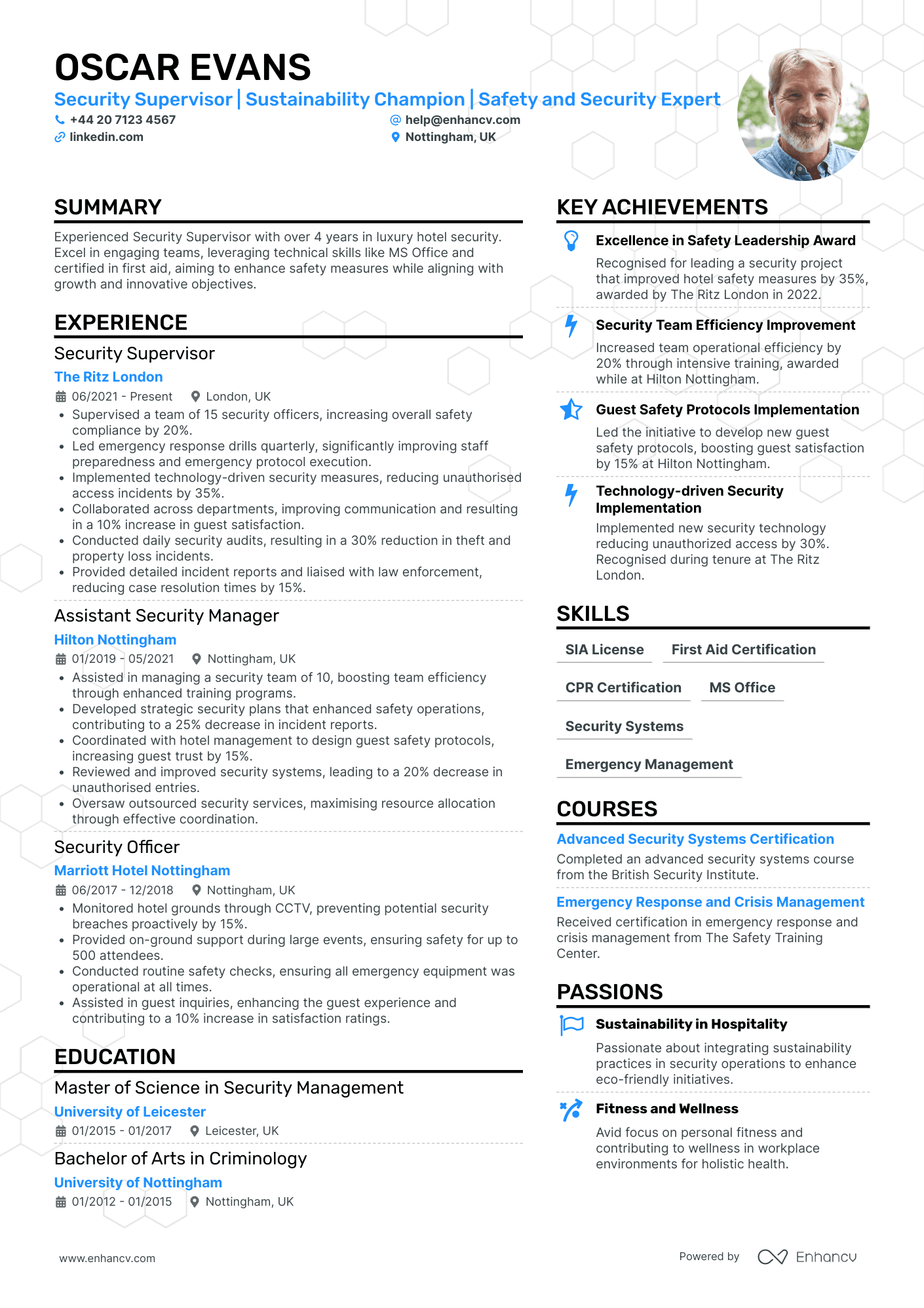
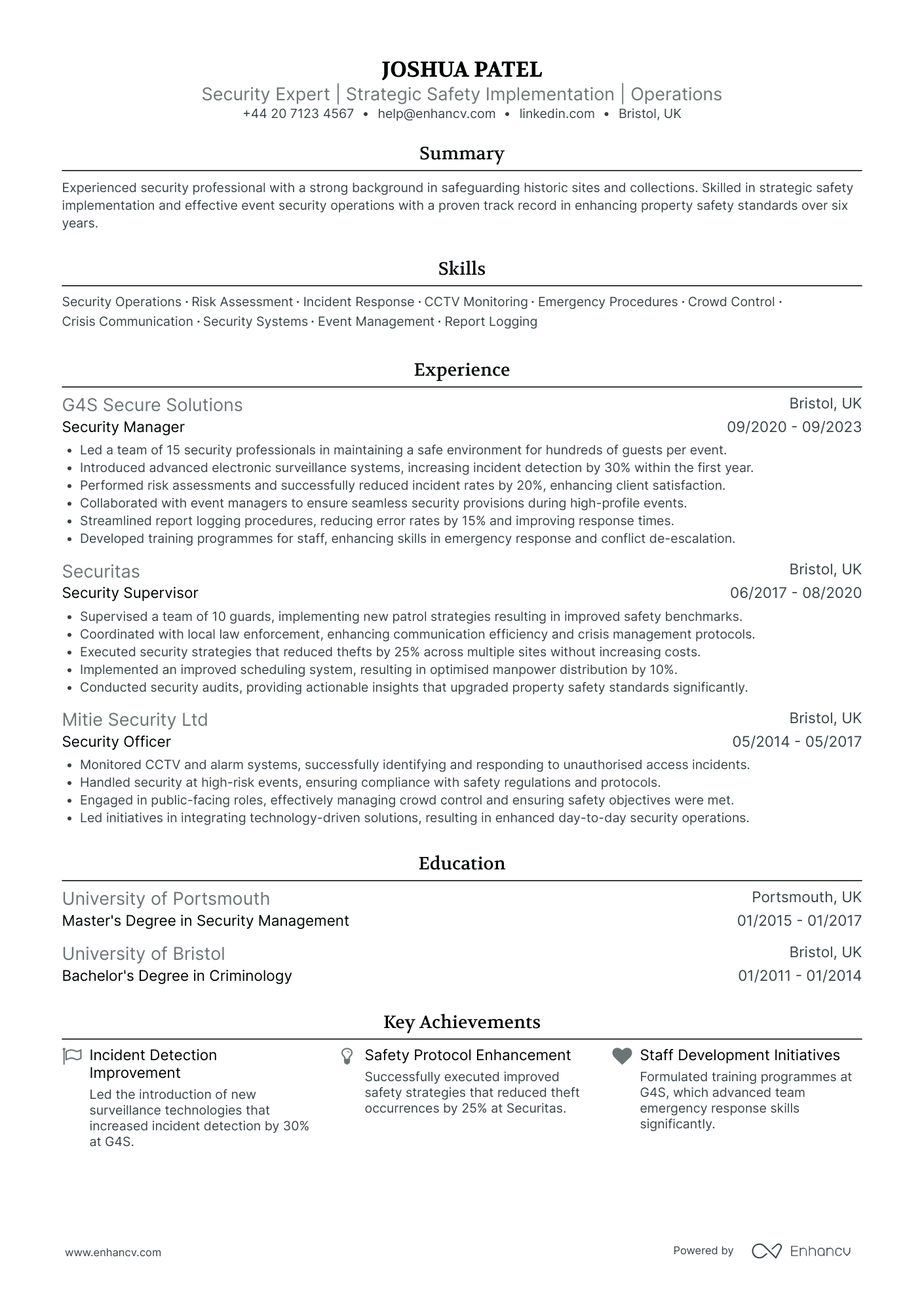
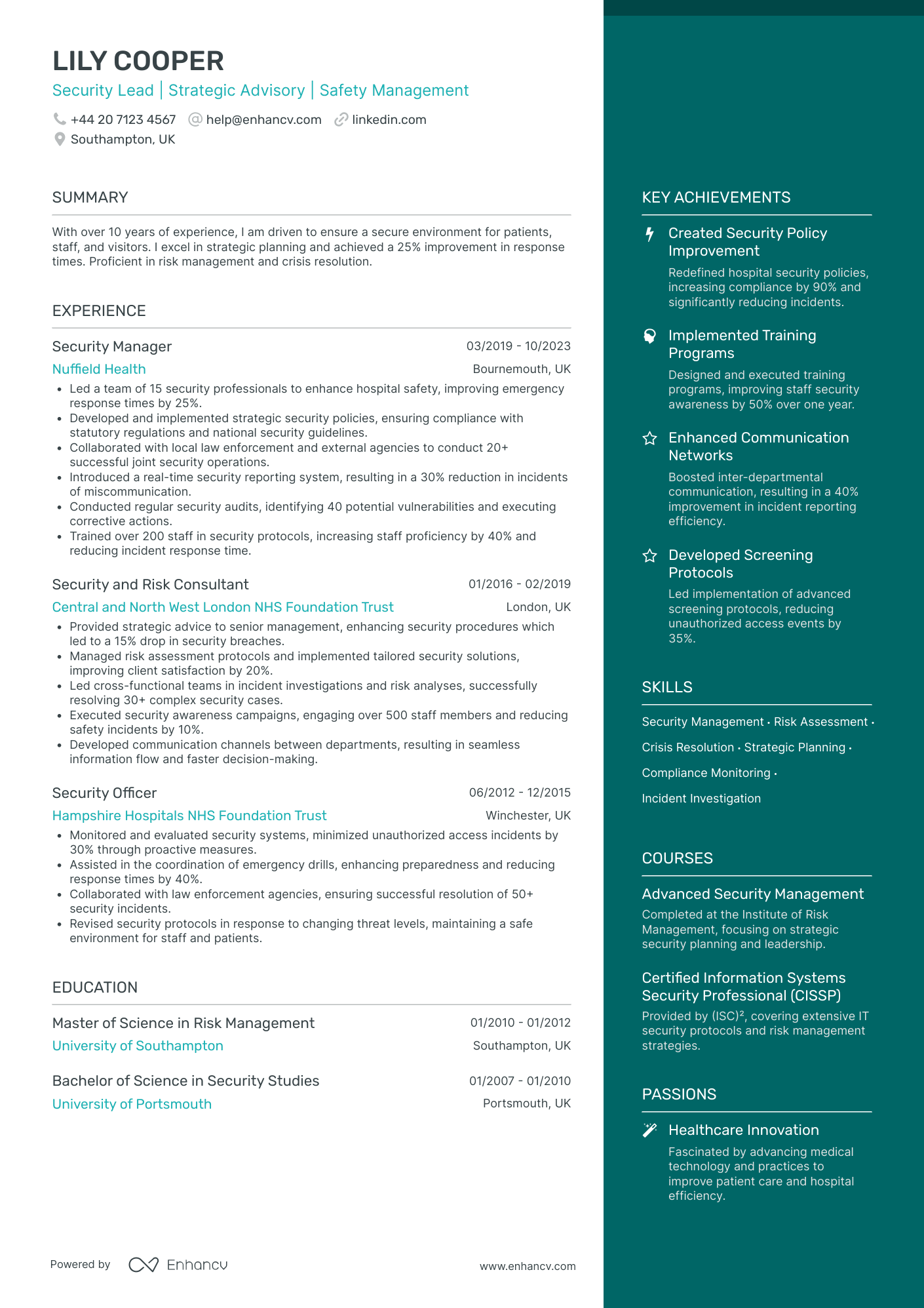
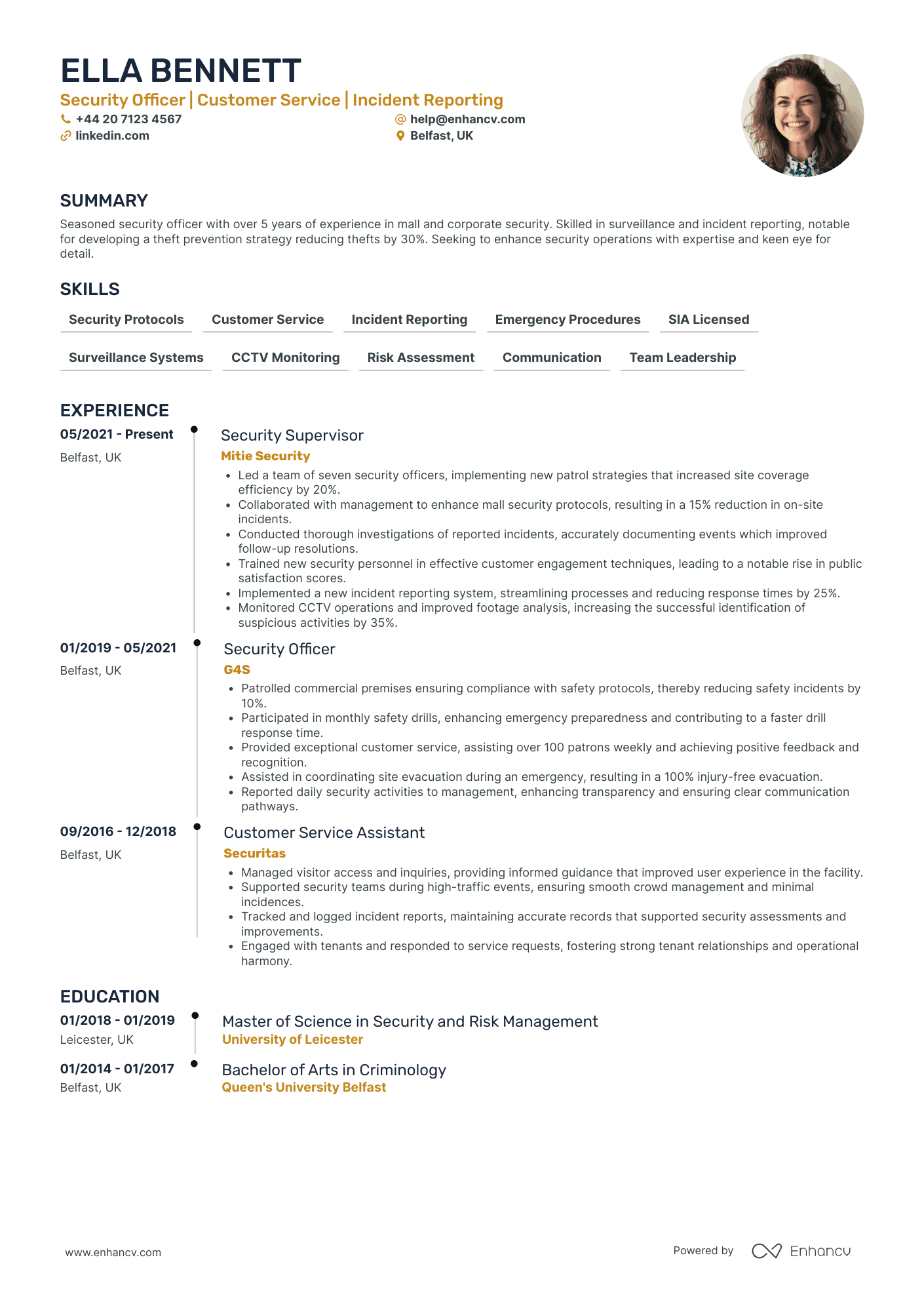
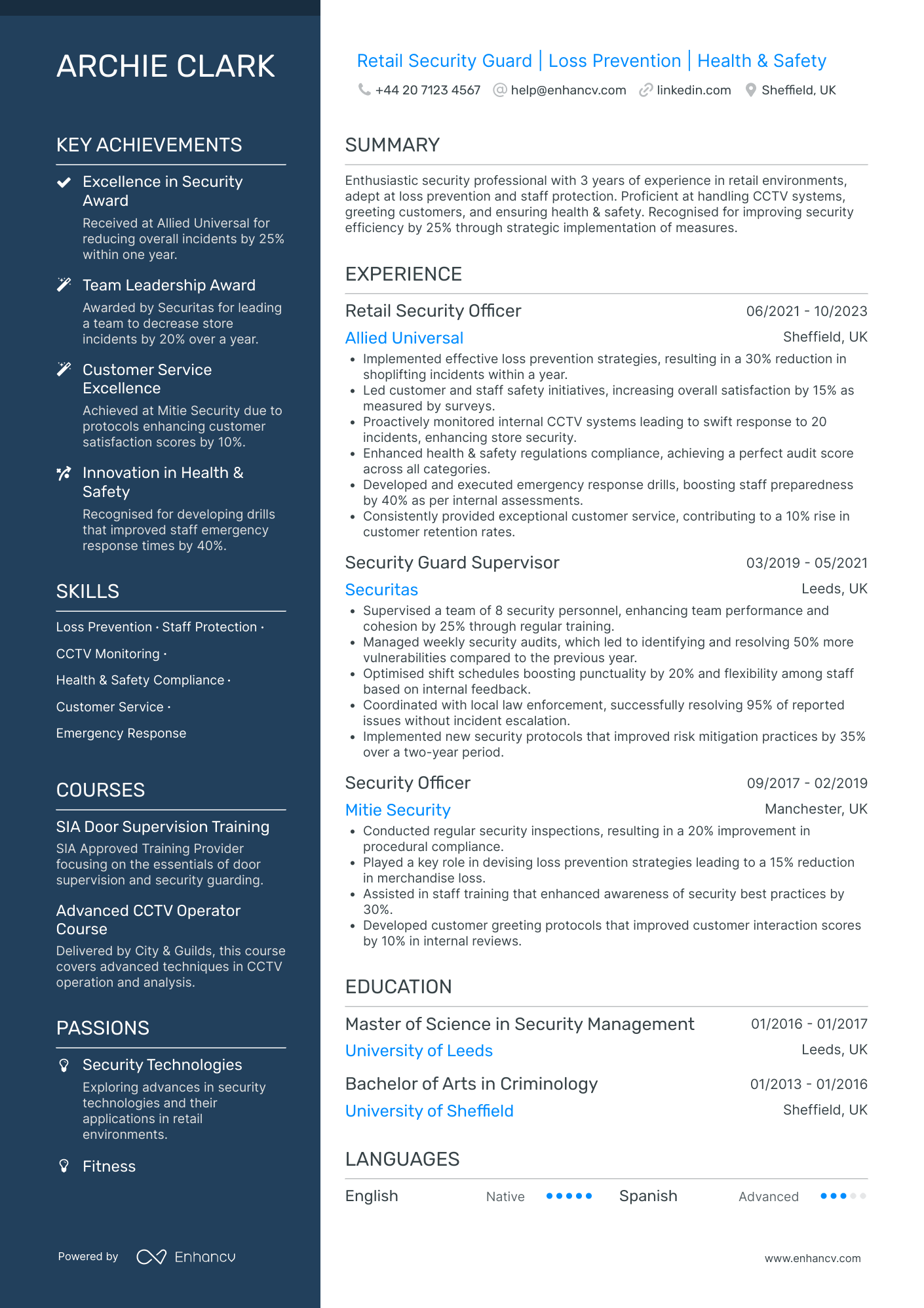
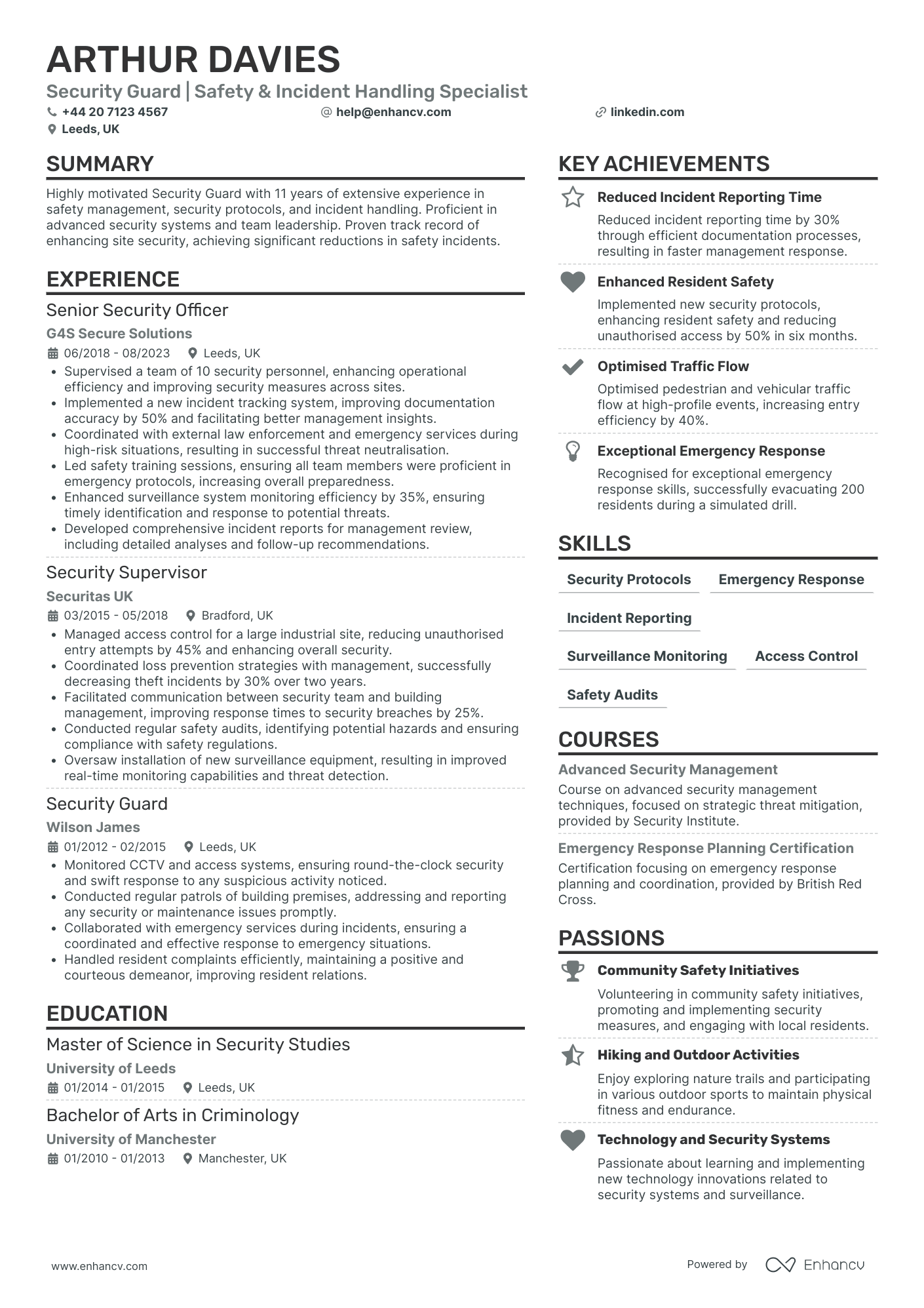
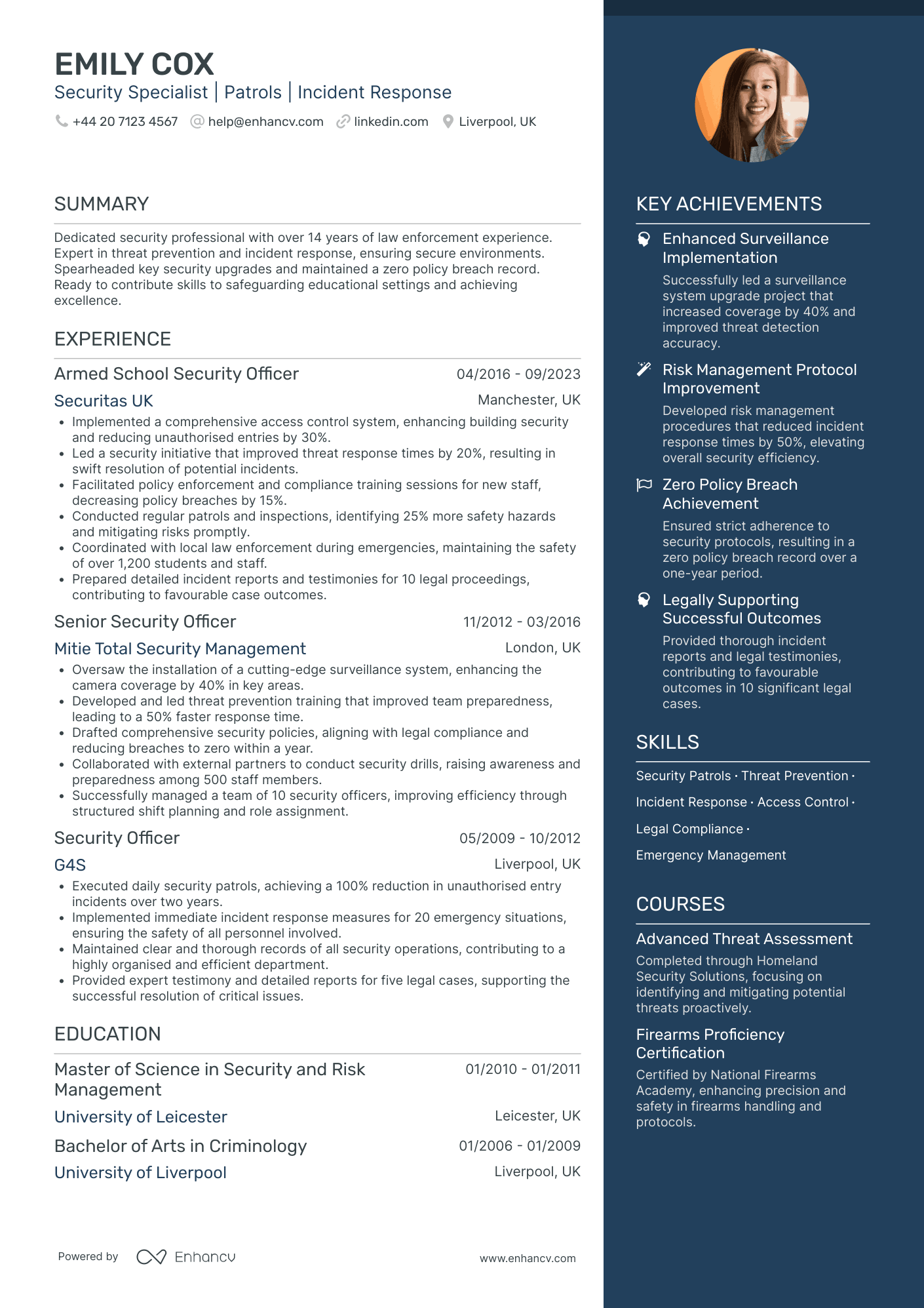
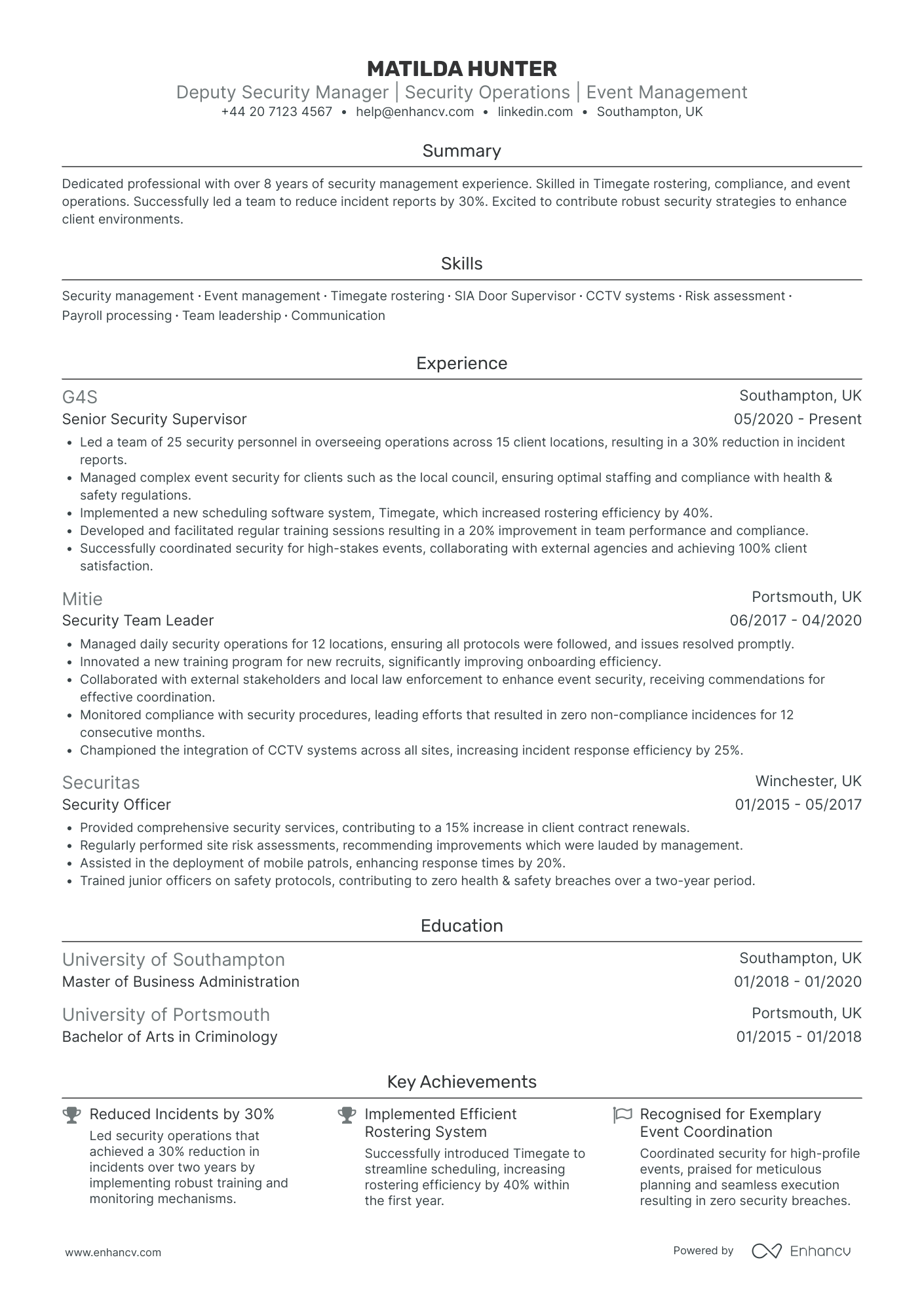
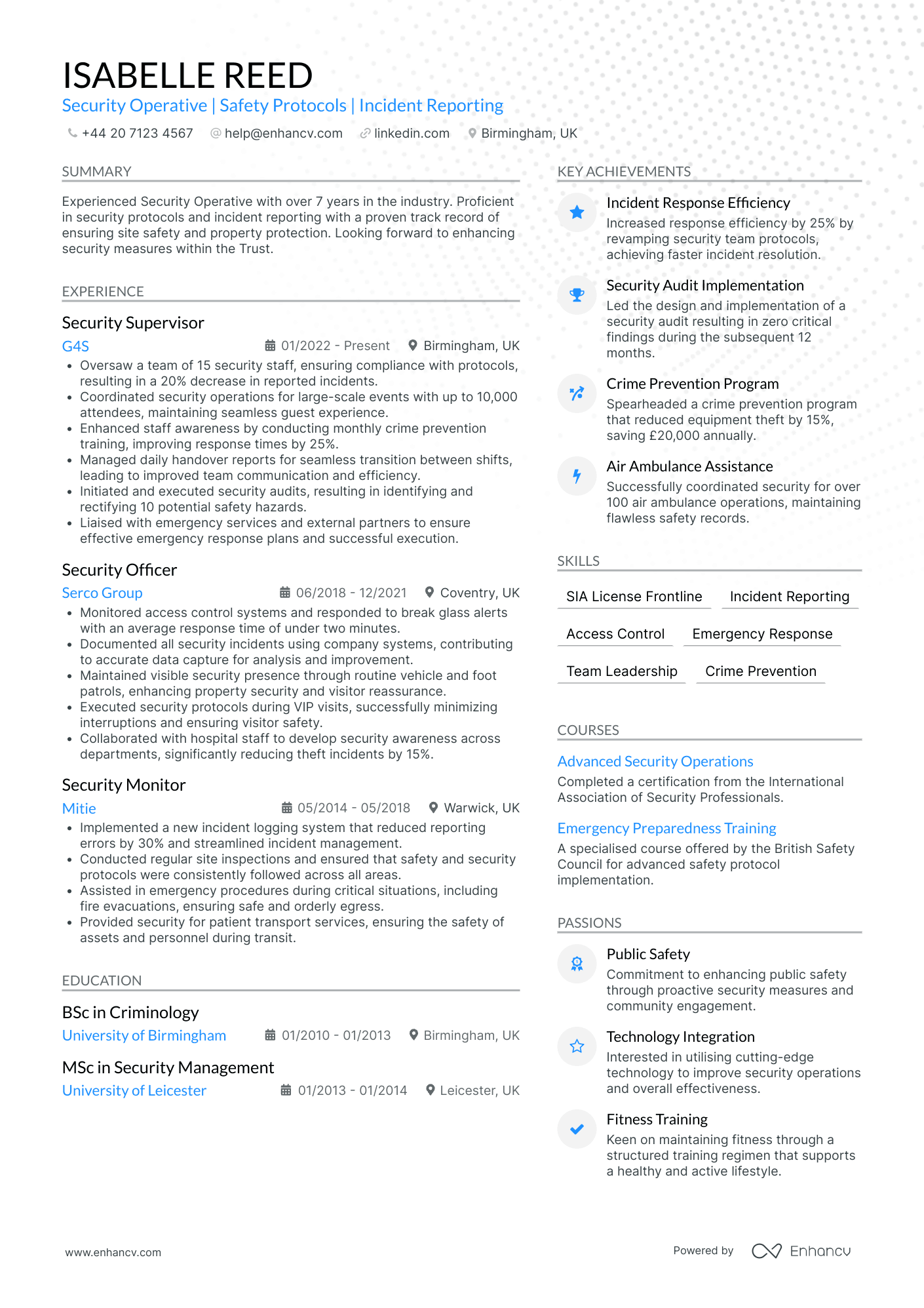
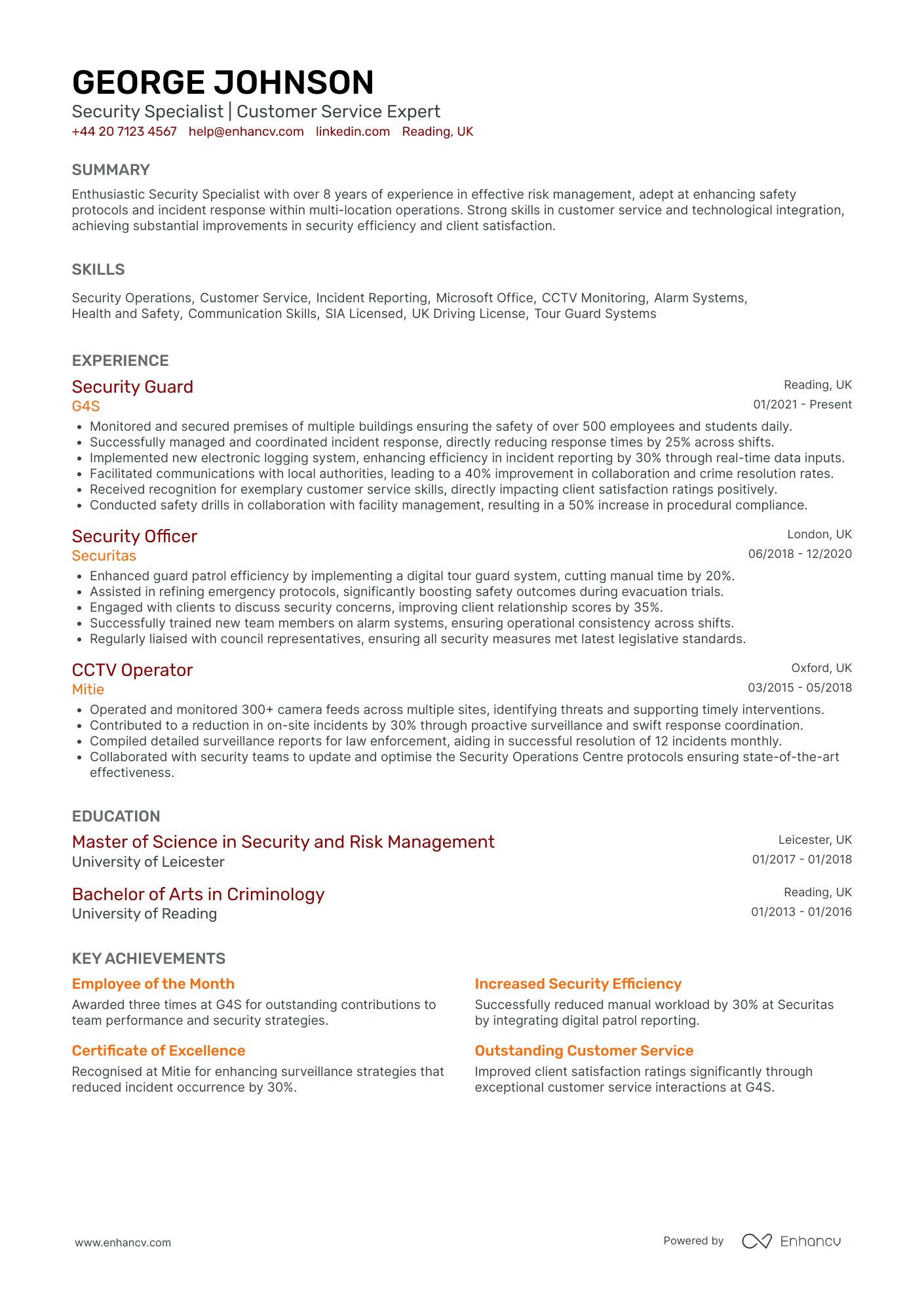
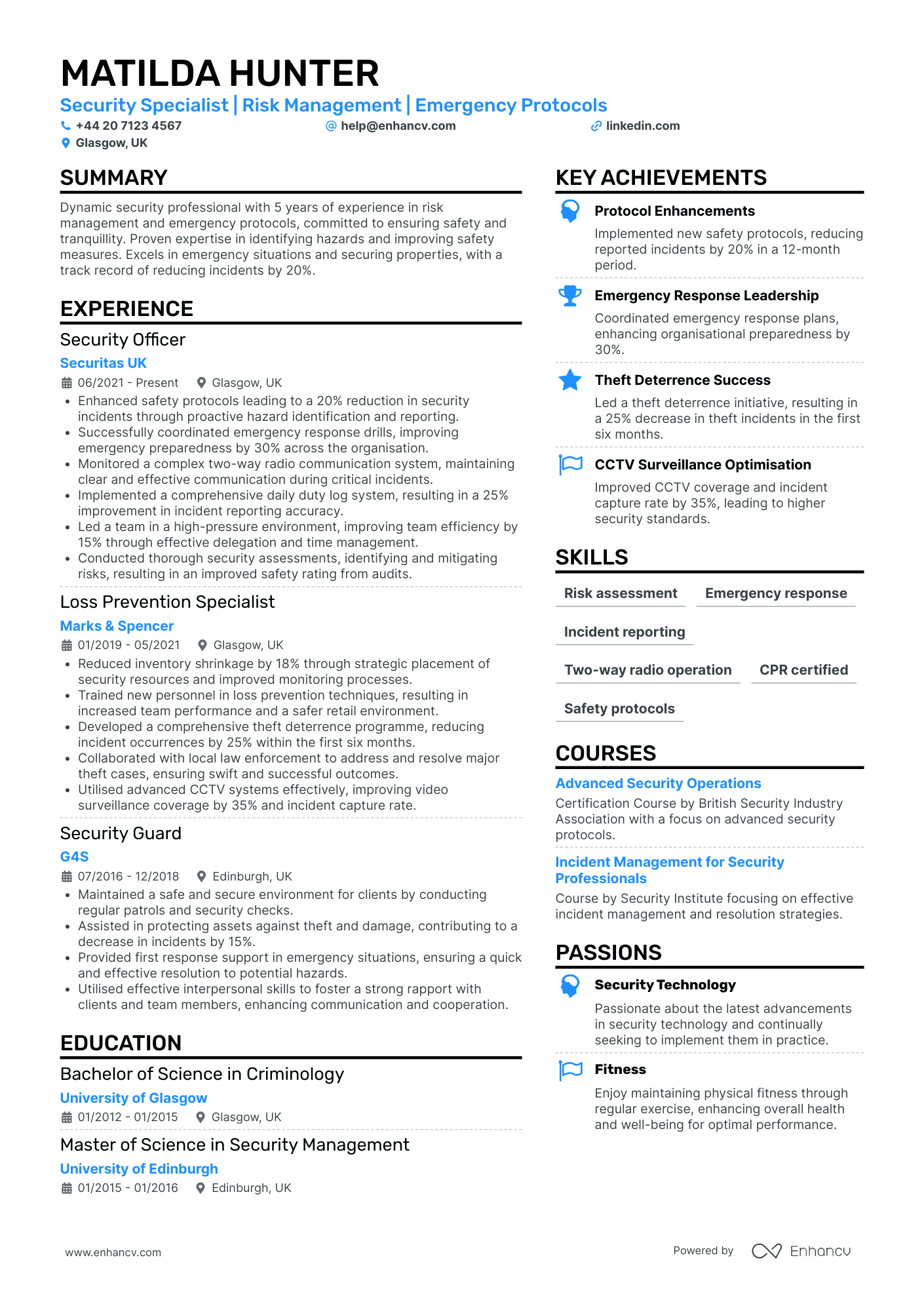
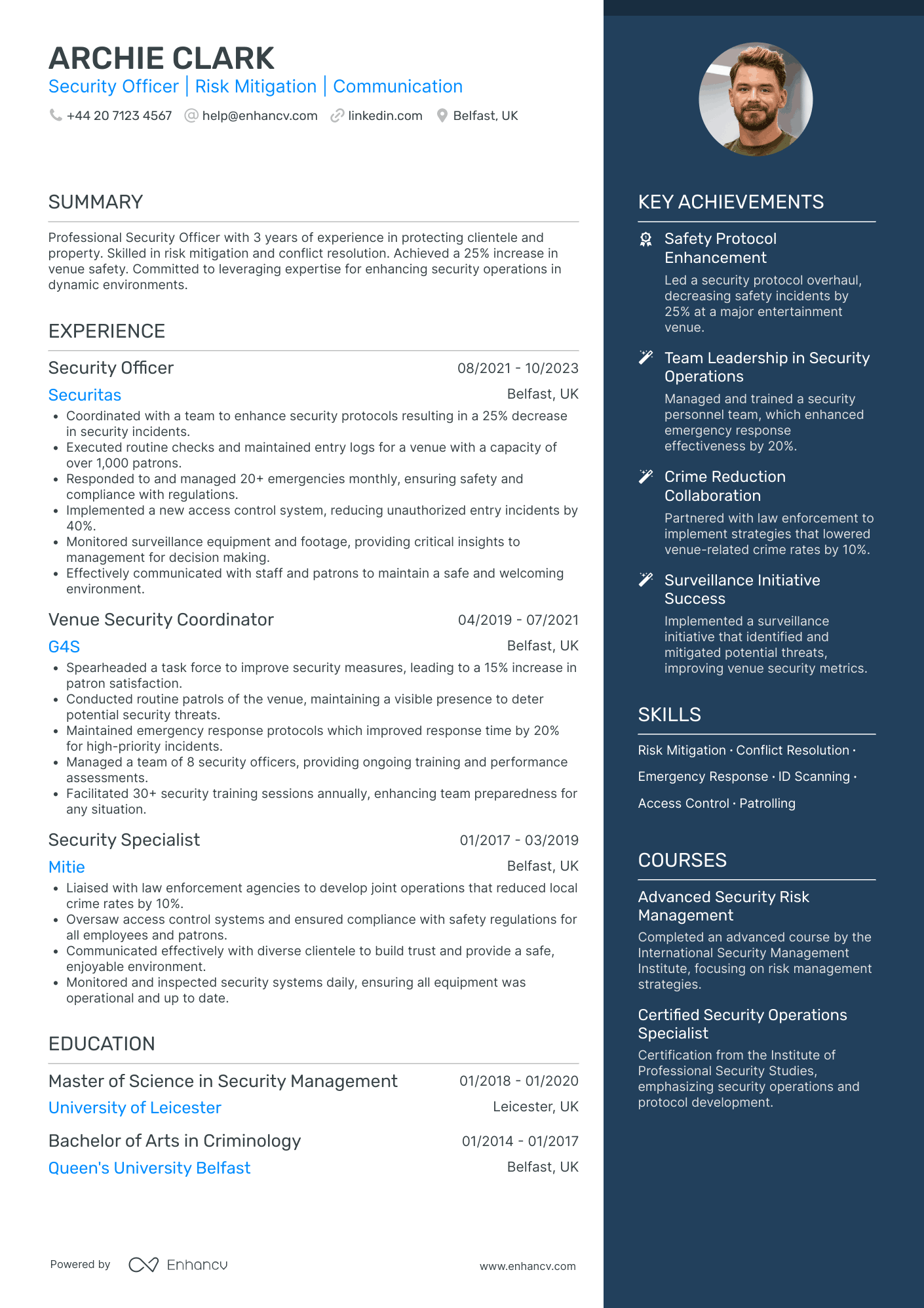
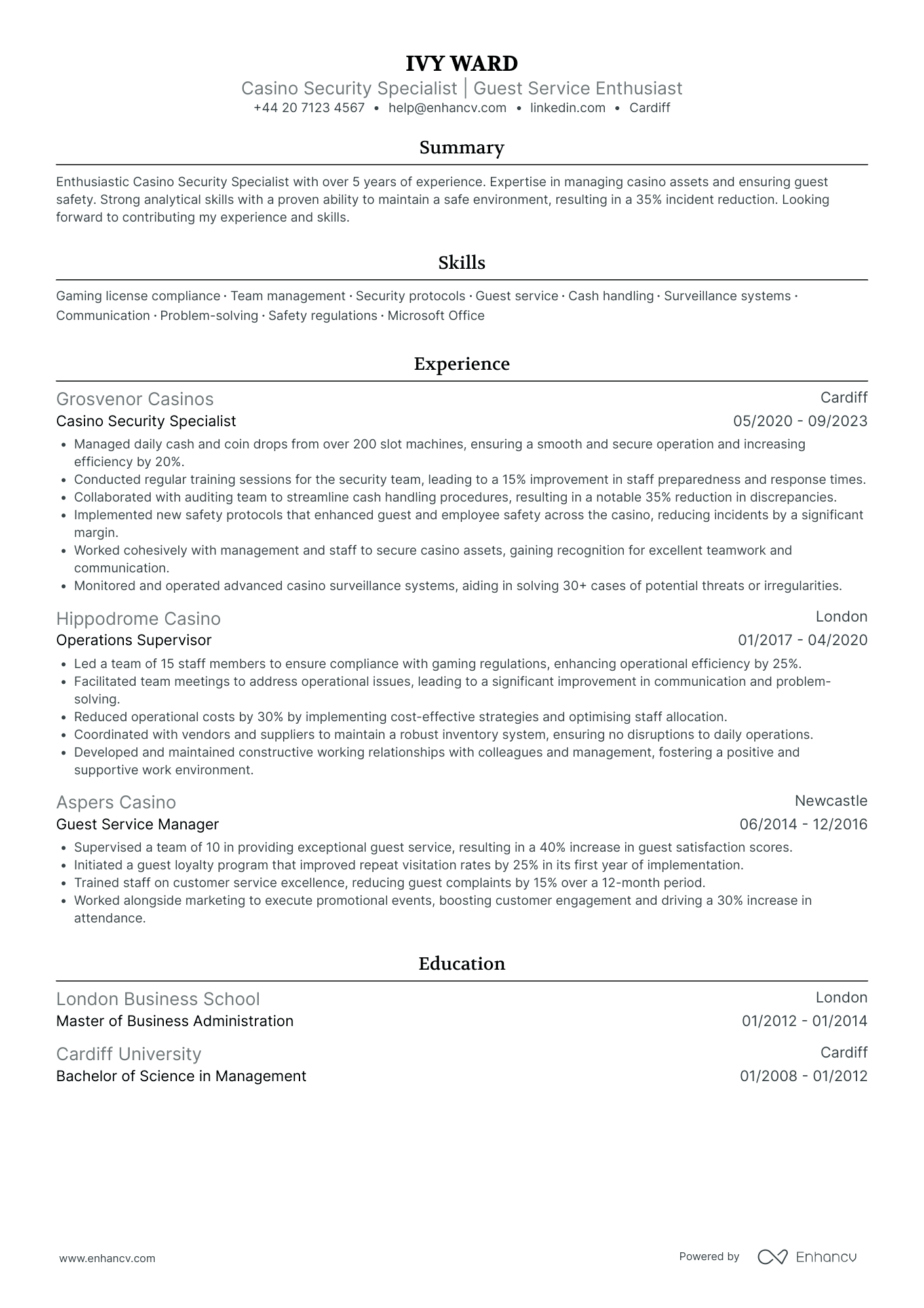
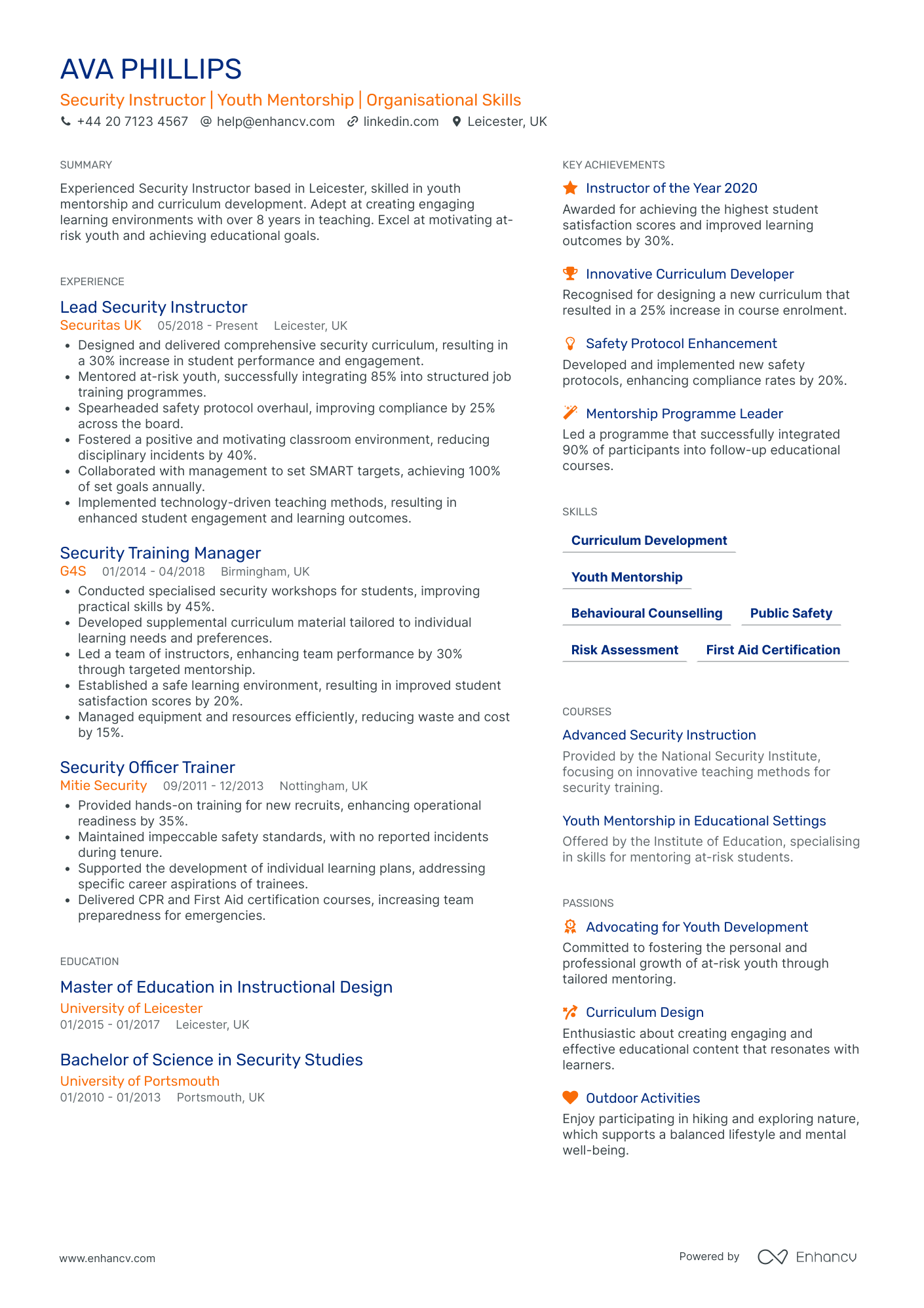
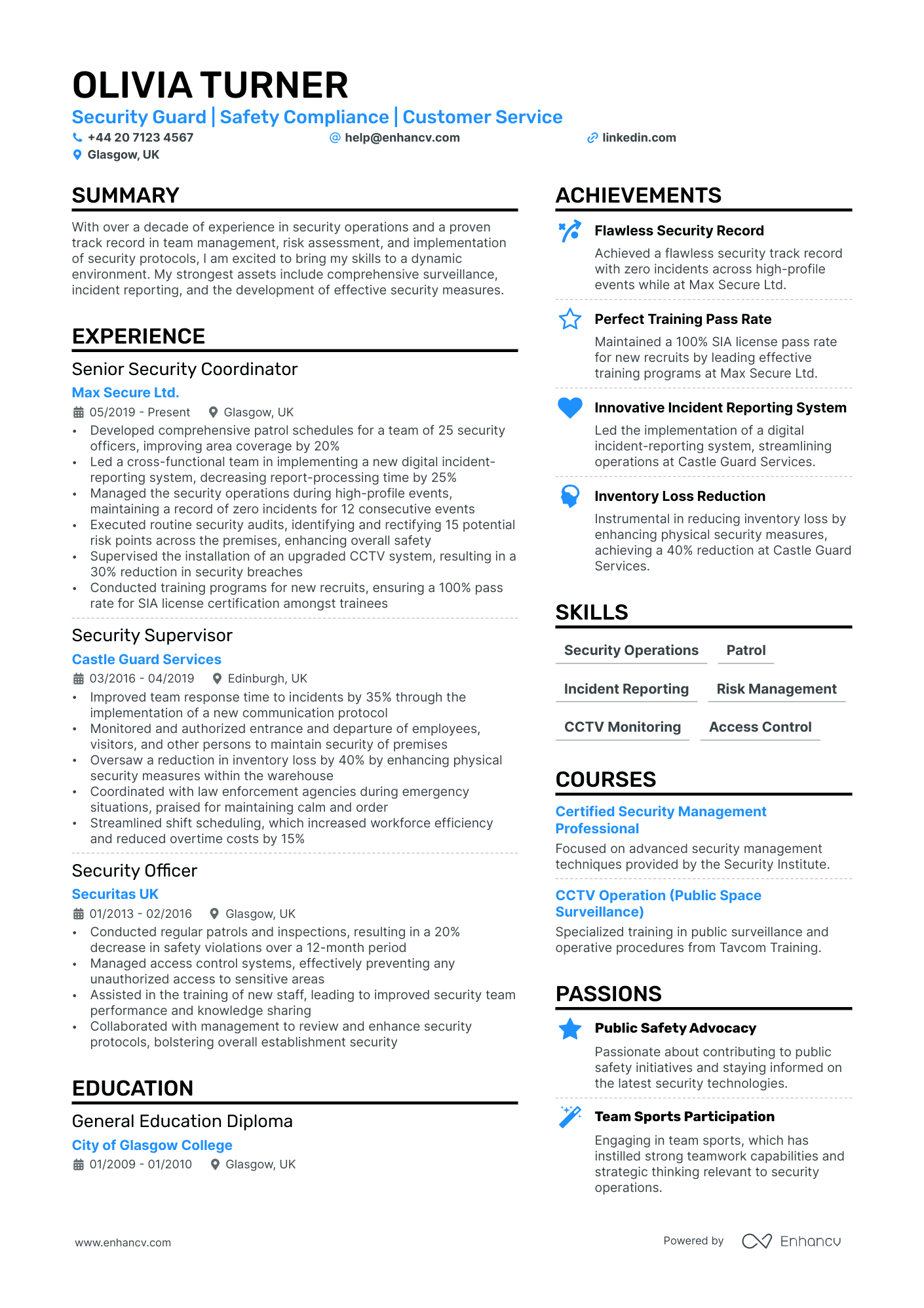
You do not need years on the door to land your first security guard interview. You need a CV that proves you are reliable, observant, and licence-ready from day one.
Most first-time security CVs waste the top third on a vague profile and a list of duties copied straight from the advert. The ones that get called lead with an SIA licence, or a clear plan to get one, and the everyday judgement the job actually runs on.

Key takeaways
- No experience is normal for this role. Lead with reliability, an SIA licence or one in progress, and any job where you were trusted with people or property.
- Most UK guarding roles need an SIA licence. Put it near the top, even when it is still in progress.
- Security work is on-site and shift-based. Show your location, travel radius, and whether you can work nights and weekends.
- Name the everyday duties employers recognise: CCTV monitoring, access control, patrols, and incident reporting.
- Open with a short personal statement built on reliability, observation, and one concrete example.
- Two pages, reverse chronological, sent as a PDF unless the advert asks for a Word file.
Writing a security guard CV with no experience
Security is one of the more open doors in the UK jobs market. Employers hire on reliability and licensing, and many of them put you through the site training once you are on the books.
So your first CV carries its weight differently. Use a skills-led structure: personal statement, then your SIA licence and skills, then any relevant experience, with unrelated jobs lower down. If you want the fundamentals first, see how to write a CV.
The reason this works is simple. For most guarding roles the licence is the real qualifier, not a decade of experience, so a licensed newcomer with a clean record often clears the first filter ahead of an unlicensed veteran.
Mine your life for evidence that you can be trusted with people and property. It is almost always there:
- Retail, warehouse, or hospitality work where you handled cash, keys, stock, or closing up alone.
- Stewarding, marshalling, or door work at events, festivals, or clubs.
- Military, reserves, cadets, or a policing or first-aid background.
- Any role with a duty of care or lone working, from care to caretaking to night driving.
Write those in security language. "Trusted to lock up and set the alarm for a busy retail unit for two years" is a security bullet that happened in a shop.
If you have stewarded or volunteered on the door, give it a dated entry like a job, with duties and hours. Volunteering on a CV counts as experience for this role, not filler.
Availability is its own selling point when experience is thin. Guarding rotas are built around nights, weekends, and bank holidays, so a line like "available for night shifts and short-notice cover across Greater Manchester" answers a question the recruiter was about to ask.
One line moves a no-experience CV up the pile: "SIA Door Supervisor licence in progress" or "enrolled on Level 2 SIA training". It tells the employer you are already on the path and worth a call.
The SIA licence and screening UK employers expect
For most front-line guarding in the UK, the Security Industry Authority (SIA) licence is the real gate, not years of experience. Get that sorted and a thin CV suddenly clears the first hurdle.
Match the licence to the work. A Security Guarding licence covers static and patrol roles, a Door Supervisor licence covers venues and licensed premises, and a CCTV (Public Space Surveillance) licence covers camera operators. Most people start with the Level 2 training course, then apply to the SIA for the badge.
If the advert asks for a licence you do not have yet, apply anyway when you are enrolled on the course. Plenty of employers will hold a start date for the right candidate, and stating a clear timeline reads far better than staying silent about it.
If you can only afford one to begin with, the Door Supervisor licence is usually the flexible pick, since it also lets you take on standard guarding shifts. Note any conflict-management or physical-intervention training that came with the course, because employers value it.
Put the licence type and number right under your name, or in a short licences section near the top. If it is still in progress, say so with a date. Naming the qualification saves the employer a question, and any first-aid or conflict-management certificates belong there too.
Guarding roles also run background screening, often to the BS 7858 standard, which checks your last five years of employment and references. Keep your dates continuous, account for any gaps in employment, and have your referees lined up before you apply.

PRO TIP
Security adverts name the exact licence they need. If the advert asks for a Door Supervisor licence, write "SIA Door Supervisor licence" on your CV, not just "SIA licensed". Mirror the wording so both the recruiter and the tracking software see the match.
What UK security employers look for
Beyond the licence, the same qualities come up in guarding adverts again and again. They are practical, and every one of them can be shown on a CV rather than just claimed.
| What the role needs | How to show it on your CV |
|---|---|
| An SIA licence | State the type and number under your name, or write "in progress" with a date. |
| On-site, shift-based cover | Give your town and travel radius, and confirm you can work nights, weekends, and bank holidays. |
| Vigilance and observation | Use a bullet where you spotted a problem early and acted before it grew. |
| Reliability and calm conduct | Show clean attendance, lone working, or a time you de-escalated a tense situation. |
| The everyday duties | Name CCTV monitoring, access control, patrols, and incident reporting the way the advert does. |
Two of those matter more than the rest for a first application.
Guarding is on-site and shift-based, so a recruiter needs to see you can reliably get there and cover unsocial hours. Put your location and availability in the header, and mention a driving licence if you have one.
And the job runs on judgement more than force. A good security guard is observant, reliable, calm under pressure, honest, and clear on the radio and in a report. Prove those with a short example rather than a row of adjectives.
Honesty deserves its own mention, because guarding puts you around cash, keys, and stock with nobody watching. Anything that signals integrity, from a clean screening history to a reference that vouches for your conduct, does quiet work on this CV.
Formatting your security guard CV
For a first security CV, use a skills-led order so your licence and reliability come before a thin work history. Once you have guarding roles behind you, switch to reverse chronological.
Keep it to two pages, one column, standard headings, and a readable font. Control-room managers and agency staff skim fast between shifts.
Use the header for the details that decide a guarding shortlist: your location, your availability, your SIA licence, and a driving licence if you hold one. A photo is not expected on a UK CV, so the space is better spent there.
Send a PDF for direct applications so the layout holds. Keep a Word copy for security agencies, which place a large share of guarding work and reformat CVs into their own template. If the advert names a file type, follow it.
Applications often pass through tracking software, so keep the layout clean and the headings standard for an ATS-friendly CV. Build it from a tested layout rather than a blank page, since Enhancv's CV templates export to a clean PDF.
Writing your security guard personal statement
Three or four sentences at the top: who you are, your licence status, the reliability you bring, and one concrete example. Keep it specific. See more personal statement examples if the opening line will not come.
Skip the adjective soup every other CV leans on. "Hard-working, trustworthy, and vigilant" tells a recruiter nothing they can check, because every other applicant wrote the same three words. Lead with evidence instead:
Security guard CV personal statement example (no experience)
Reliable warehouse operative with an SIA Door Supervisor licence in progress and three years of shift work with a spotless attendance record. Trusted to open and lock up a busy site, monitor CCTV, and log deliveries against manifests. Calm with the public and quick to flag anything out of place. Looking to bring that vigilance to a security guard role covering nights and weekends near Manchester.
When I read a security CV with no guarding experience, I look for two things: proof you can be trusted alone with a site, and a real plan for the SIA licence. A line like "trusted to lock up and hold the keys to the unit for two years" tells me more than any list of qualities. Name the responsibility you have already carried, add the licence you are working towards, and a first application starts to look credible.
Writing your security guard experience section
Whether it is paid, casual, or stewarding, write each entry the same way: a dated heading, then bullets that show what you did and what came of it. Lead each bullet with a verb. For the mechanics, see work experience on a CV.
Security work is measurable even when it does not feel it: sites covered, people screened, incidents logged, patrols completed, a shift that ended without a problem. Those details are your CV achievements, so lead the bullets with strong action verbs.
Keep the outcome on the same line as the action. "Radioed a suspected theft to the control room and detained the individual until police arrived" shows judgement, procedure, and a result in one bullet, which is exactly what a control-room manager is scanning for.
No guarding history yet? Reframe the job you did have. A warehouse role becomes "controlled access to a restricted stock area and challenged unbadged visitors", and a shop role becomes "monitored CCTV and handled shoplifting incidents to company procedure".
Tailor each application: pull the duties and licence wording from the advert and mirror them where they are true of you. Enhancv's CV tailoring feature reads the ad and suggests the matching edits, which saves rewriting from scratch each time.
- Staff entry gates and search points at stadium events of up to 20,000 people, checking tickets and bags to venue procedure
- Watch crowds for early signs of trouble and radio incidents to the control room, logging each one clearly
- Completed SIA Door Supervisor training and an in-house conflict-management course
- Commended by the event manager for calmly clearing a blocked fire exit during a full-capacity match
PRO TIP
Numbers make guarding experience land. "Patrolled a 12-acre site hourly through a 12-hour night shift" or "screened 300 visitors a day" beats "responsible for patrols and access". Reach for the figure you can defend.
Skills to put on a security guard CV
Read a dozen live guarding adverts and the same demands repeat. CCTV monitoring, access control, patrolling, and incident reporting come up constantly, so list them as hard skills in the words the adverts use.
The soft skills that matter here are checkable: vigilance, clear communication, reliability, and staying calm in conflict. Since guarding is a public-facing job, customer service skills count too. Prove each in a bullet rather than just claiming it.
Do not skip the systems. If you are trained on an access system such as Net2, or you write clean incident logs and daily occurrence reports in Word and Excel, those are the small specifics that separate two similar CVs.
List only what you can stand behind. If you are trained on a task, name it. If you are not licensed yet, put the SIA licence under training in progress rather than in your skills section.
Top skills for your security guard CV:
SIA licence (Door Supervisor / Security Guarding)
CCTV monitoring
Access control (incl. Net2)
Patrolling
Incident reporting
Report writing (Word, Excel)
Conflict management
First aid
Vigilance
Communication
Reliability
Conflict resolution
Teamwork
Conclusion
Lead with reliability and your SIA licence, name the everyday duties employers screen for, and keep the format clean and shift-friendly.
Pair the CV with a short cover letter that says why security, and a no-experience application starts to compete.
Get the licence line, the availability, and one real example of trust onto the page, and you have already done more than most of the pile. That is what turns a first application into a first shift.

Author's take - the Enhancv team
When I read a security CV with no guarding experience, I look for two things: proof you can be trusted alone with a site, and a real plan for the SIA licence. A line like "trusted to lock up and hold the keys to the unit for two years" tells me more than any list of qualities. Name the responsibility you have already carried, add the licence you are working towards, and a first application starts to look credible.