



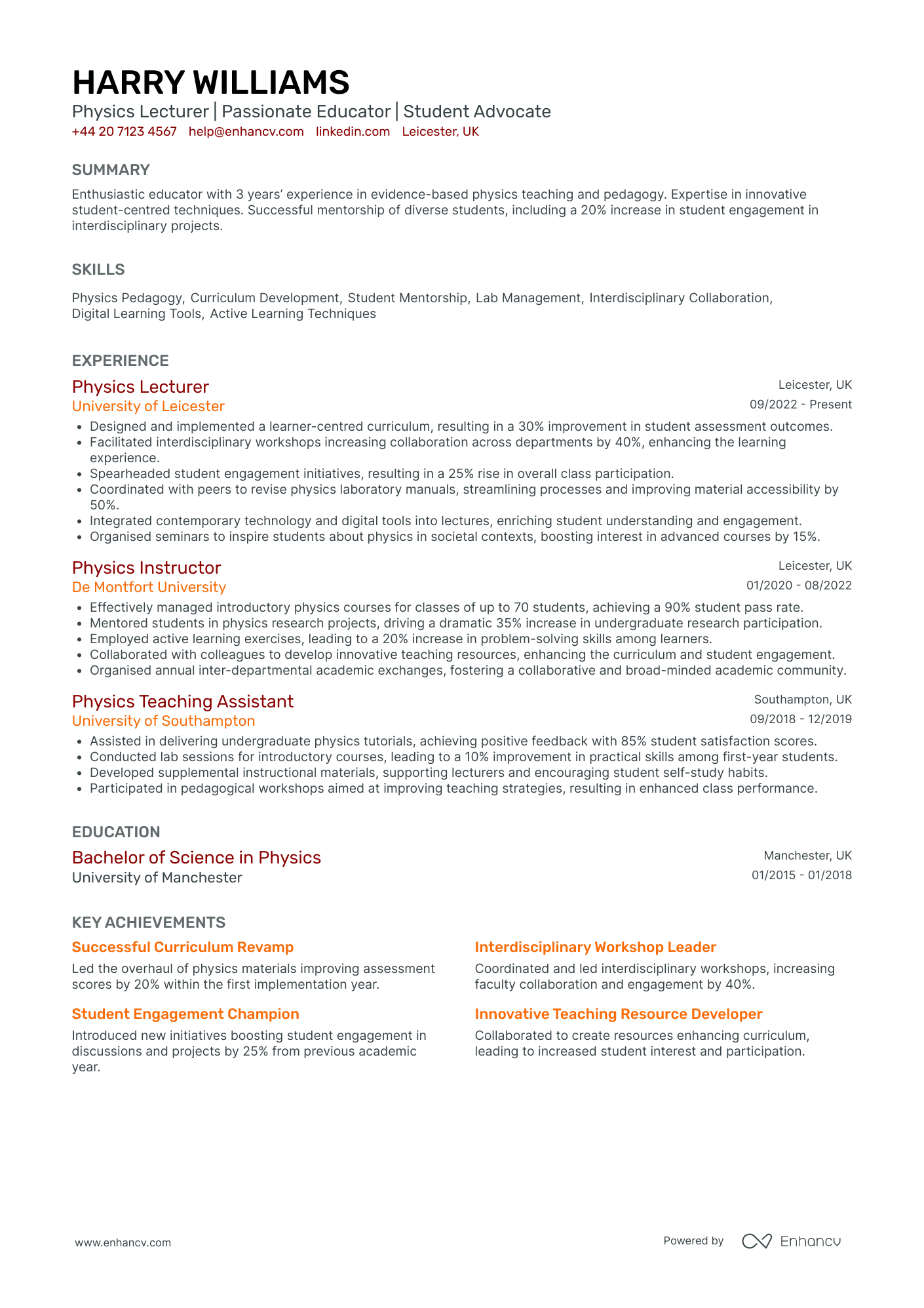
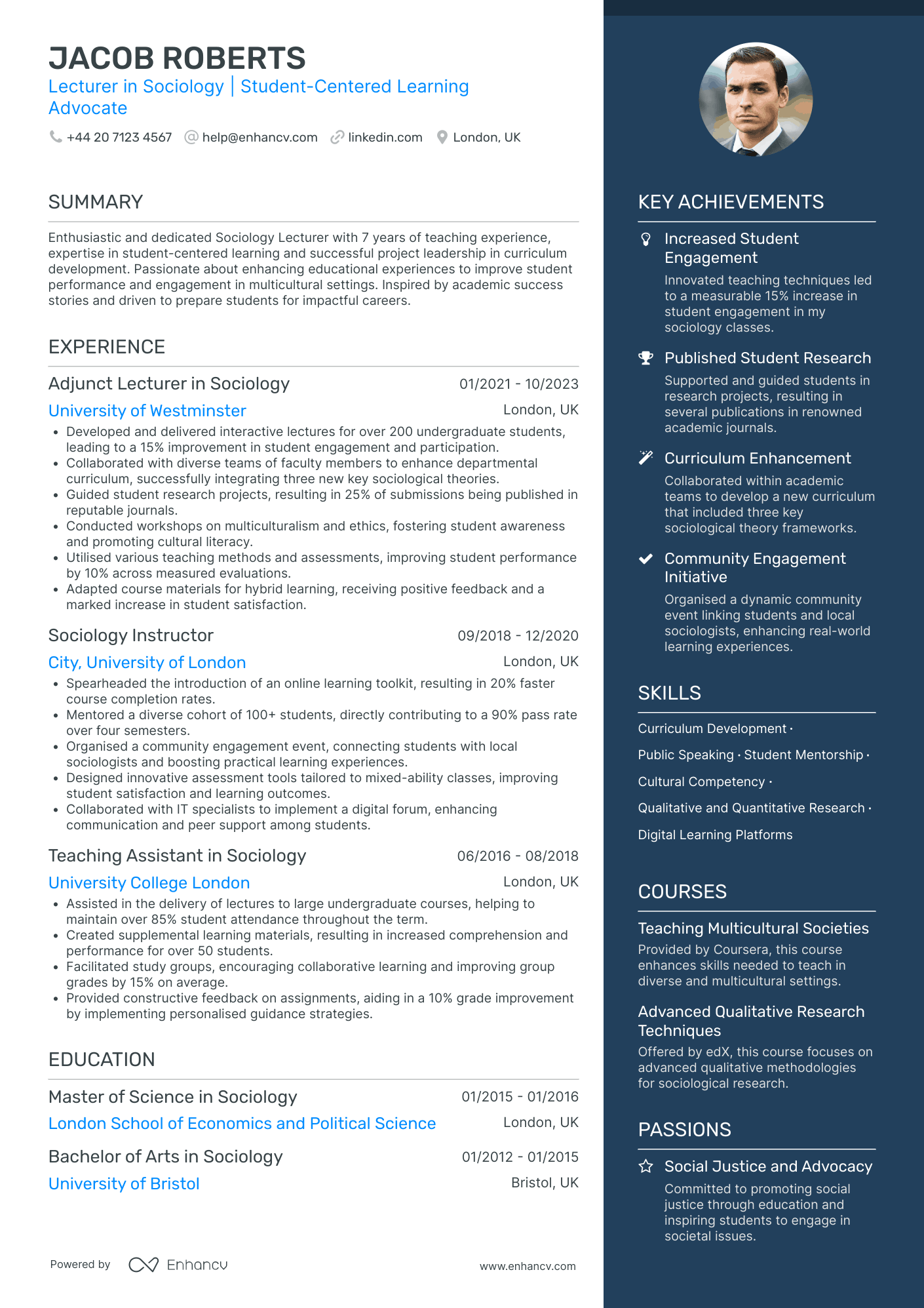
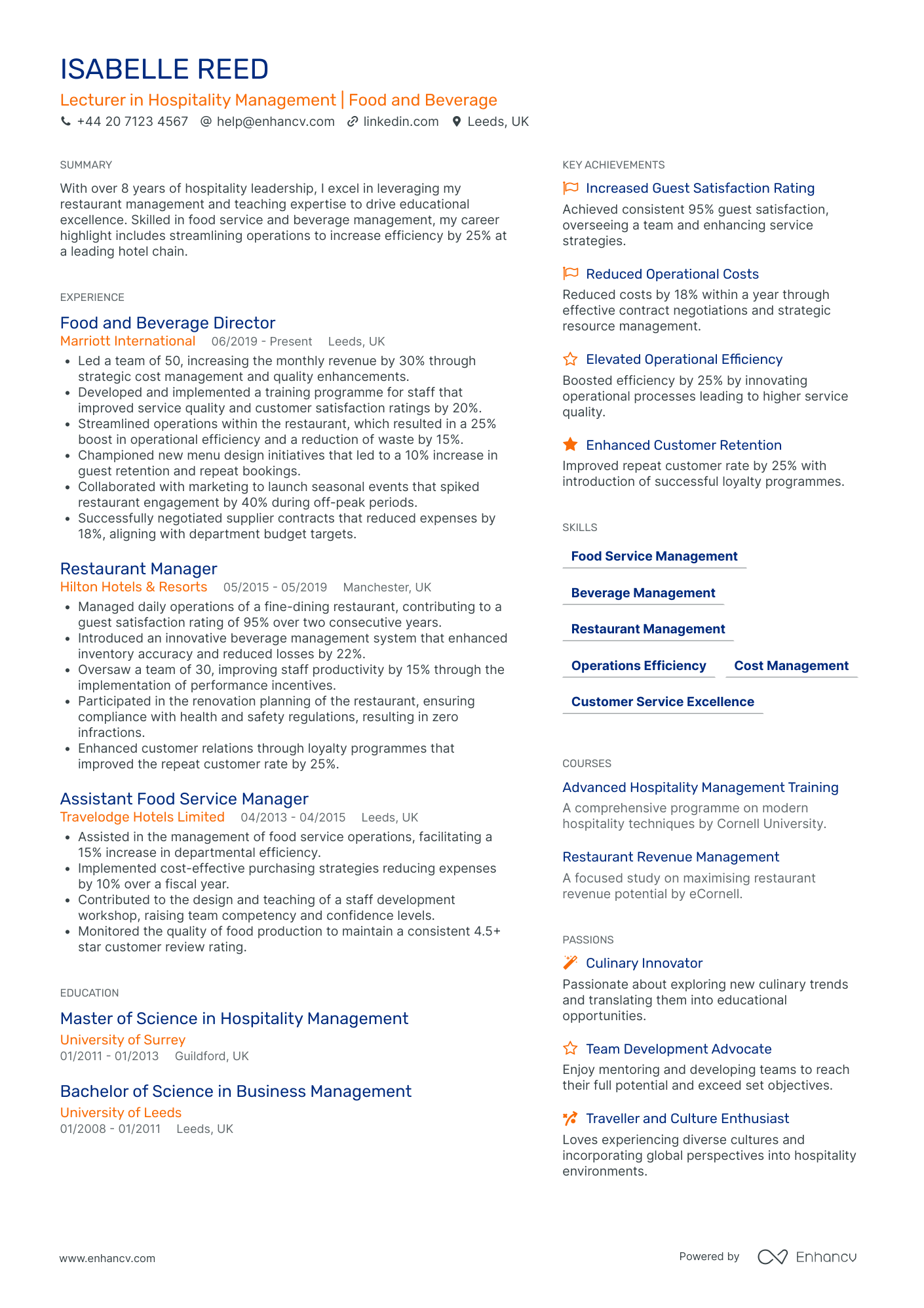
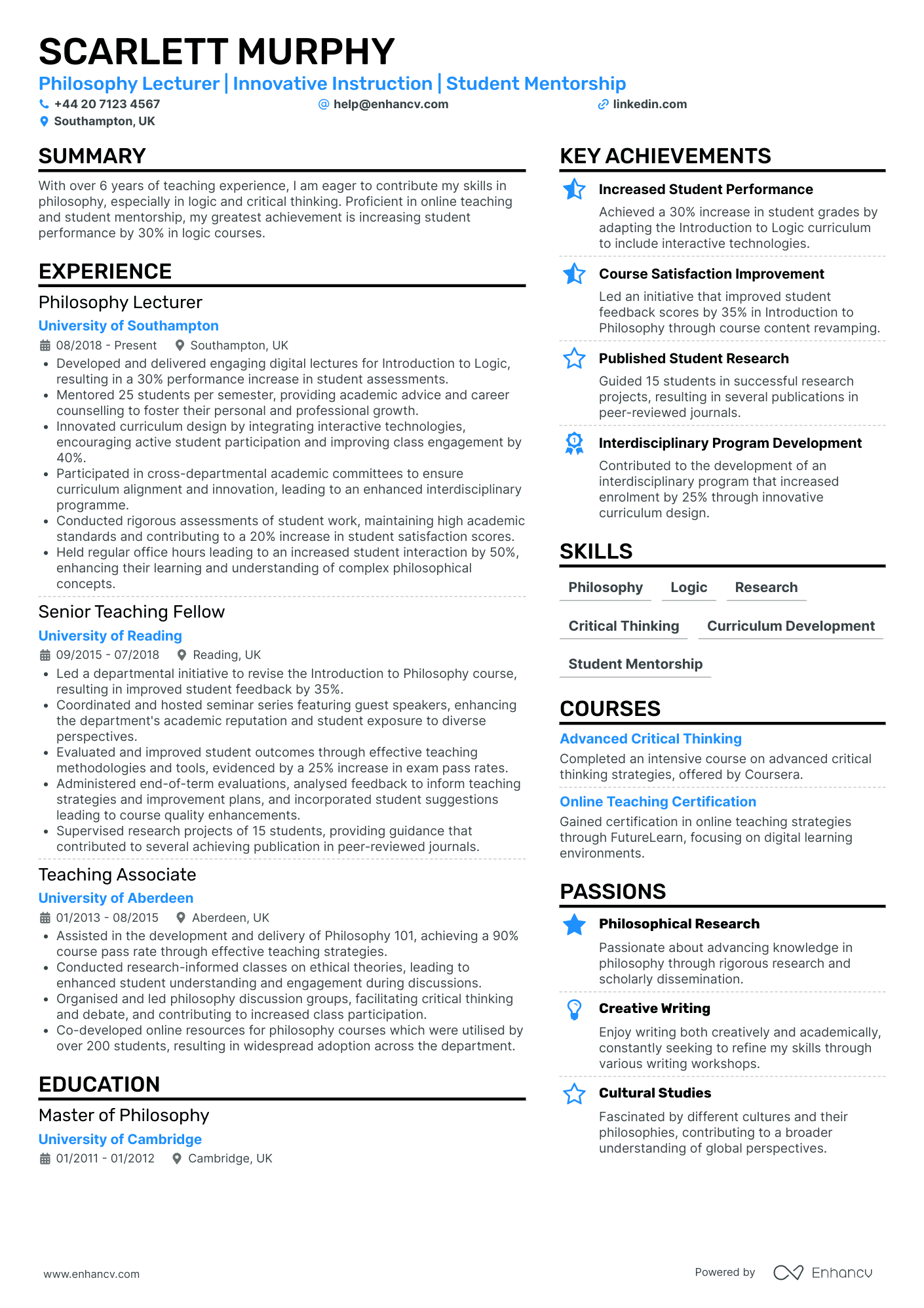
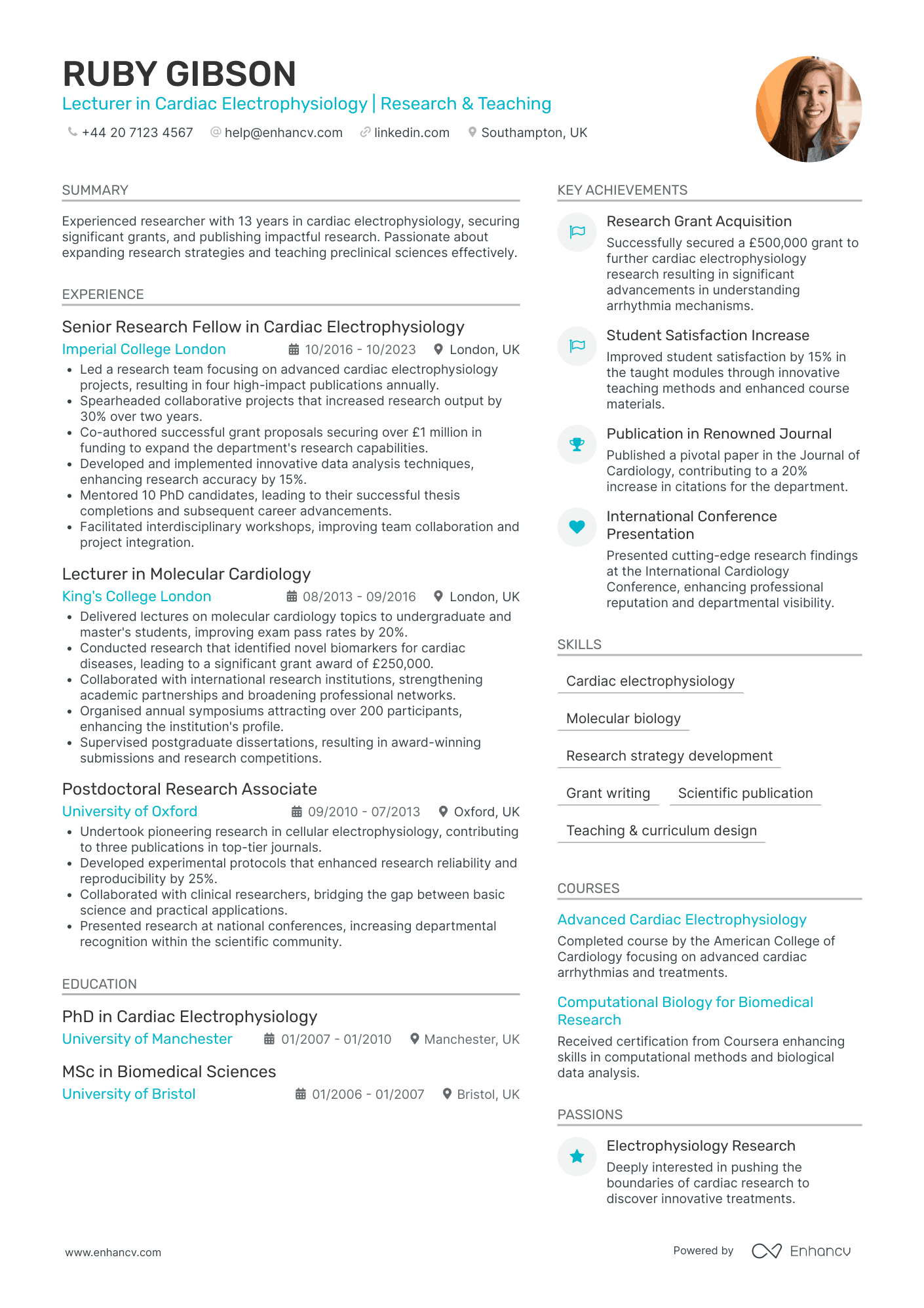
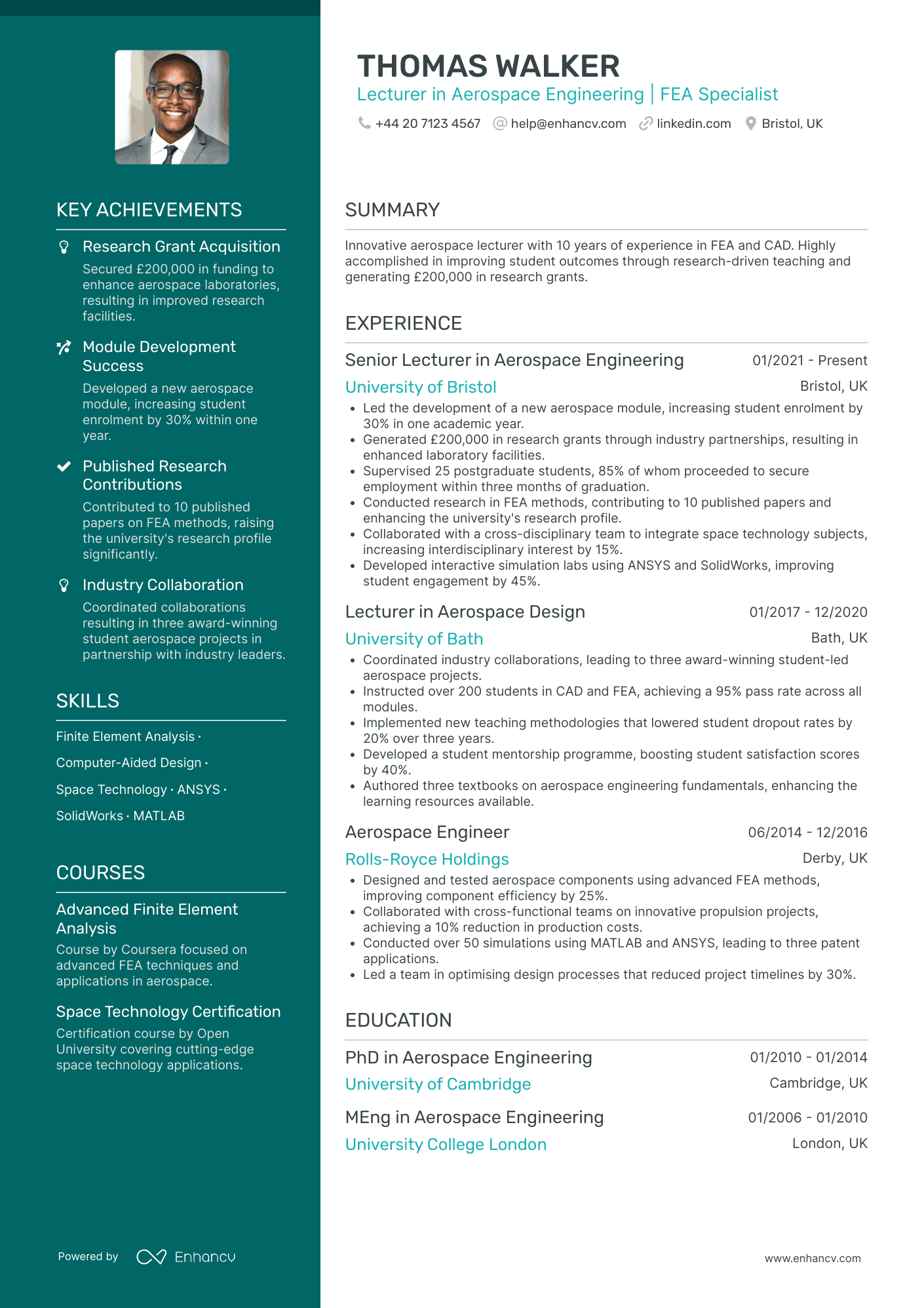
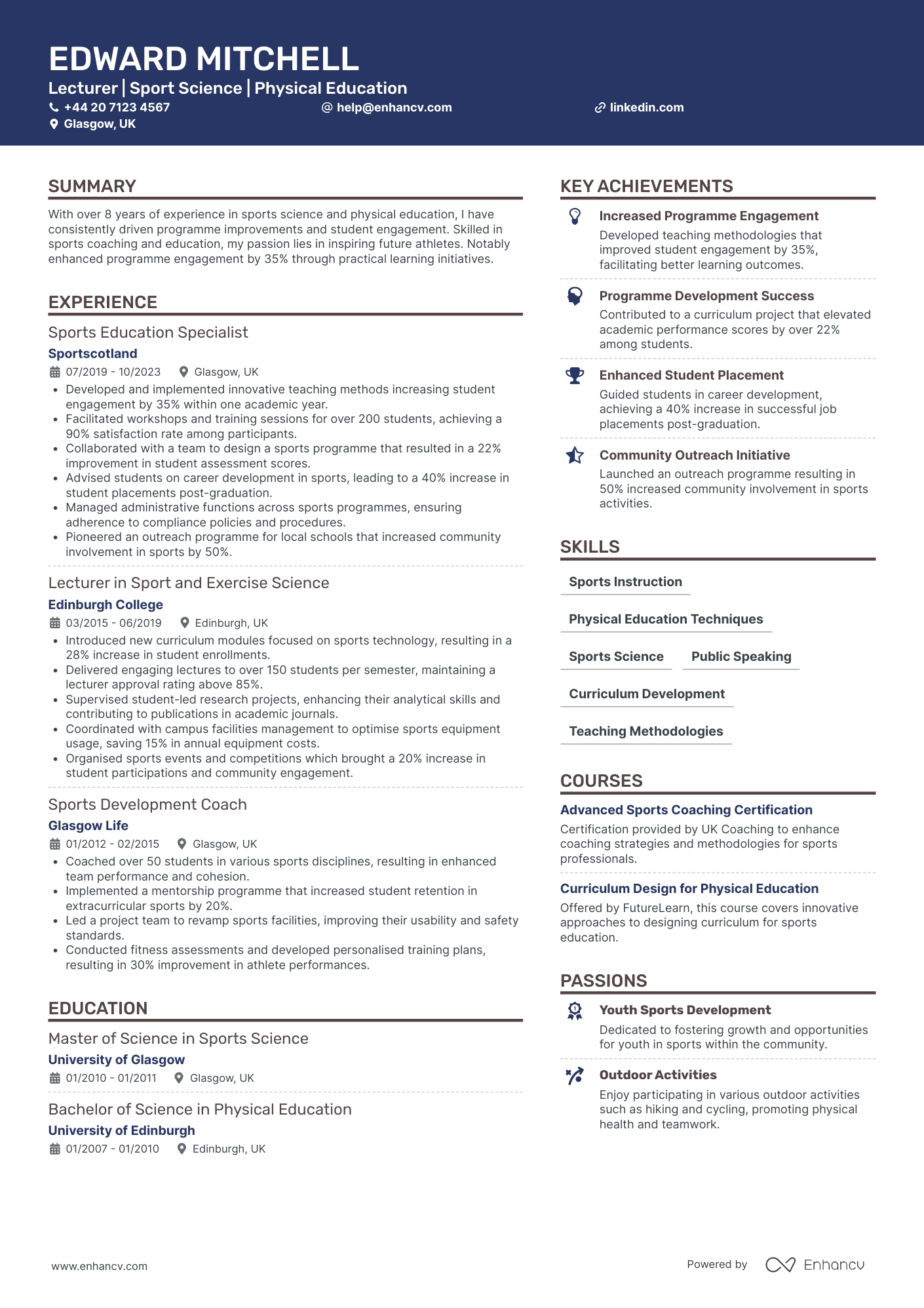
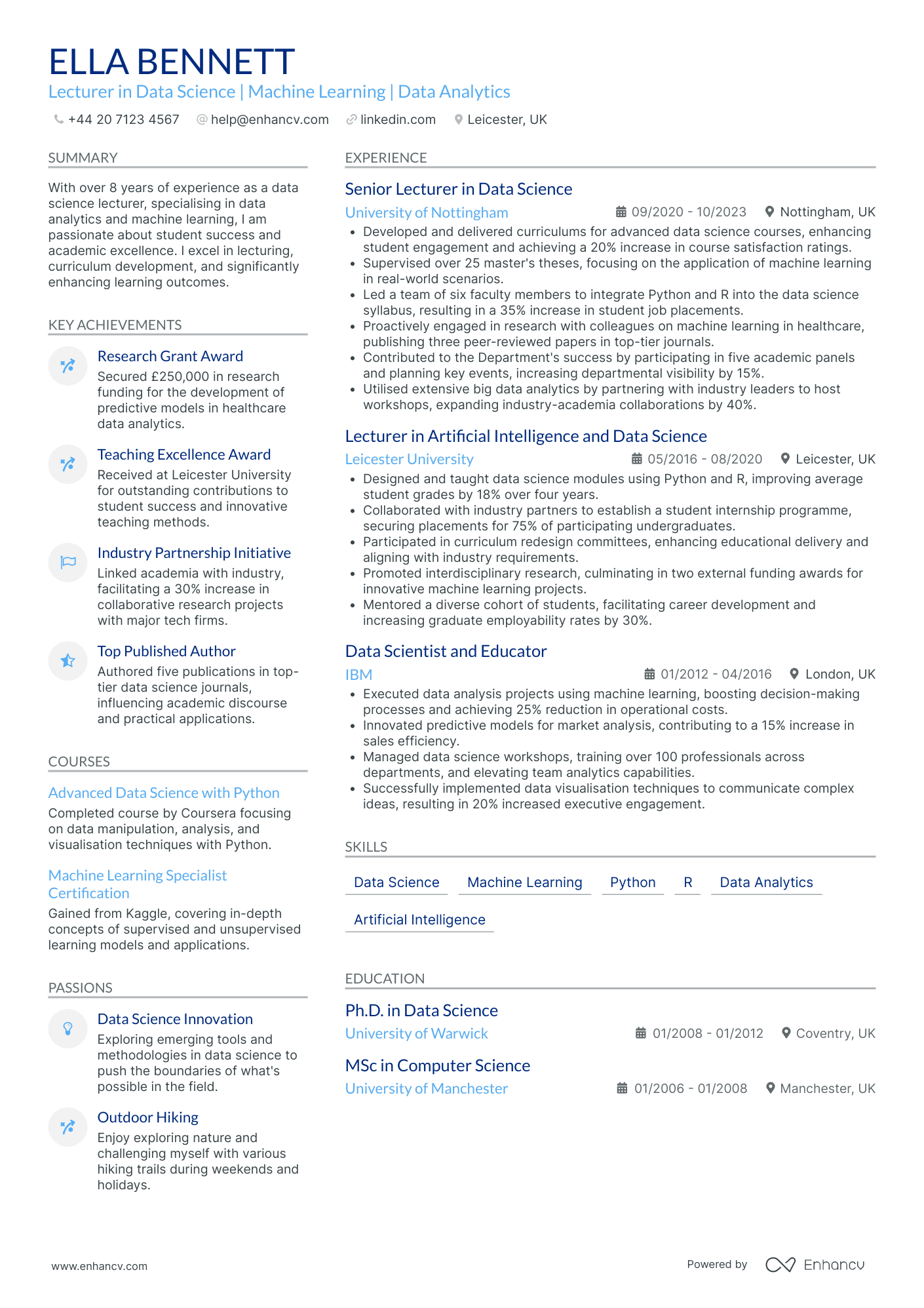
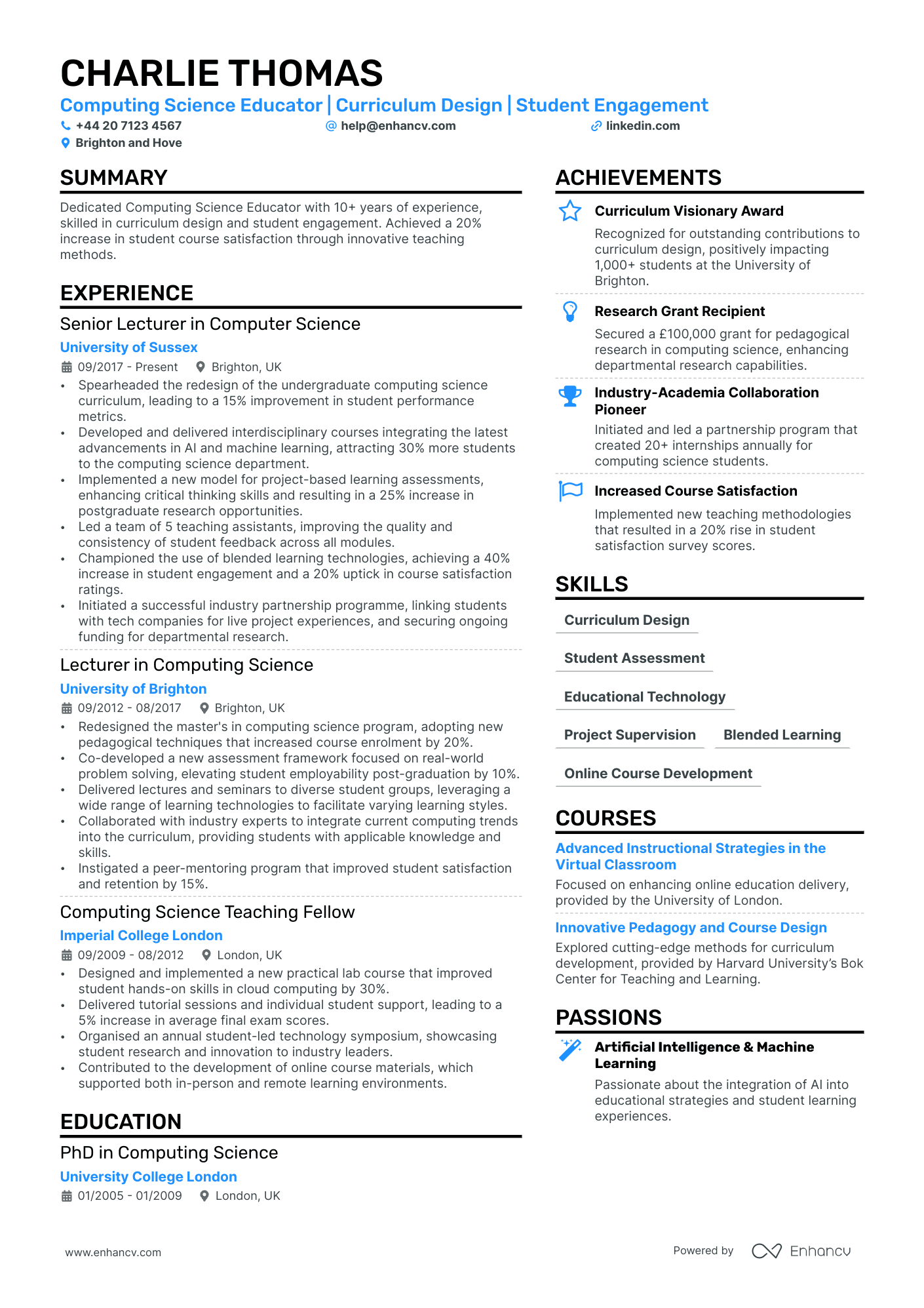
The academic CV is the one UK CV where running past two pages is expected rather than penalised, because your publications, teaching record, and funding history are the evidence a hiring panel actually reads.
Most lecturer applications still get squeezed into a corporate one or two page template, and the panel loses the record it came to see. The versions that get shortlisted treat length as a feature, order the sections the way a department reads them, and put teaching and research where a panel looks first.

Key takeaways
- Academic CVs run long. Two pages is a corporate rule, not an academic one, so give publications, teaching, and research the room they need.
- Lead with format. Panels read academic CVs in a set order, so structure yours the way they expect rather than in a generic layout.
- Name the skills adverts repeat. Curriculum development, teaching, and student assessment came up most across UK lecturer postings.
- The work is overwhelmingly on-site, so make your institution, location, and campus availability clear near the top.
- Most vacancies are pitched at mid-level, so evidence independent teaching and a research trajectory, not only a doctorate.
- Send a PDF unless the advert names a format, and keep a plain version for university application portals.
Formatting your lecturer CV
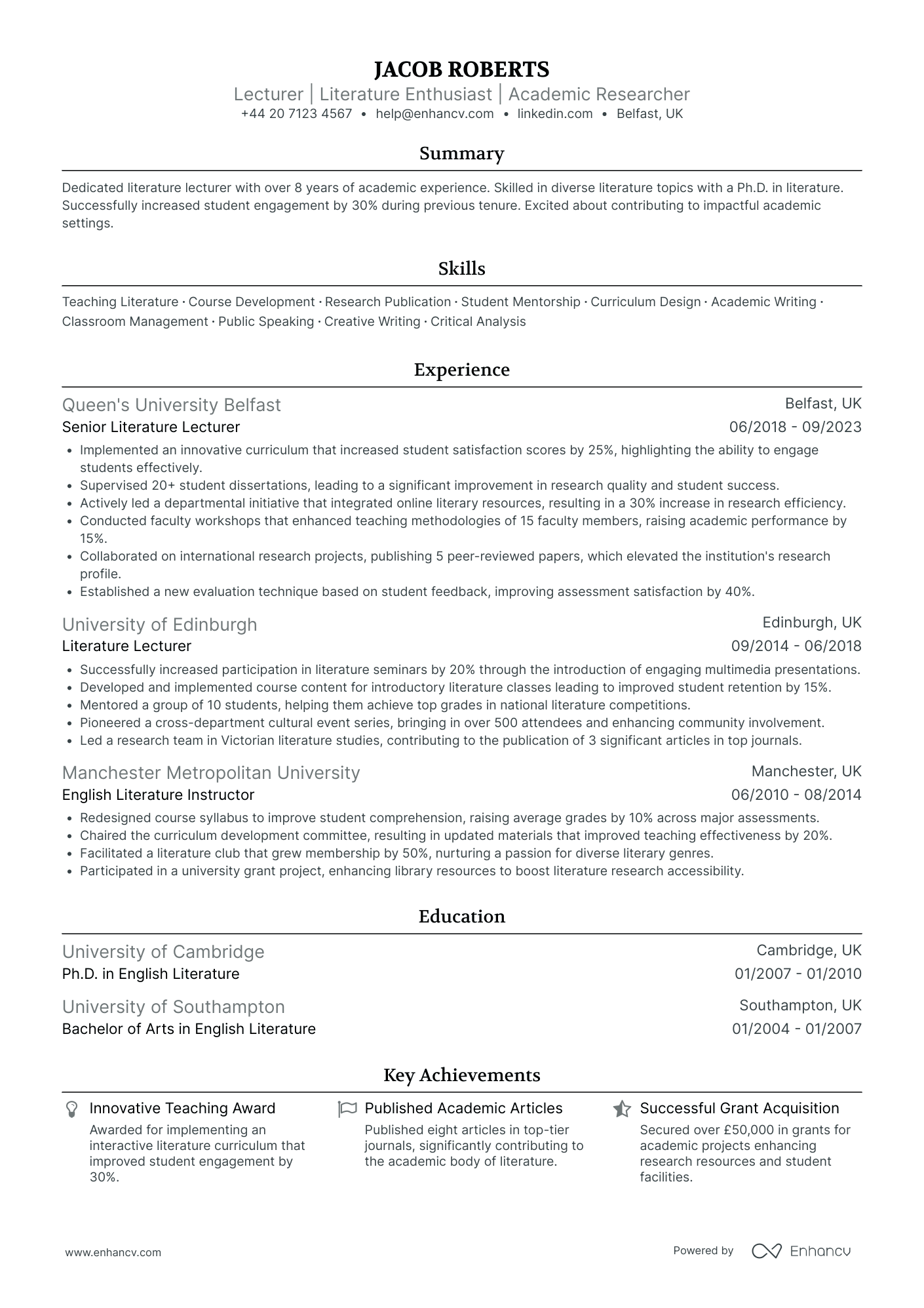
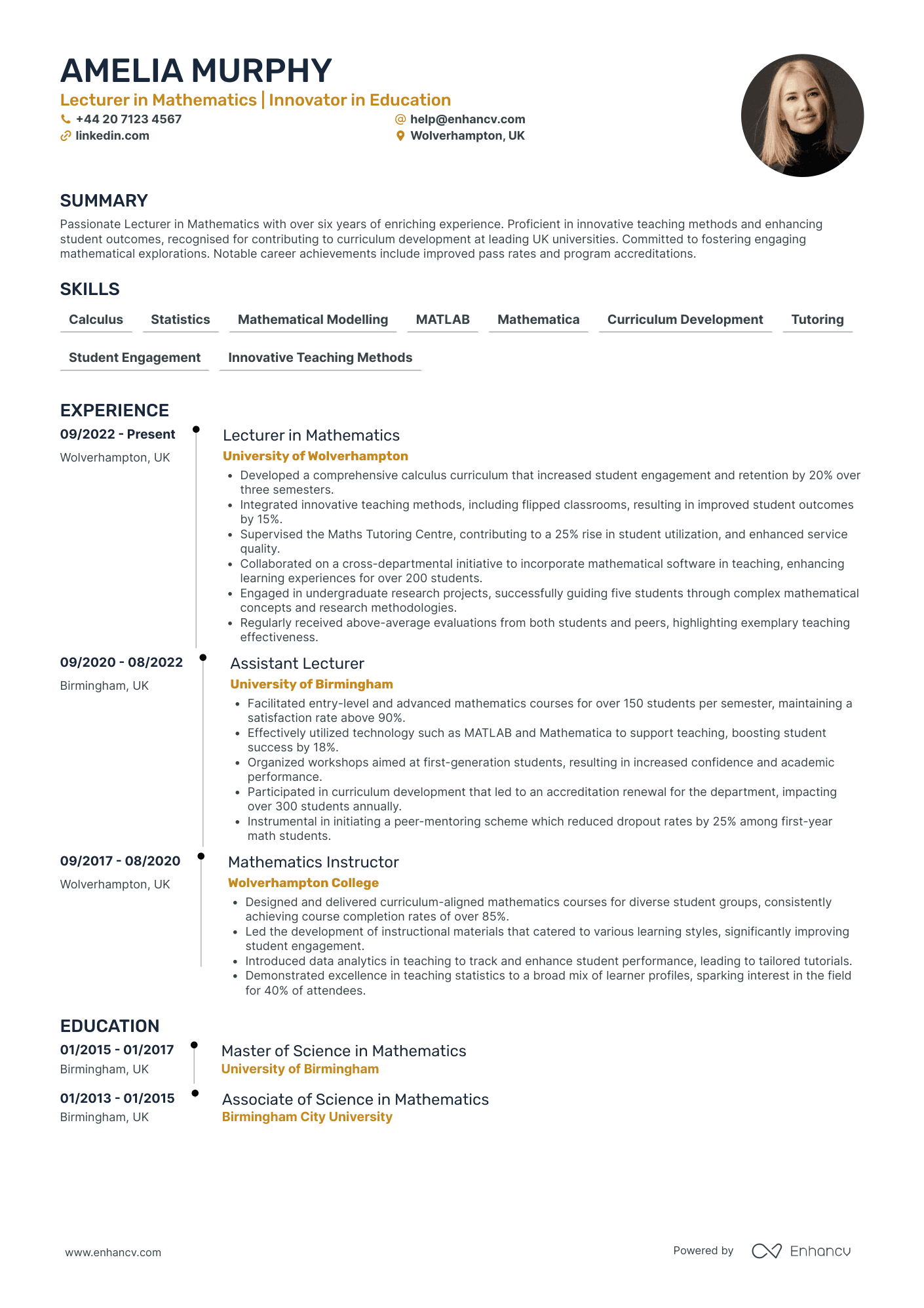
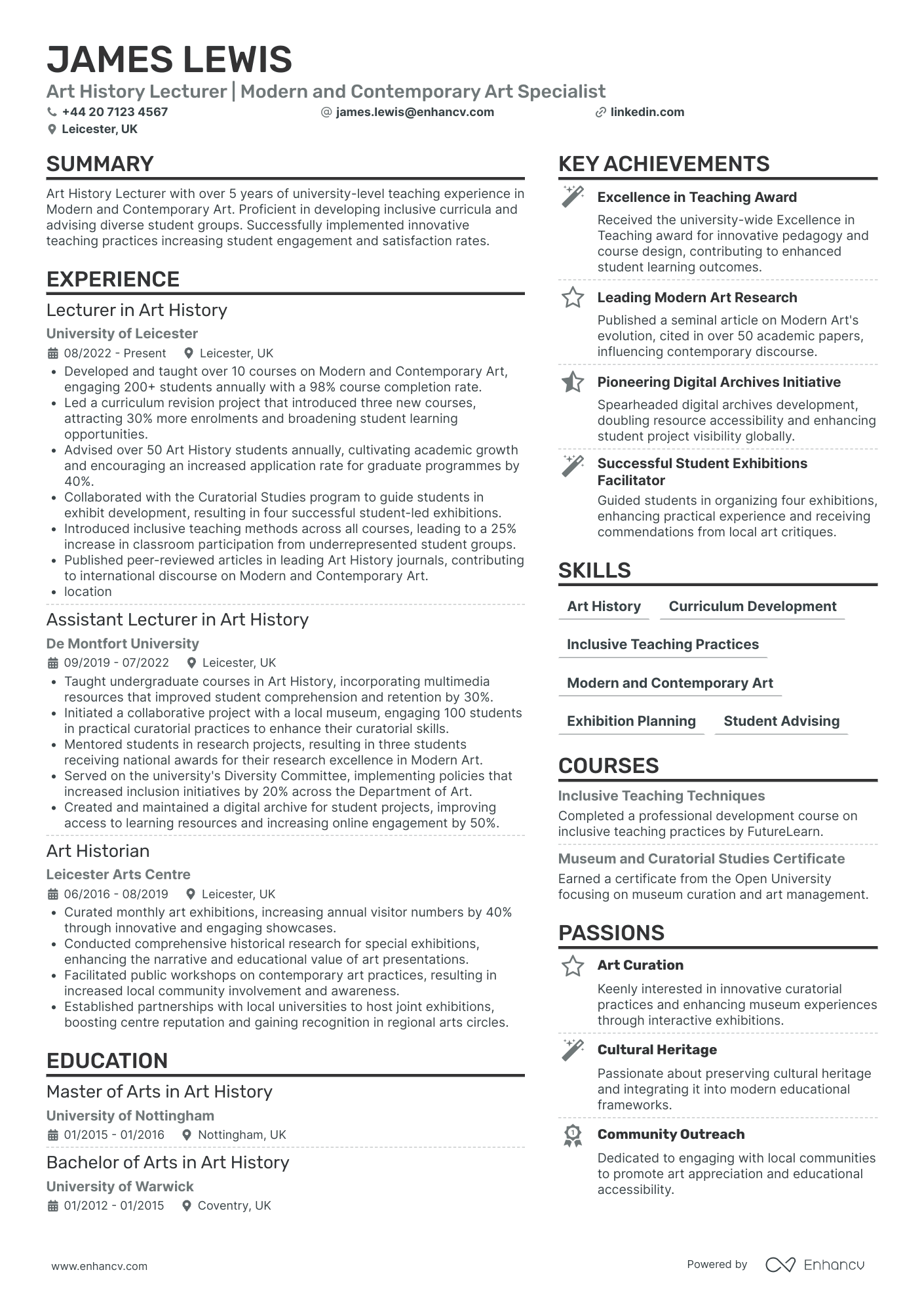
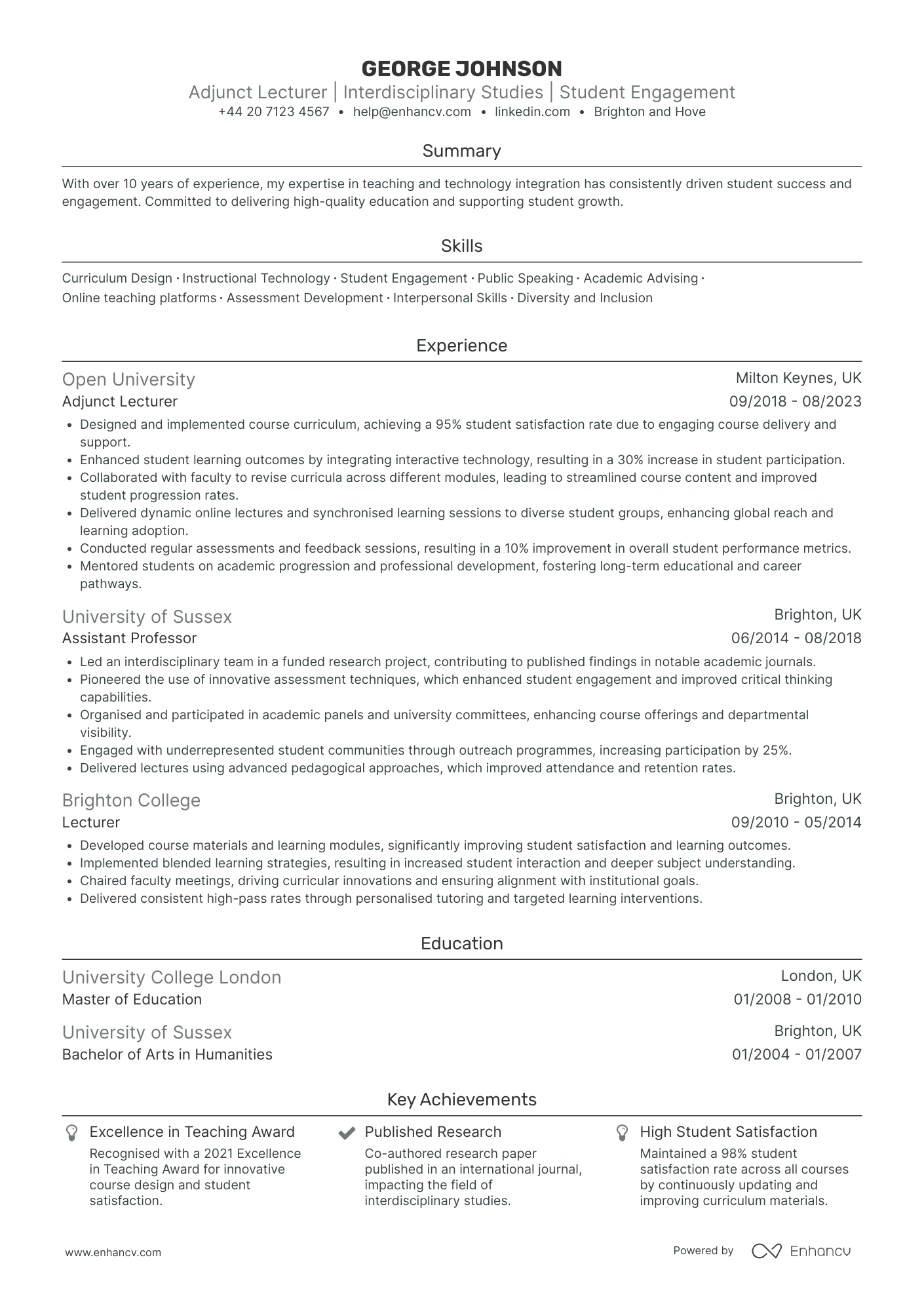
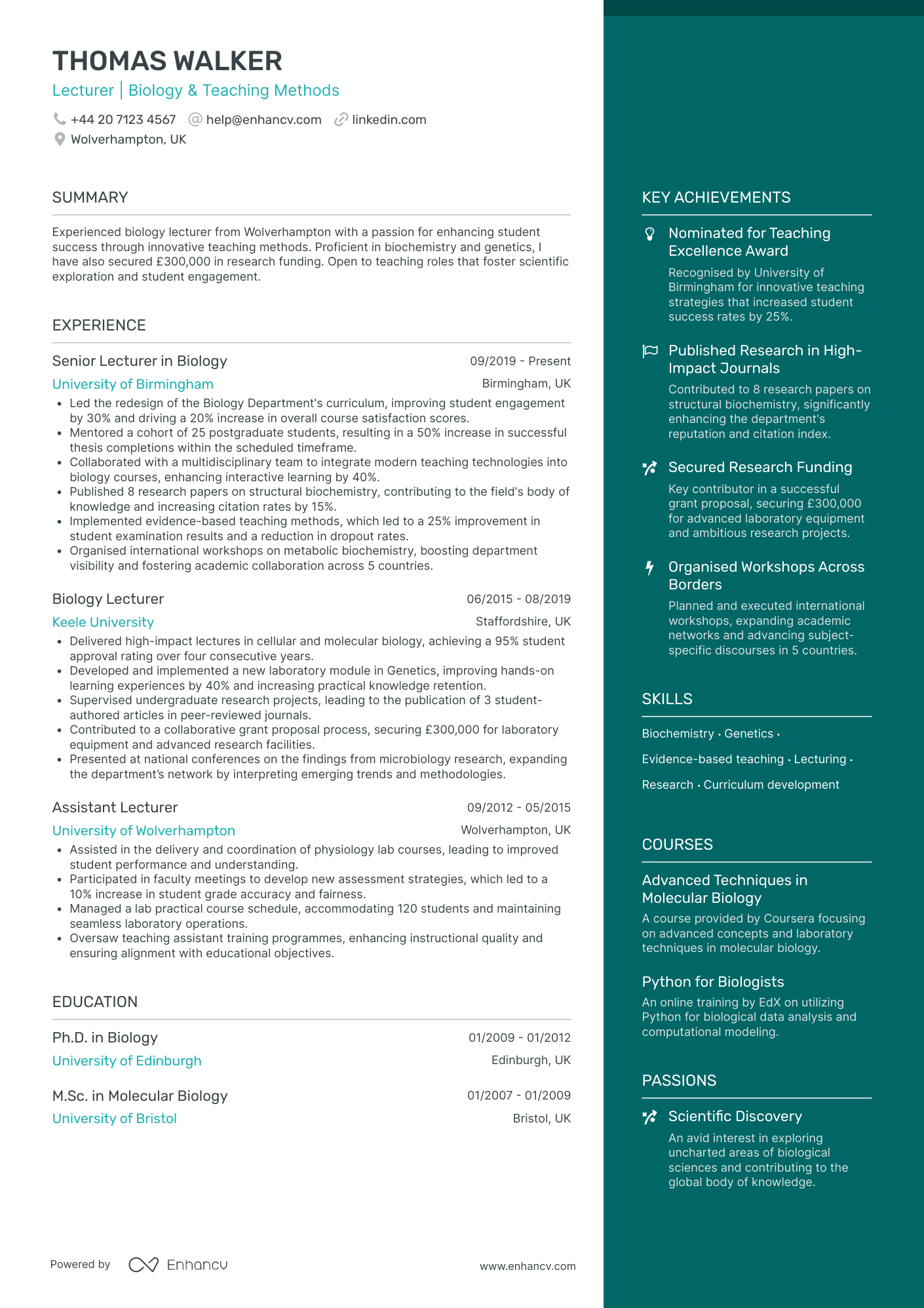
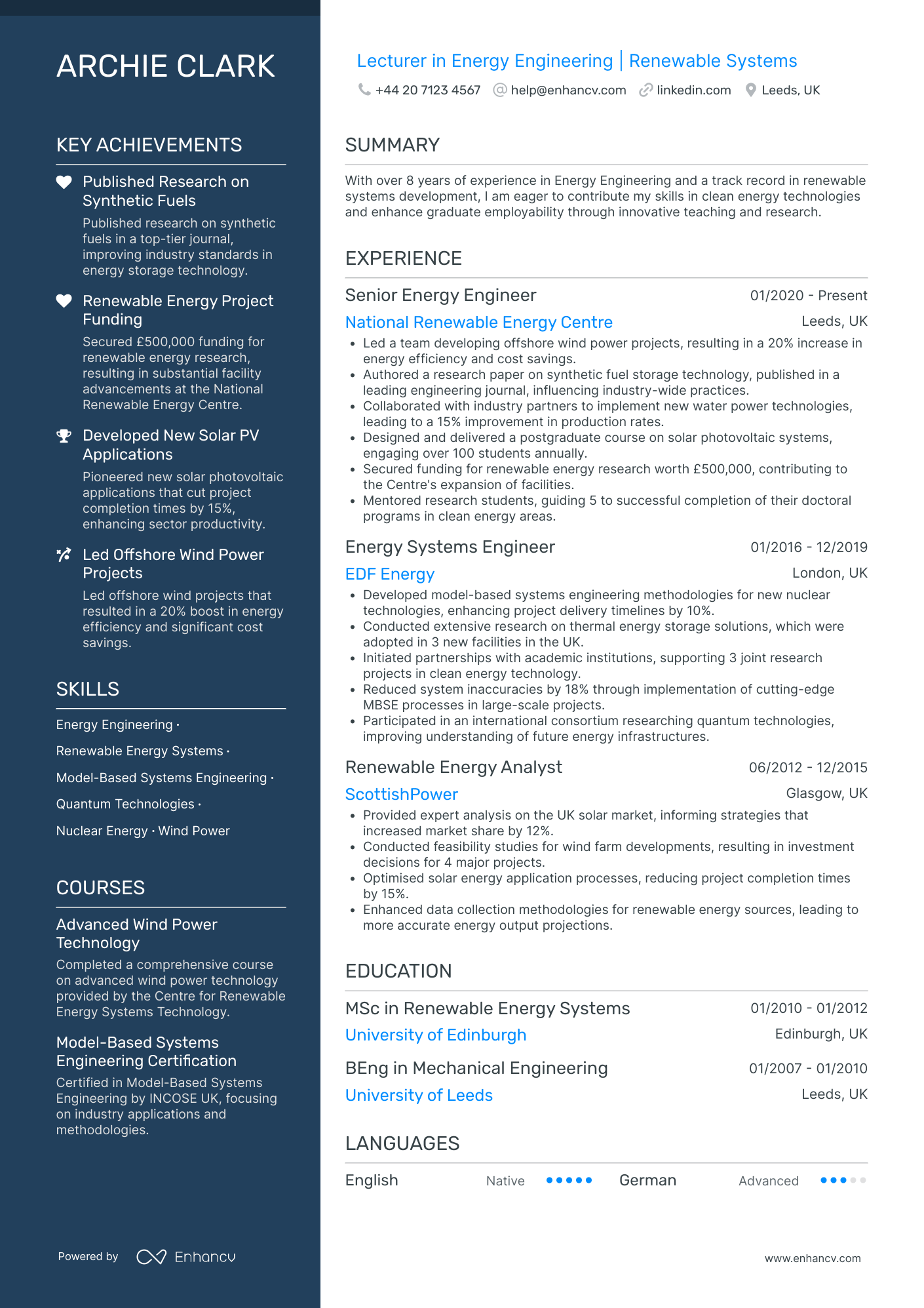
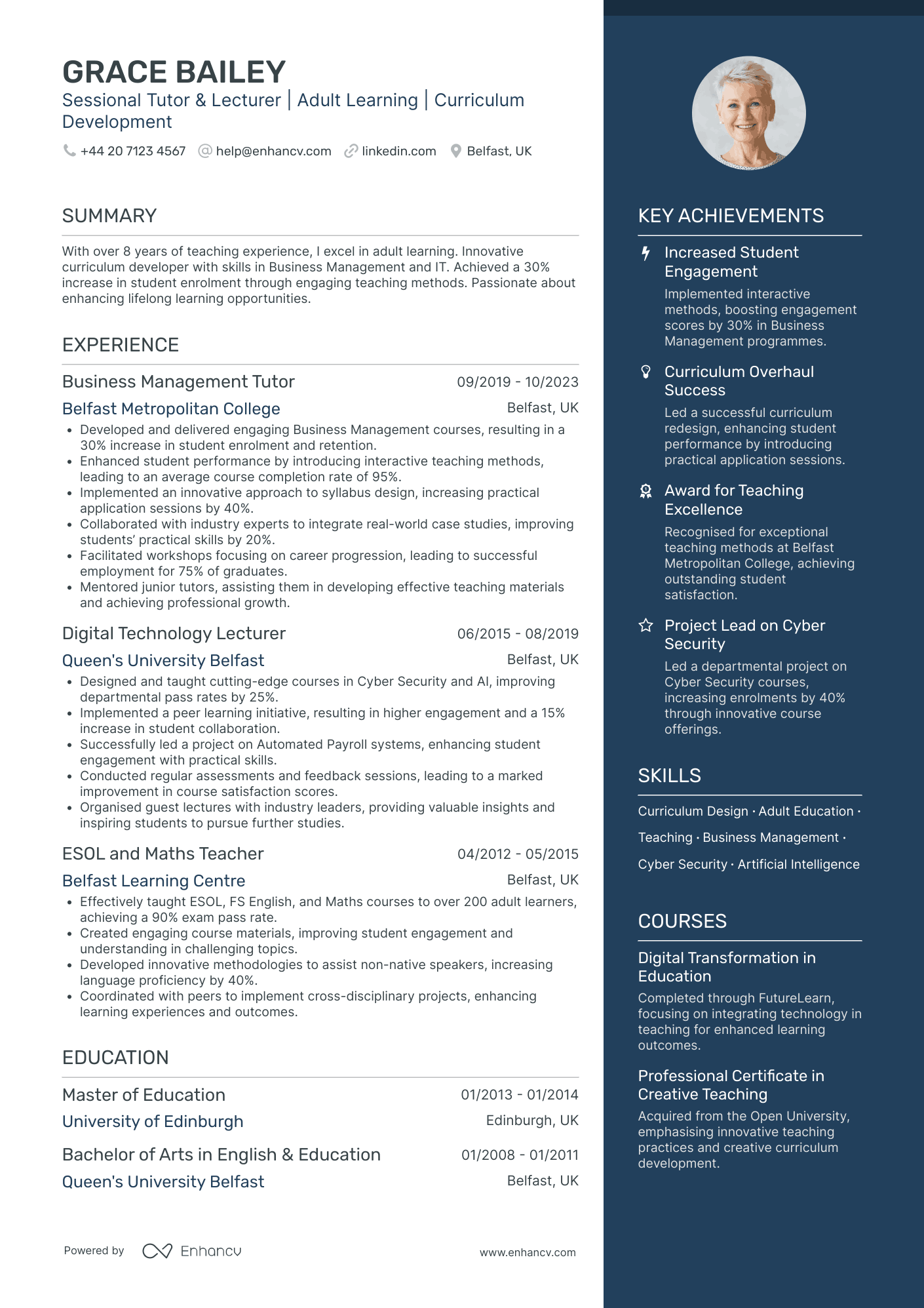
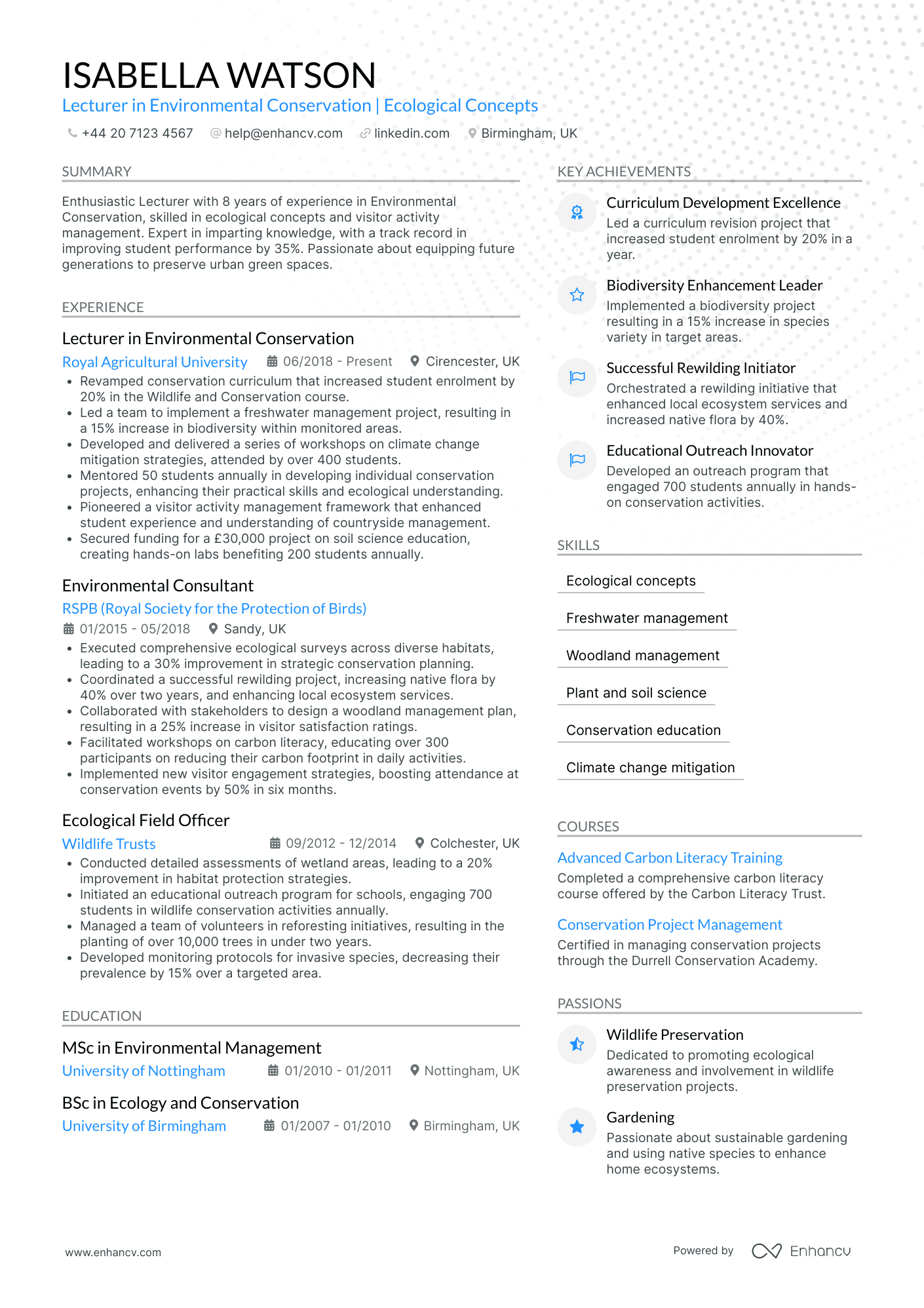
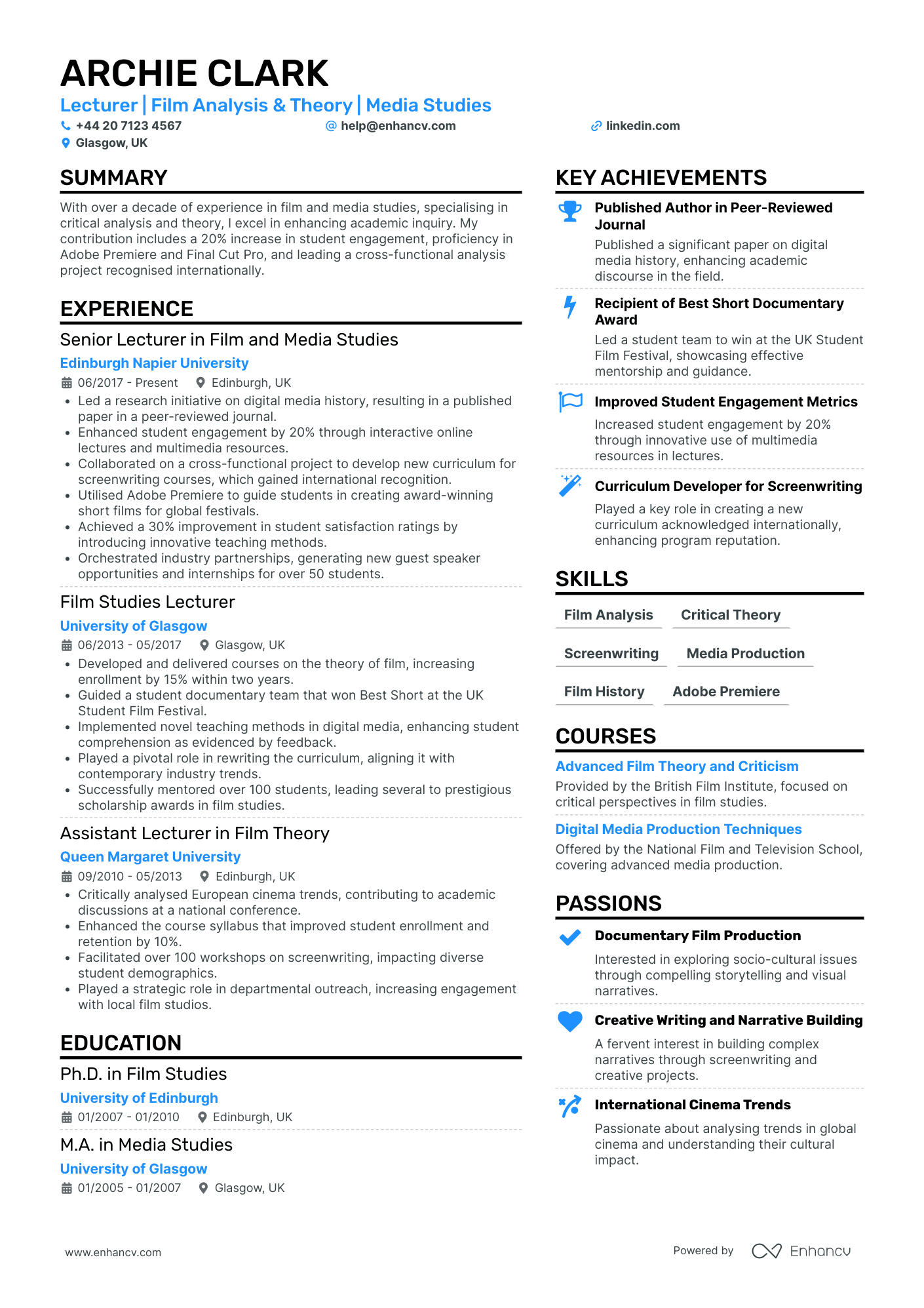
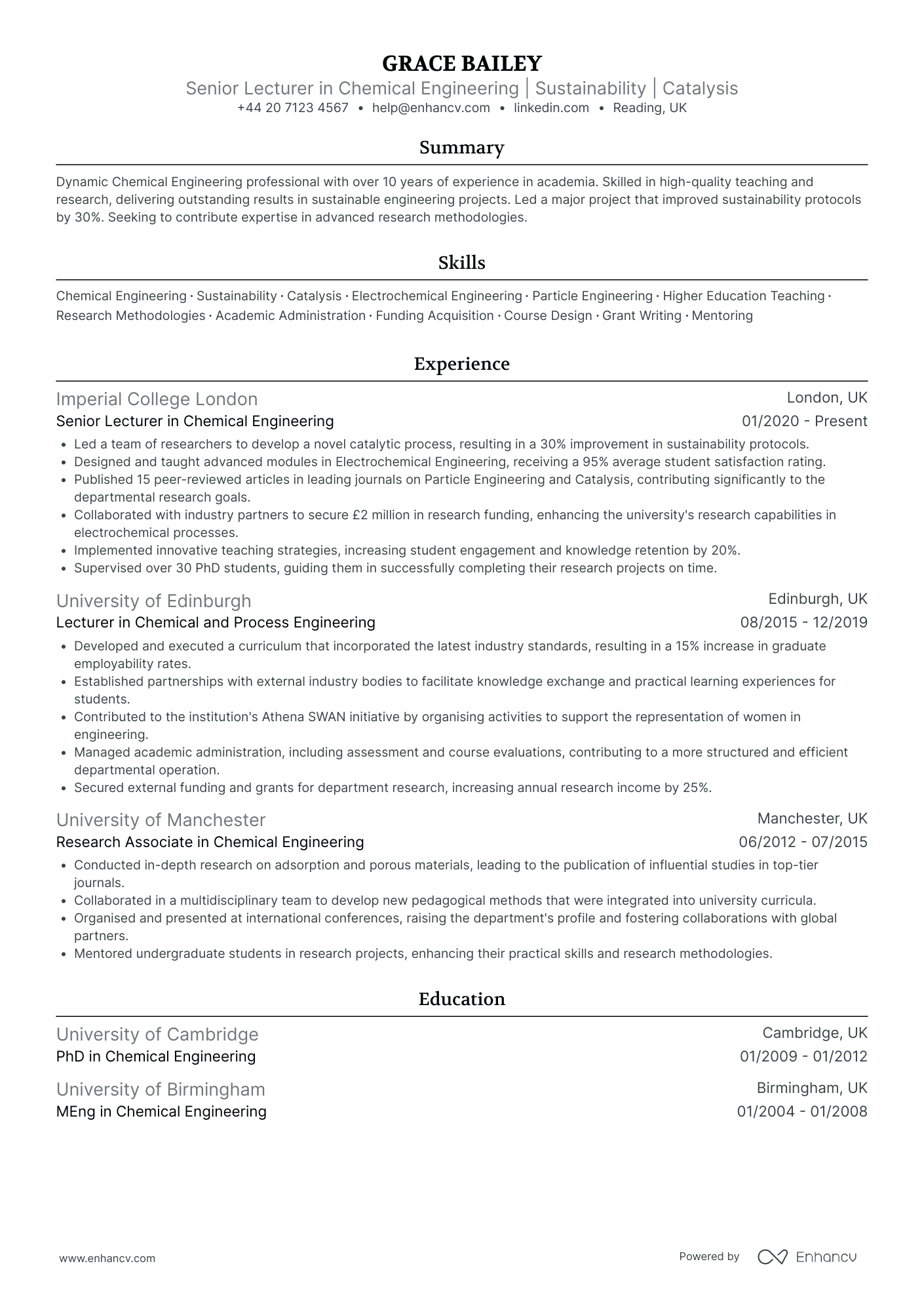
Decide the format first, because it shapes everything else. An academic CV is longer, more detailed, and more structured than the standard two-page CV most UK sectors expect, and it follows a conventional order a panel already knows how to read.
Forget the two-page rule. An early-career lecturer usually runs to three or four pages, and an established academic runs longer once publications and grants accumulate. See how long a CV should be for the standard case, then give yourself permission to go past it here, as long as every line earns its space.
Work in reverse chronological order within each section, newest first. Use one column, standard headings, a readable font, and consistent date formatting so a reader can scan the record quickly.
Read the advert before you fix the order, because a teaching-focused post and a research-focused post reward different first pages. A teaching fellowship wants your modules, class sizes, and student outcomes up top. A research lectureship wants your publications and funding first. The rest of the CV stays the same. Only the running order changes, and that single decision does a lot of the work of tailoring.
Send a PDF for direct applications and email, so the layout holds on any screen. Keep a plain version too, because many universities route applications through an online portal that parses your CV into its own form. If the advert names a file type, follow it.
Those portals often sit on tracking software, so keep the structure clean and the headings standard for an ATS-friendly CV. Build from a tested layout rather than a blank page. Enhancv's CV templates export to a clean PDF and hold up at academic length.
A few details help a longer document stay readable. Add your name and a page number to the footer, keep generous margins, and use the same heading style throughout so a panel never loses its place across six pages. Leave off a photo, date of birth, and marital status. They add nothing a UK panel can act on and only take room the record needs.
What the UK lecturer market looks like
Knowing the market shapes the CV. Here is where lecturer roles sit and what departments ask for most, drawn from live UK postings.
| What | UK lecturer roles |
|---|---|
| Where the work happens | On-site, roughly 84% (109 of 130 UK lecturer postings in the last ~30 days, Enhancv's internal job feed) |
| Experience level asked for | Mid-level 71% · lead 27% · entry and senior 2% (of 130 postings) |
| Skills that recur most | Curriculum development, teaching, student assessment, research, and student supervision |
| Working pattern | Mostly full campus presence, with around 15% hybrid and fewer than 2% fully remote |
Two of those numbers should shape your CV.
Lecturing is overwhelmingly on-site, so a panel needs to see you can be on campus. Put your location near the top and be clear about relocation if the post is in another city.
Most vacancies are pitched at mid-level, which means departments want someone who can run modules independently, not only hold a doctorate. Evidence independent teaching and a clear research trajectory, and the mid-level tilt works in your favour.
Curriculum development, teaching, and student assessment are the skills that recur most often across UK lecturer postings, so mirror that language where it is true of you. Pay is set by grade on national pay spines and varies widely by institution and seniority, so treat any single headline figure with caution and check the specific grade in the advert.
Structuring the sections of an academic CV
An academic CV carries sections a standard CV never touches, and a panel expects each one in a recognisable place.
Your research section states your interests and current projects in a few concrete lines, so a reader in your field knows immediately where your work sits. Name the questions you work on, the methods you use, and where the work is heading next. A vague statement of interests reads as a candidate who has not yet found their focus.
Your teaching section lists the modules you have taught, the level, class sizes, and any module leadership or supervision, because a lectureship is a teaching post first. Note the ones you designed or convened, not just delivered, and add any innovation in assessment or delivery that changed an outcome you can point to.
Your publications section is the heart of a research CV. List full citations in one consistent referencing style, group them by type, and mark peer-reviewed work clearly. Separate journal articles, book chapters, and conference papers so a panel can weigh the record at a glance, and flag anything under review honestly rather than padding the list.
Funding, grants, and awards each get the amount, the funder, your role, and the dates. State plainly whether you were principal investigator or a named collaborator, since panels read that distinction closely.
Conferences and invited talks show reach beyond your own institution, and a short professional development block covers memberships, review work, and any leadership or outreach that rounds out the picture.

A typical academic CV order
Personal details and personal statement, then the blocks a panel came to read:
- Research interests and current projects
- Teaching experience and module leadership
- Publications and conference papers
- Funding, grants, and awards
- Education and qualifications
- Professional membership and development
Move the block the post prioritises to the top. A teaching-focused role leads with teaching, a research post leads with research and publications.

PRO TIP
List your publications in a single, consistent referencing style and mark peer-reviewed work clearly. A panel scans this section fast, and inconsistent citations read as carelessness in the one place academics are trained to be precise.
Writing your lecturer personal statement
Three or four sentences at the top: who you are, your research area, how you teach, and why this department. See more personal statement examples if the opening line is hard to start.
Skip the adjective soup. "A passionate, dedicated, and hardworking academic with excellent communication skills" tells a panel nothing it can check, and it reads the same on every CV in the pile.
Lead with evidence a reader can verify: your discipline, your degree, one line on how you teach, and one on the research that defines you. Then name the department and its focus so the fit is obvious rather than assumed.
Match the emphasis to the post. If the advert leans towards teaching, open on your teaching record and philosophy. If it leans towards research, open on your field and output. The example below is written for a research-led department.
Lecturer CV personal statement example
Education researcher and lecturer with a PhD in Sociology and five years of teaching across undergraduate and postgraduate modules. Fellow of Advance HE, with a record of module leadership, four peer-reviewed publications, and £60,000 in secured research funding. Looking to bring active, research-led teaching to the Department of Social Sciences at Northgate University, where my work on educational inequality aligns with the group's widening-participation agenda.
When we review a lecturer CV, the first thing we check is whether the teaching and research records are easy to find and easy to verify. A panel wants to see modules you have led, students you have supervised, and papers a reader can look up, laid out in the order they read them. Length is rarely the problem. A thin record dressed up in long paragraphs is. Give the evidence room, cite it precisely, and put the block the post cares about first.
Writing your lecturer experience section
Write each post the same way: a dated heading, then bullets that show what you did and what changed. Lead every bullet with a strong verb. For the mechanics, see work experience on a CV.
Academic work is more measurable than it feels. Student numbers, module pass rates, satisfaction scores, funding secured, and papers published are all achievements a panel can weigh.
Tailor each application to the advert, mirroring the modules and research areas it names where they are true of you. Enhancv's CV tailoring feature reads the advert and suggests the matching edits, which saves rewriting from scratch for every institution.
- Lead three undergraduate modules of up to 120 students, redesigning the assessment structure and lifting average pass rates from 78% to 89% over two years
- Supervise 8 final-year dissertation students and 2 postgraduate researchers, all completing on schedule
- Secured a £45,000 research grant as principal investigator and published four peer-reviewed articles across the period
- Introduced a blended learning approach to the core module, raising student satisfaction scores from 3.9 to 4.5 out of 5
- Delivered seminars and lectures across two first-year modules totalling 200 students, under the module convener's direction
- Marked and moderated more than 400 scripts a year, feeding into a standardised rubric adopted across the department
- Co-supervised 5 undergraduate dissertations to completion, three graded first class
- Presented at two national conferences and co-authored a peer-reviewed article drawn from the department's research group
PRO TIP
Numbers make an academic record legible. "120 students", "pass rate up 11 points", "£45,000 grant as principal investigator", "4 peer-reviewed papers". One verifiable figure per bullet beats a paragraph of duties.
Skills to put on a lecturer CV
Read a run of live lecturer adverts and the same demands repeat. Curriculum development, teaching, and student assessment come up most often, alongside research, student supervision, and pastoral care. Those are your hard skills, listed in the words the adverts use.
The soft skills that matter here are real and checkable: communication, mentoring, and collaboration. Prove each one in a bullet rather than claiming it.
List only what you can stand behind, and put anything still in progress, such as a teaching qualification, under development rather than skills.
Top skills for your lecturer CV:
Curriculum development
Teaching and lecturing
Student assessment
Research and publication
Student supervision
Module design
Academic tutoring
Pastoral care
Communication
Mentoring
Collaboration
Time management
Adaptability
Education and qualifications for a lecturer CV
A doctorate is the baseline for most permanent lectureships, and many adverts accept a PhD near completion for early-career posts. List it first in your education section, with your thesis title and supervisor where relevant.
A teaching qualification carries real weight. A Postgraduate Certificate in Higher Education (PGCHE) and Fellowship of Advance HE (AFHEA or FHEA) signal you can teach, not only research, so list these qualifications clearly.
Add professional memberships and relevant training in a short block. Naming any certificates you hold saves a panel a question.
Keep this section tight even when your qualifications are extensive. A panel reads it to confirm you meet the bar, then moves back to your research and teaching, so a clean list beats a page of detail here.
Writing a lecturer CV with no experience
Few people walk into a first lectureship with a full teaching record, and panels know it. If you are a PhD researcher, graduate teaching assistant, or postdoc, your first CV carries its weight differently.
Use a teaching-led and research-led structure, so what you have done sits at the top. A skills-led structure gives you the shape, and it helps to treat this like your first academic CV rather than a thin version of a senior one.
Mine your postgraduate years for real evidence. Seminar teaching, guest lectures, marking, dissertation supervision, and conference presentations all count, as do any papers from your thesis. Write each one up with the same specifics a senior candidate would use, so a reader sees a teacher and researcher forming rather than a student.
Give your research a proper section even if the publication list is short. A well-defined thesis, a clear research agenda, and one or two outputs under review show a trajectory, and panels hiring at entry level are buying potential as much as track record.
One line lifts an early-career CV: an Associate Fellowship of Advance HE, or a PGCHE in progress. It signals you are already on the teaching path, which is often the gap a first-time applicant most needs to close.
Conclusion
Lead with format, give research, teaching, and publications the room they need, and order the sections the way the post reads them.
Mirror the language departments repeat, keep the record precise and verifiable, and pair the CV with a focused cover letter that says why this department.
Author's take - The Enhancv team
When we review a lecturer CV, the first thing we check is whether the teaching and research records are easy to find and easy to verify. A panel wants to see modules you have led, students you have supervised, and papers a reader can look up, laid out in the order they read them. Length is rarely the problem. A thin record dressed up in long paragraphs is. Give the evidence room, cite it precisely, and put the block the post cares about first.