



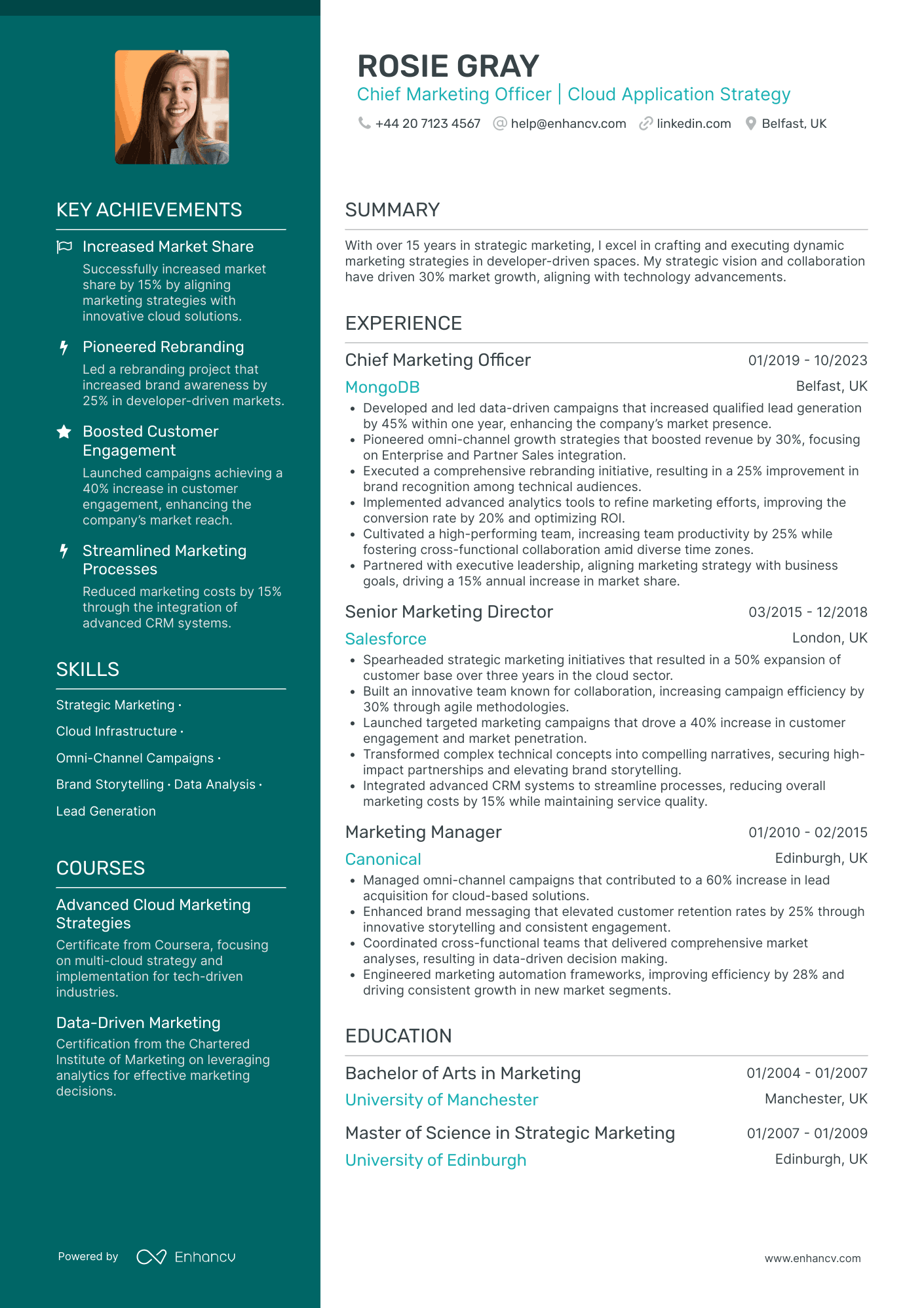
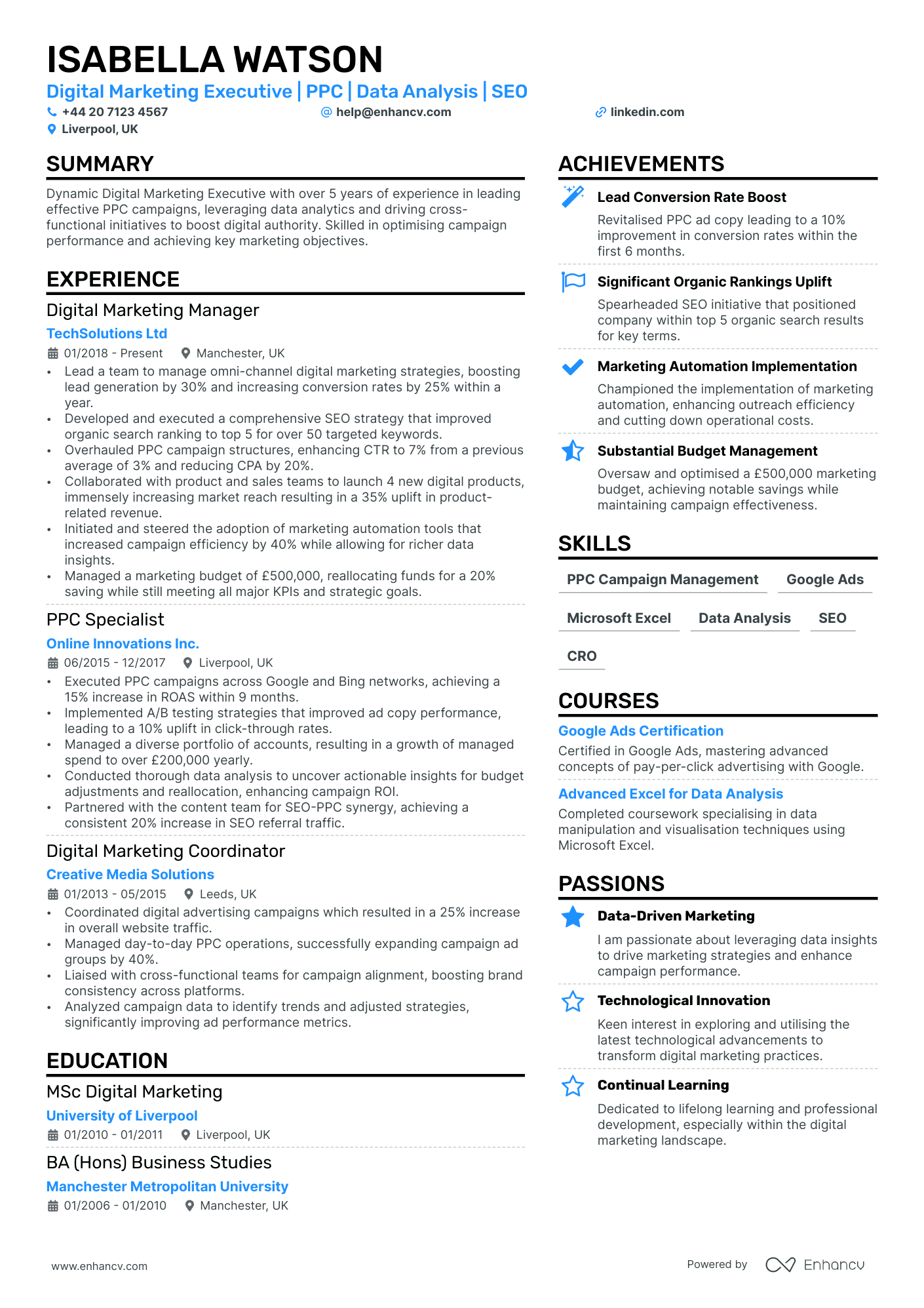
Most digital marketing CVs list the channels someone has touched and stop there. SEO, PPC, email, and social all present, none of them tied to a result a hiring manager can measure.
The CVs that win interviews do the opposite. They lead with campaigns that moved a real number, laid out so a busy marketing lead can find that number in seconds. Get the format right and every other section has somewhere to land.

Key takeaways
- Lead with results, not channels. One campaign that moved a metric beats a list of tools you have logged into.
- Analytics and SEO are the skills UK adverts ask for most, so name them early and back each with evidence.
- Two pages, reverse chronological, sent as a PDF unless the advert asks for a Word file.
- Most UK digital marketing roles are hybrid or on-site, so put your town in the header.
- Link one portfolio or campaign write-up near the top, not buried at the bottom.
- Quantify everything you can: traffic, conversion rate, ROAS, list growth, and cost per lead.
Formatting your digital marketing CV
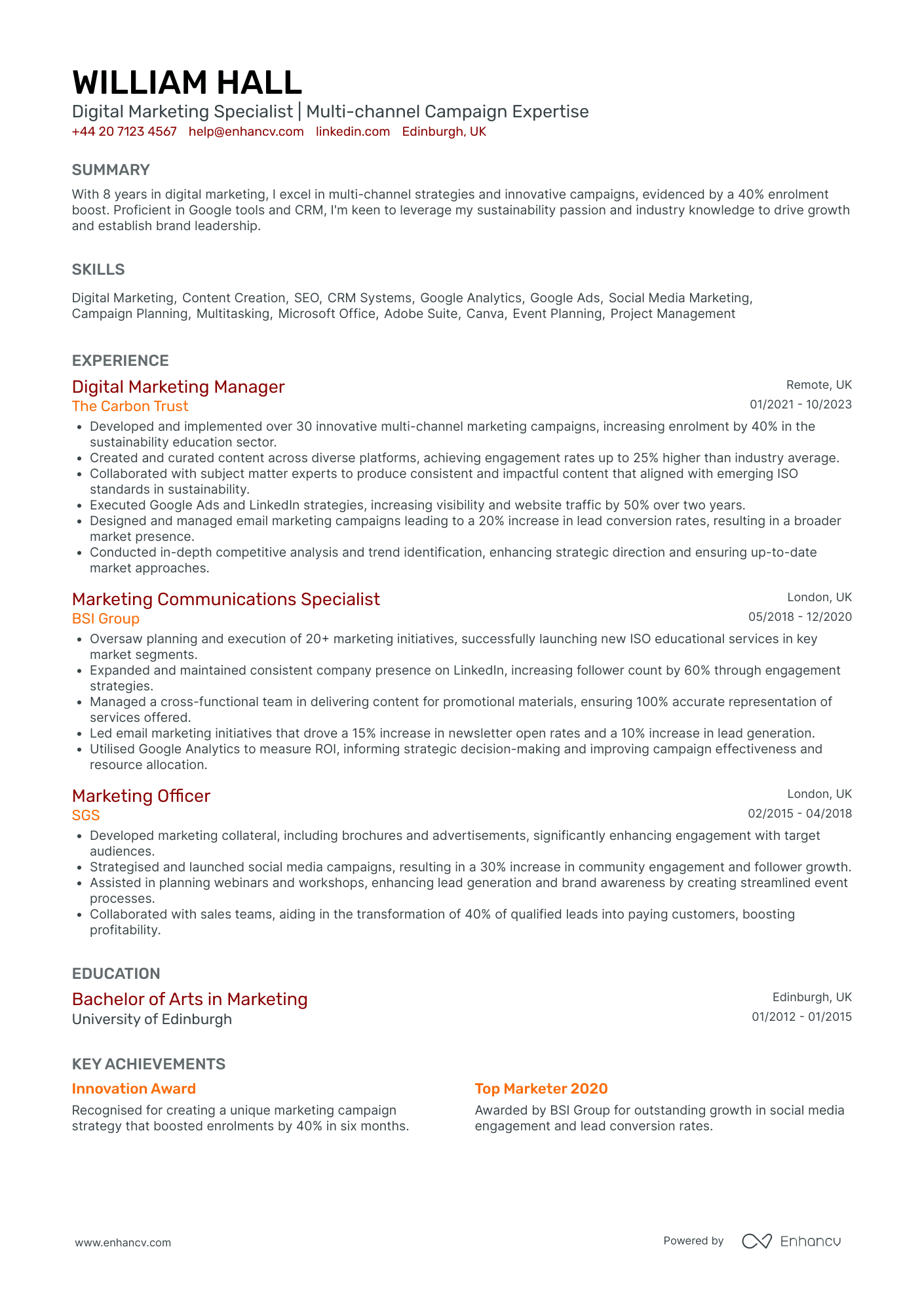
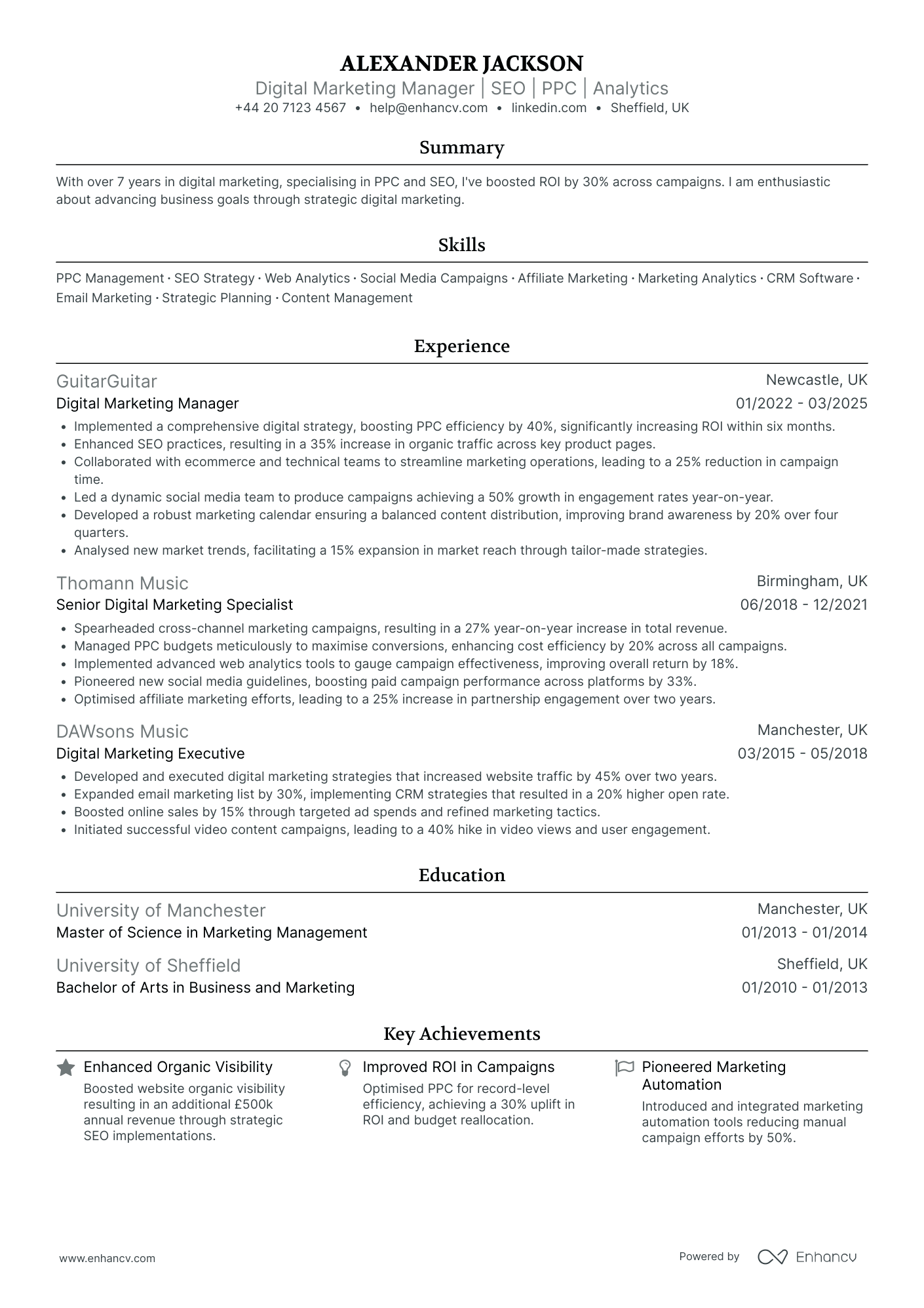
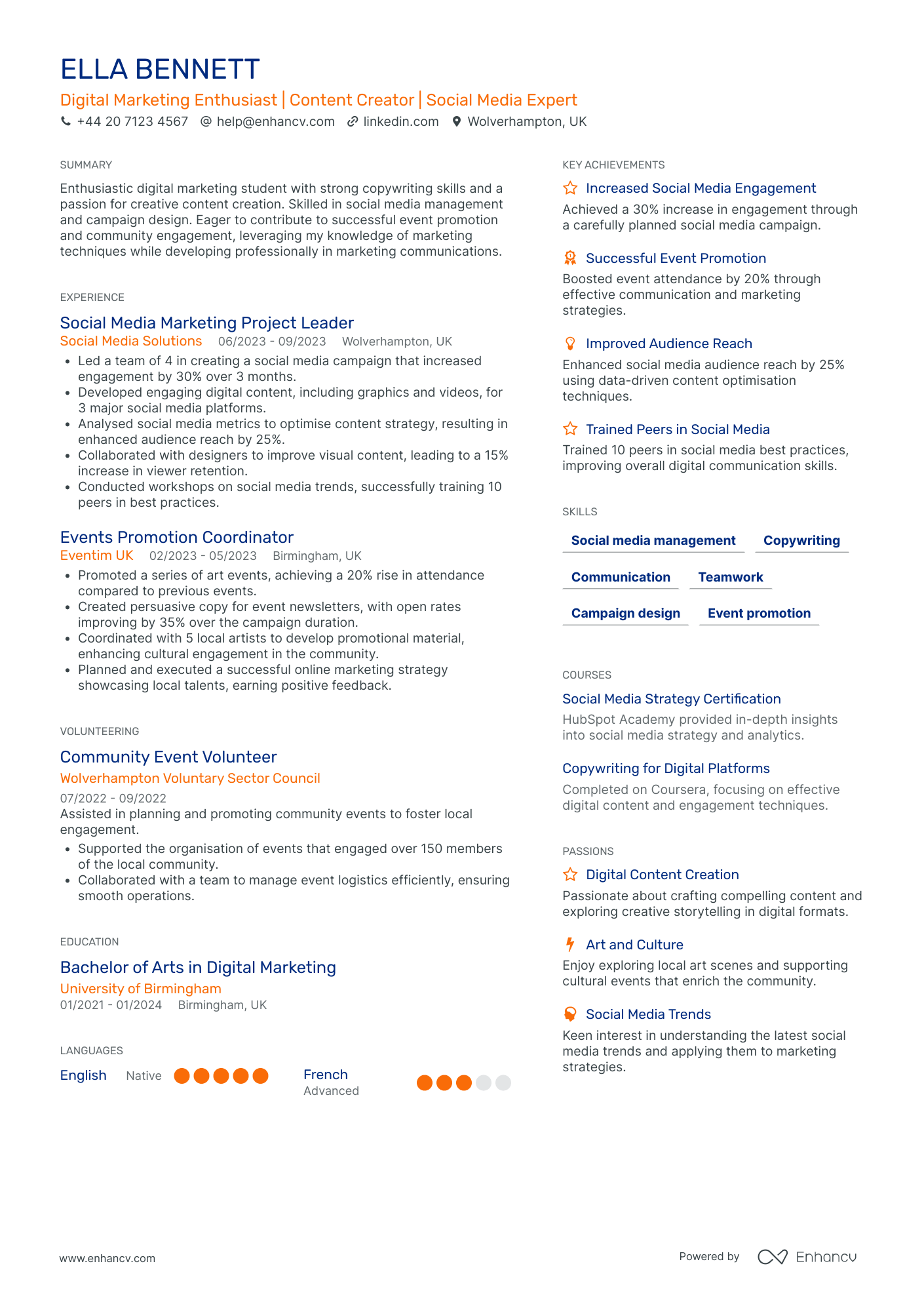
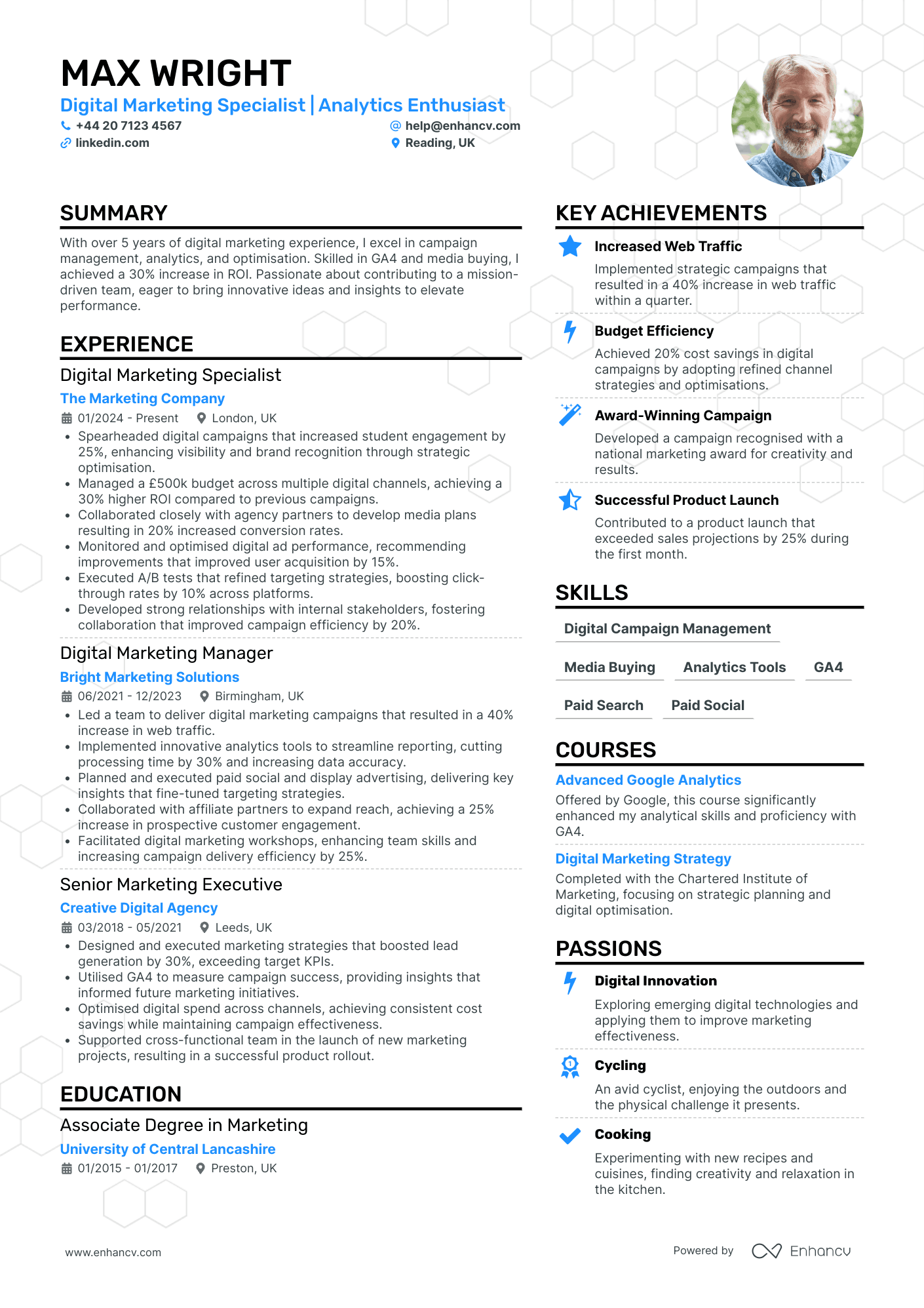
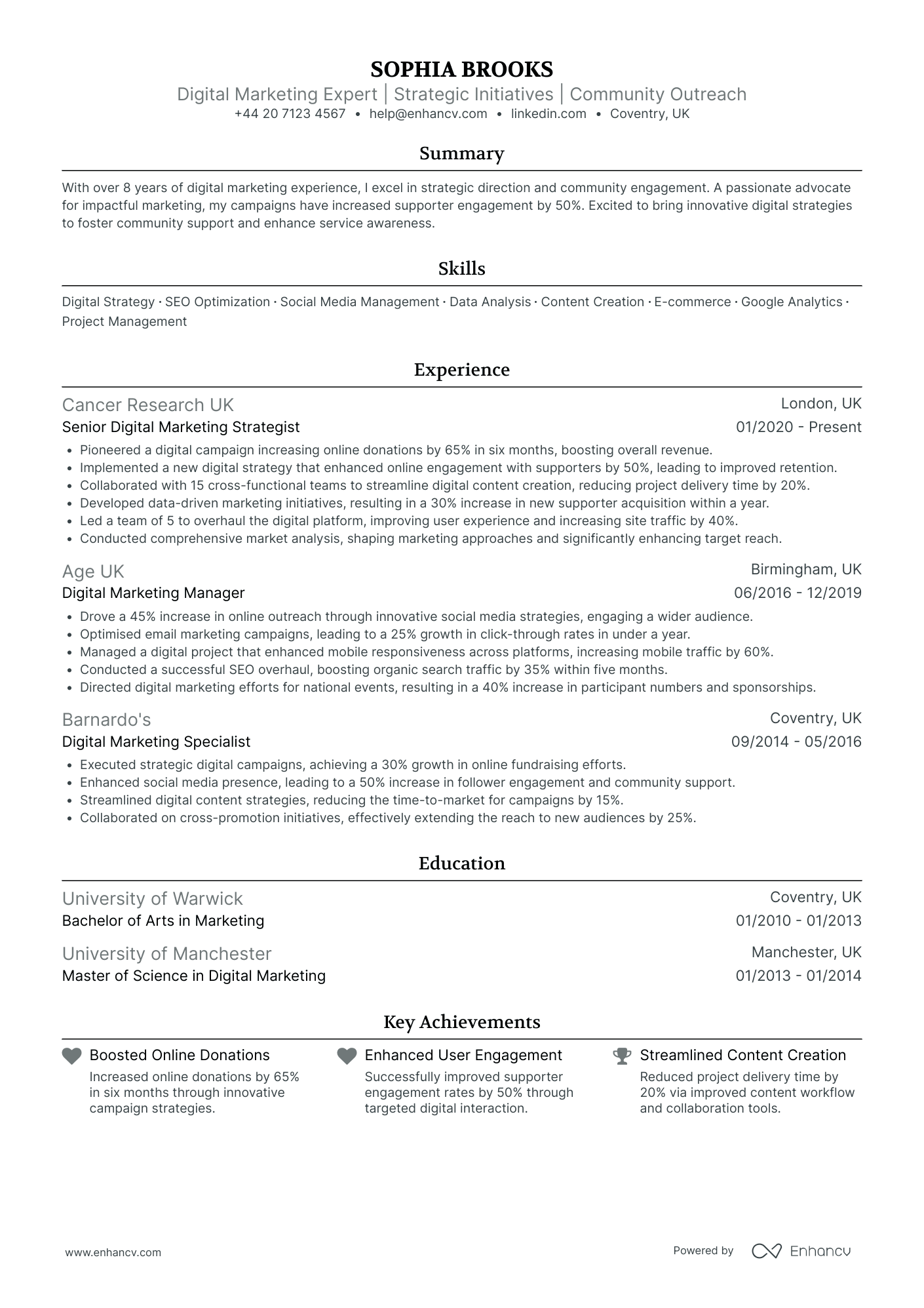
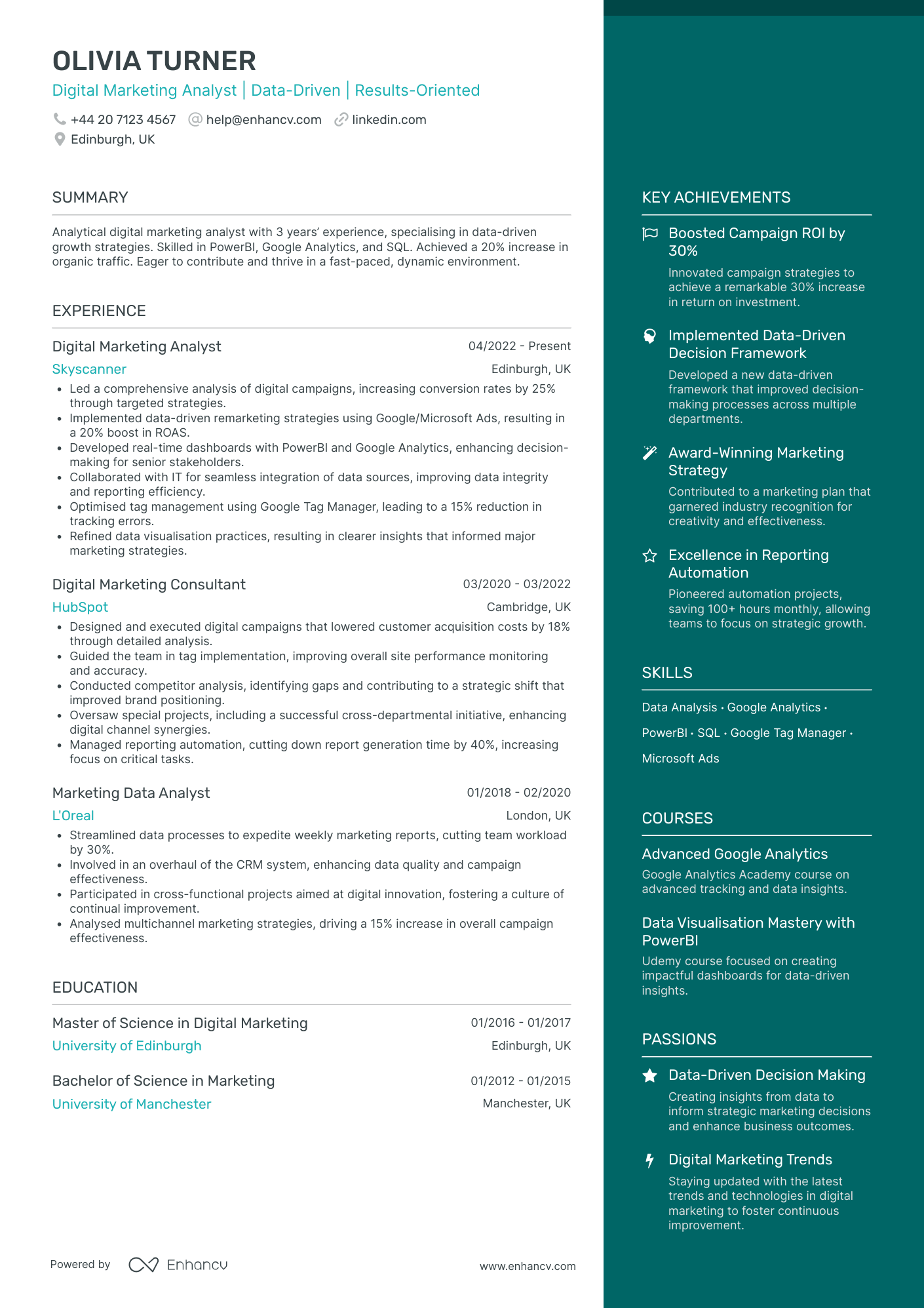
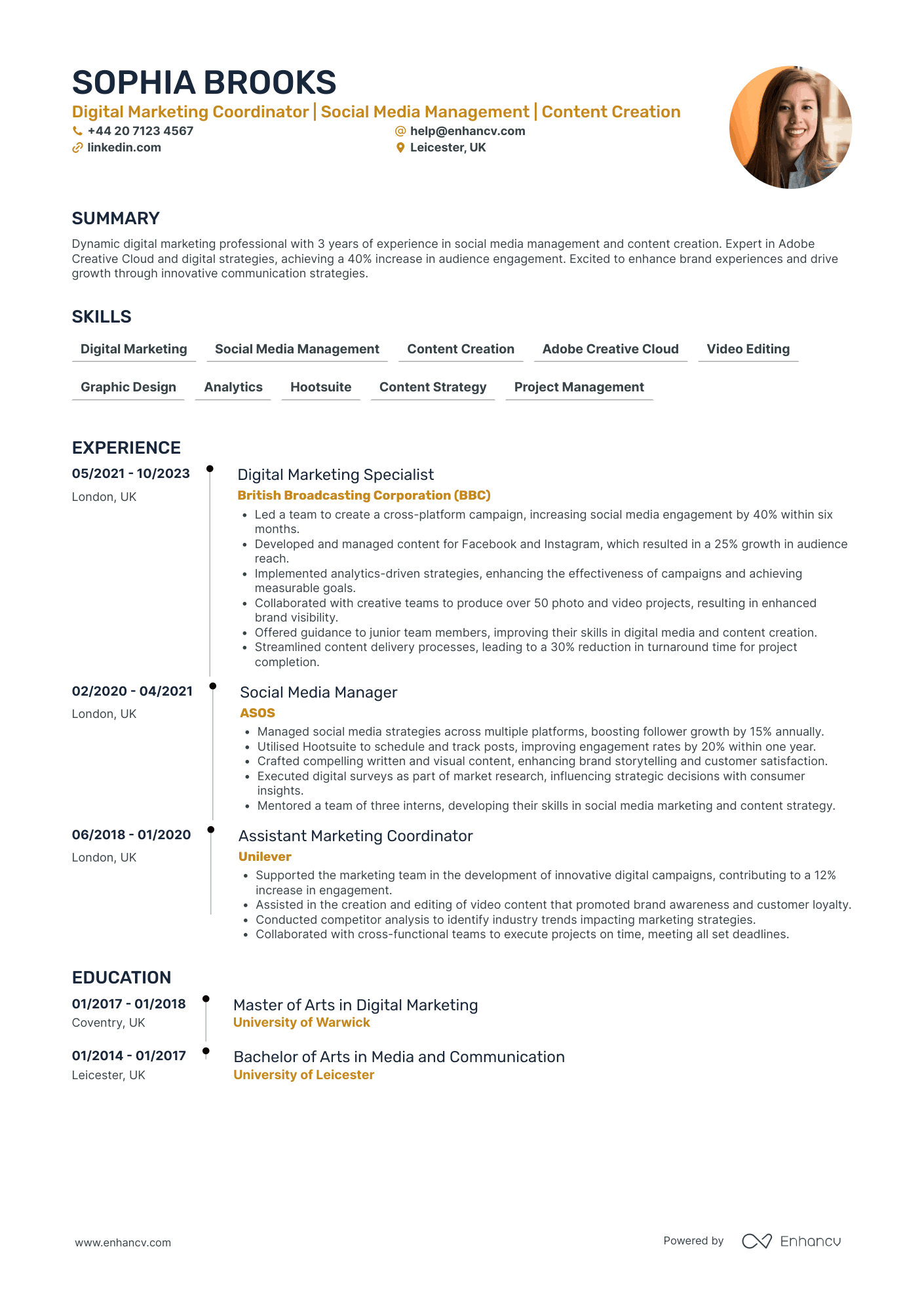
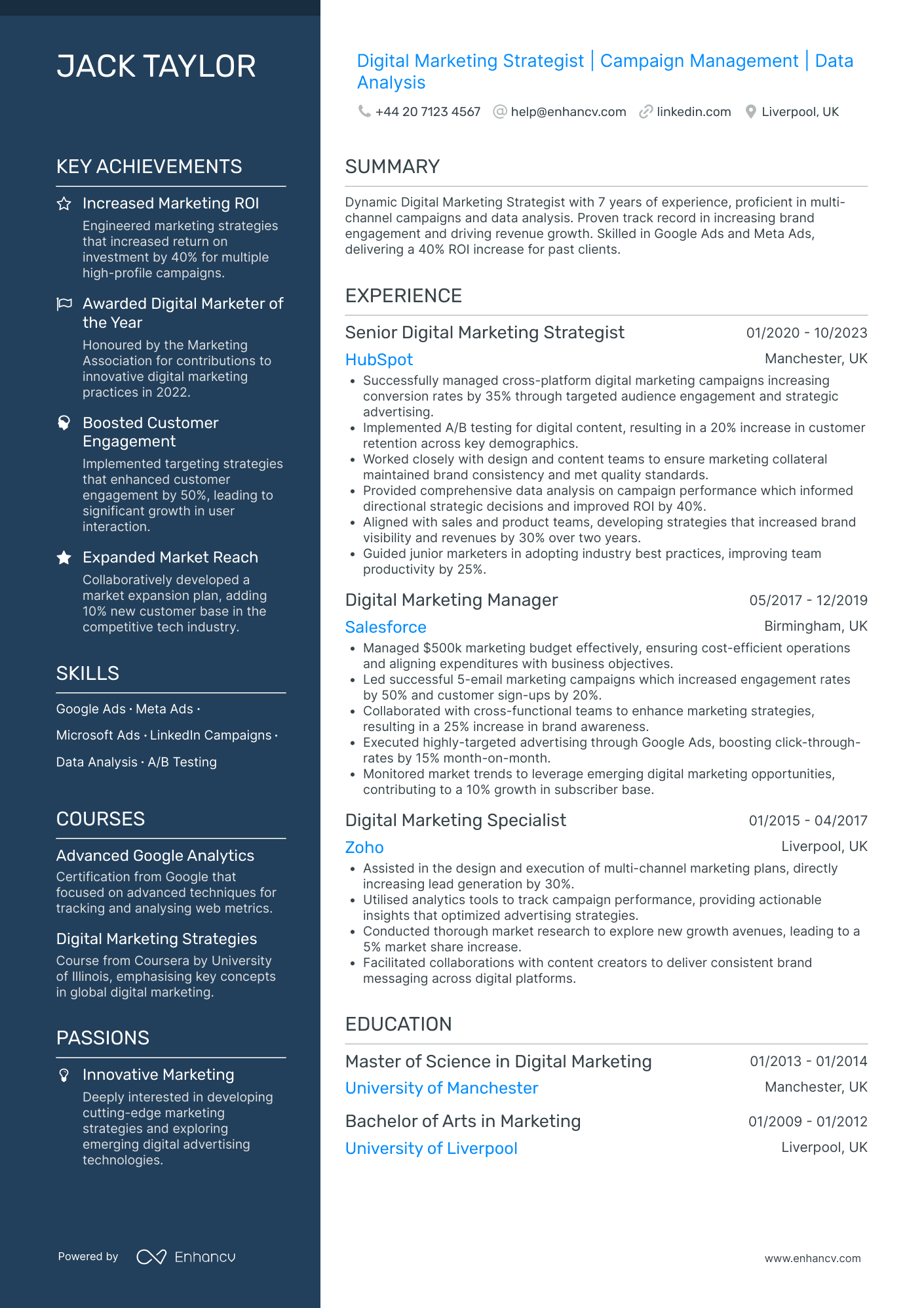
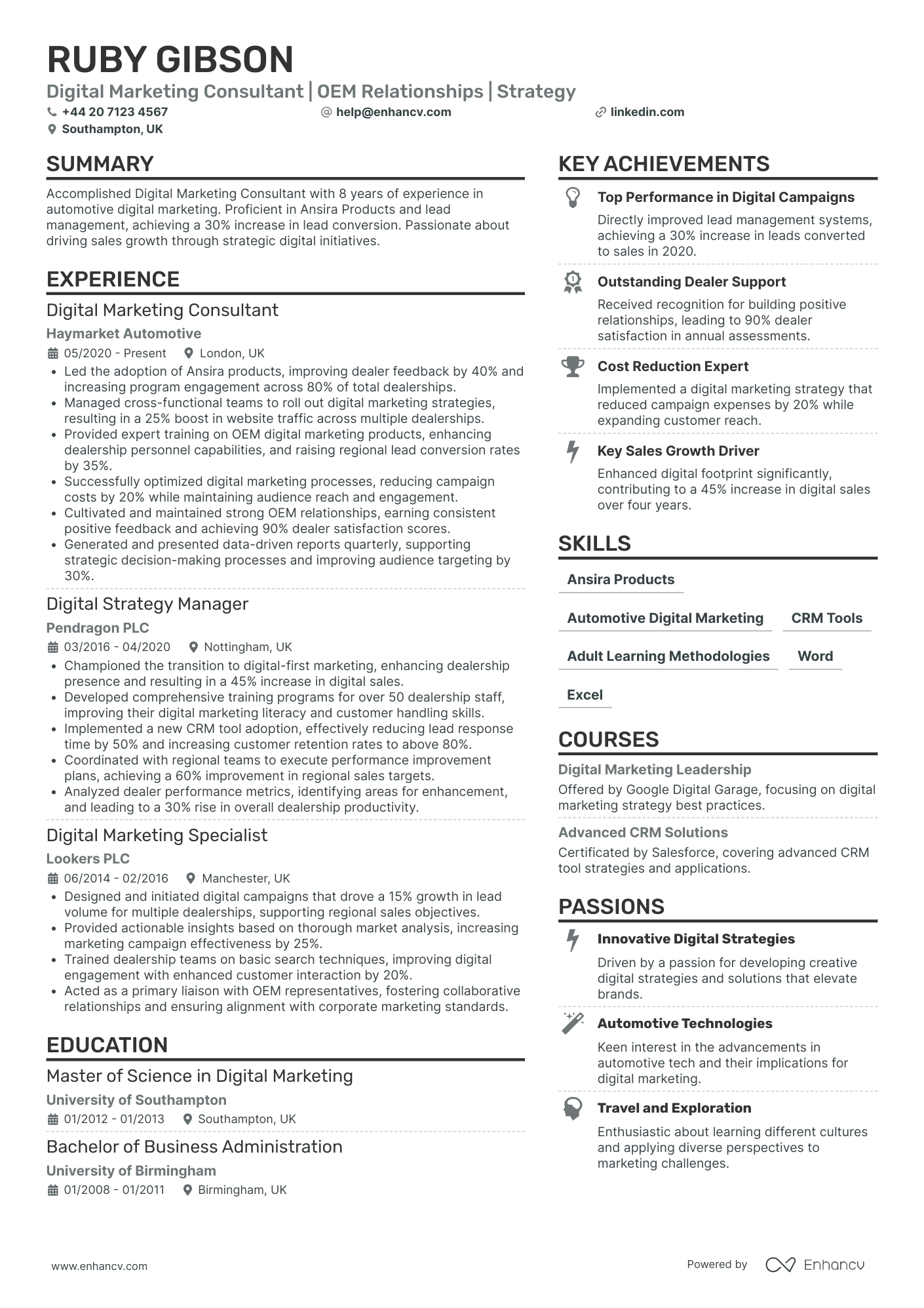
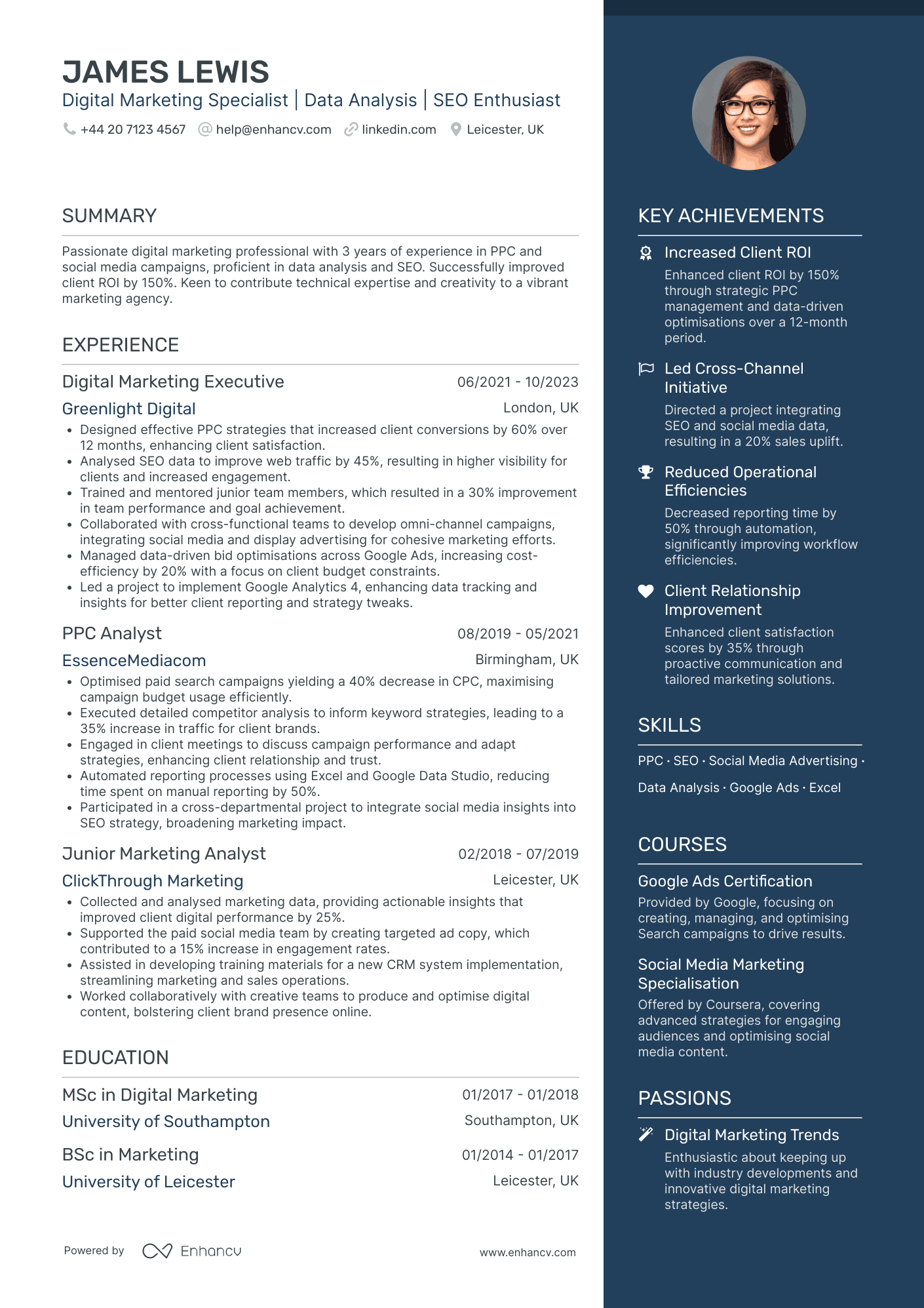
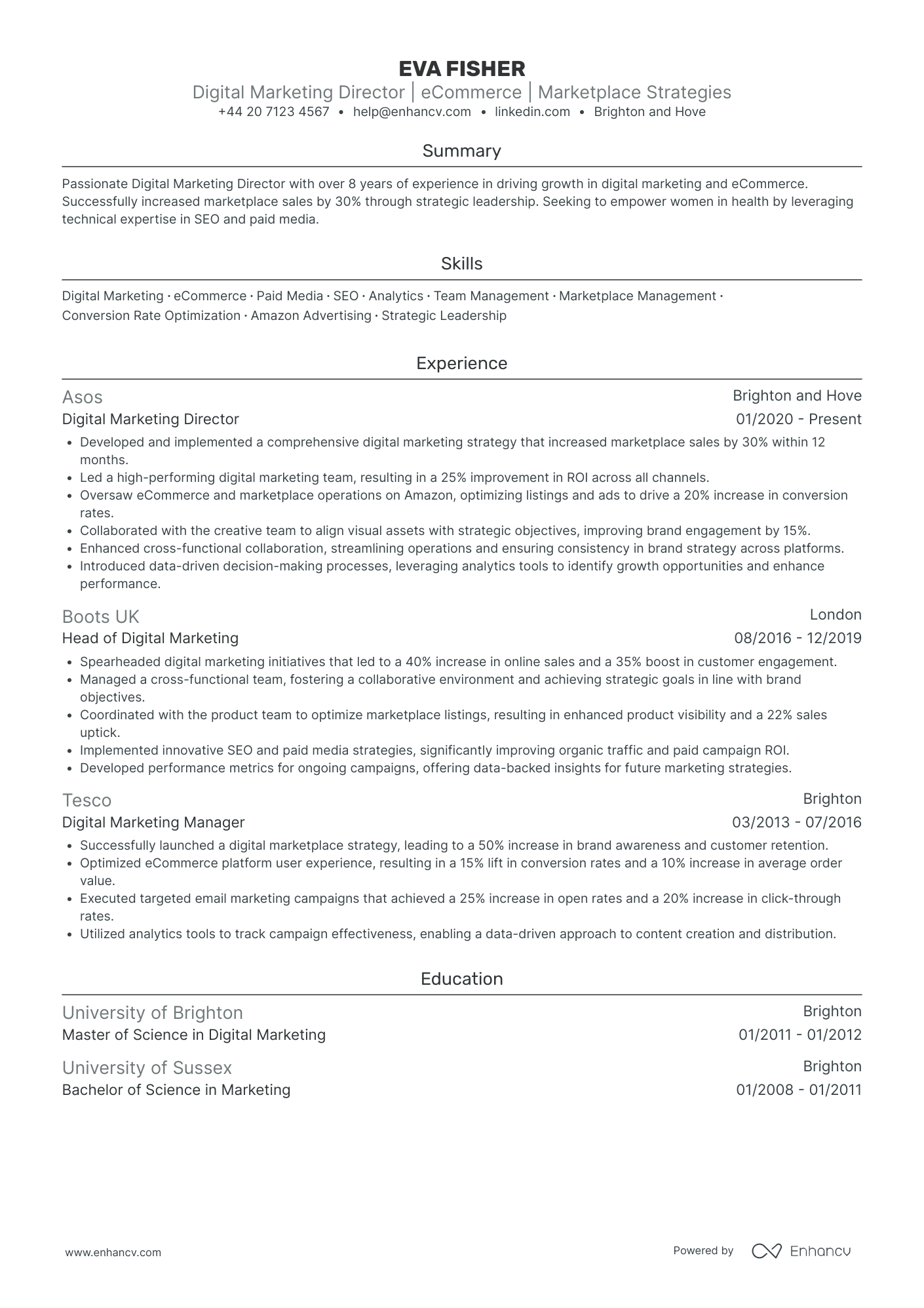
Start with structure, because a strong campaign buried in a messy layout still gets skimmed past. If you have a couple of roles behind you, use reverse chronological order so your most recent results sit at the top. For the fundamentals, see how to write a CV.
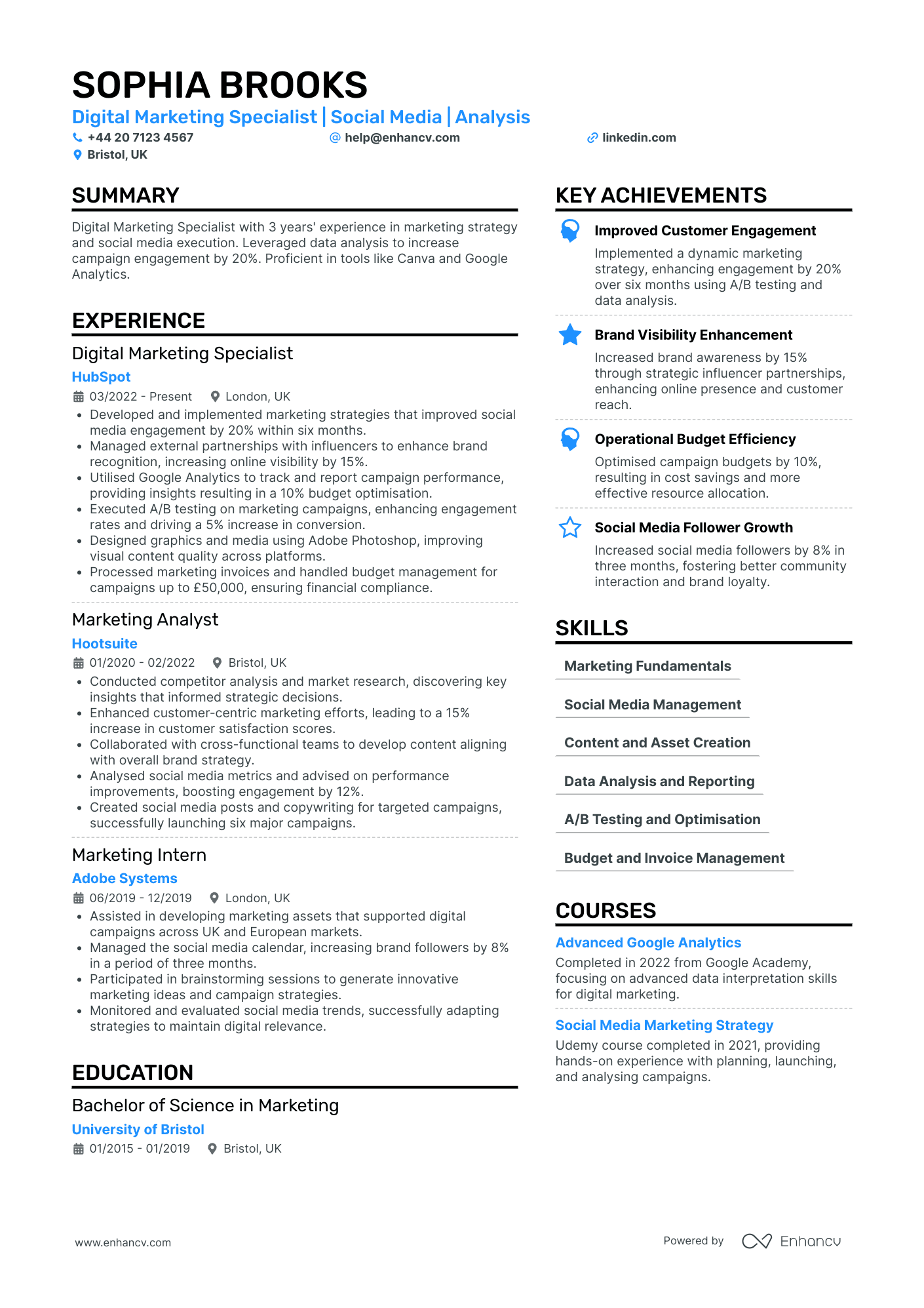
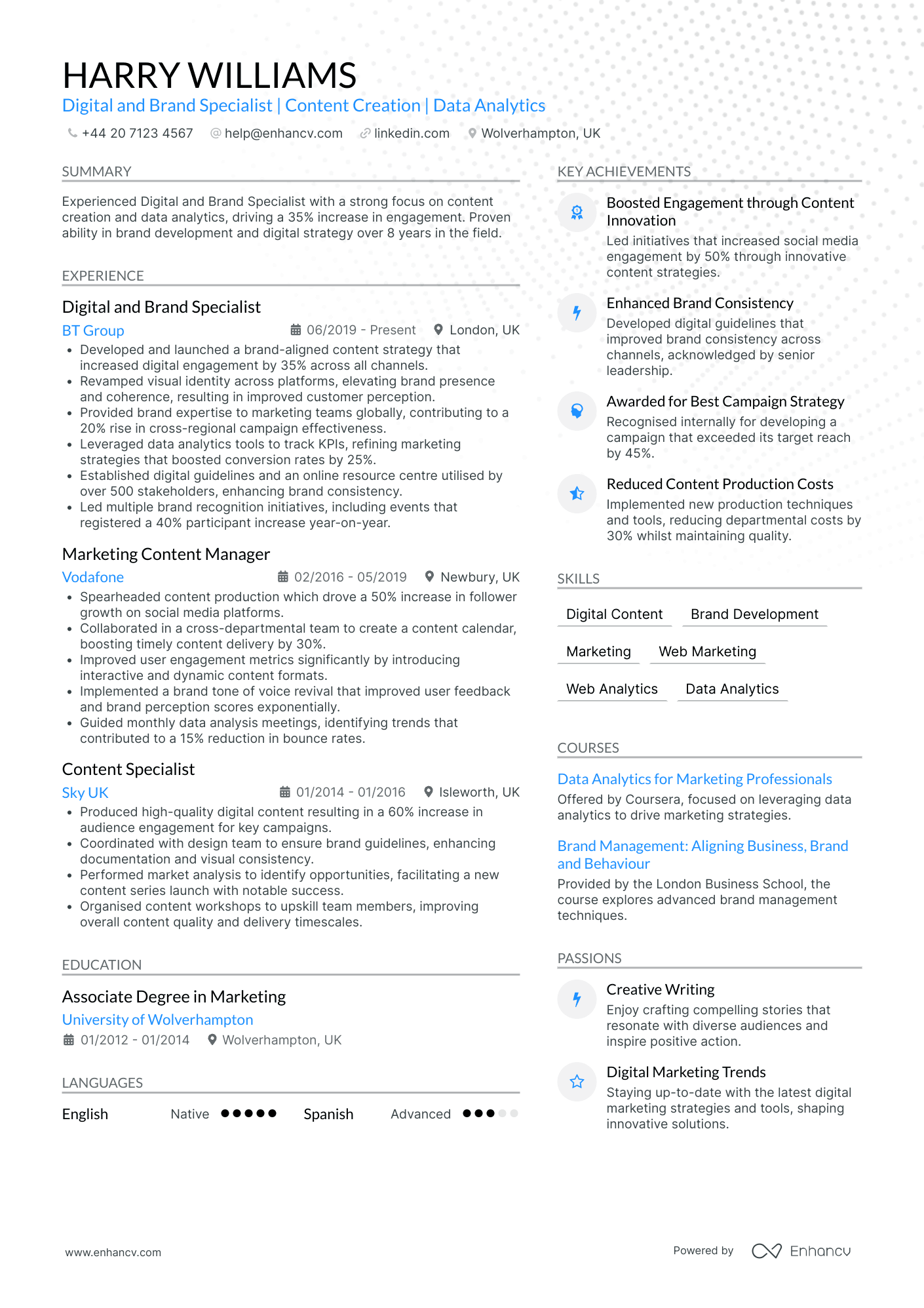
If you are early on or moving in from an adjacent field, a skills-based structure lets your skills and projects lead while your work history sits lower down.
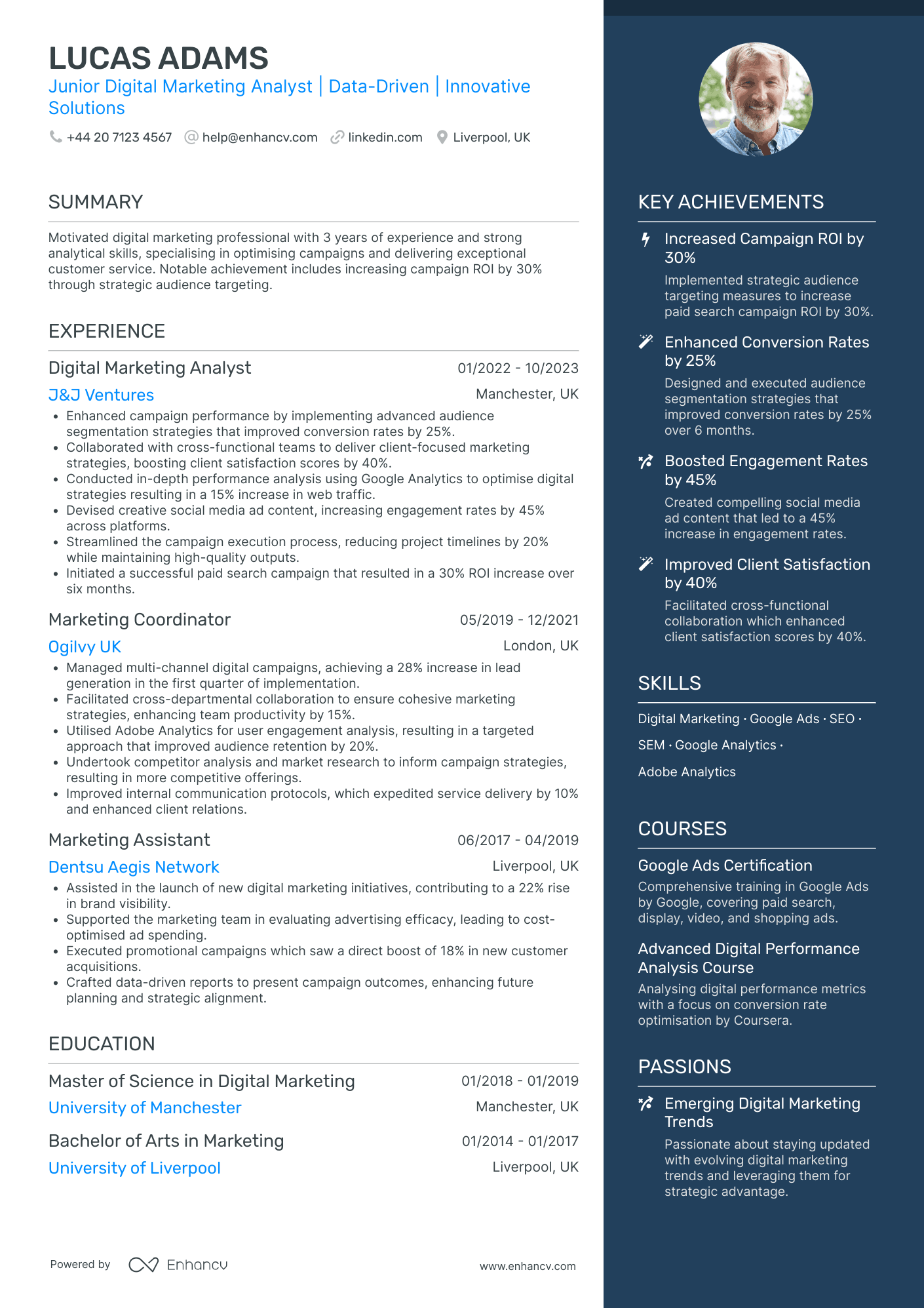
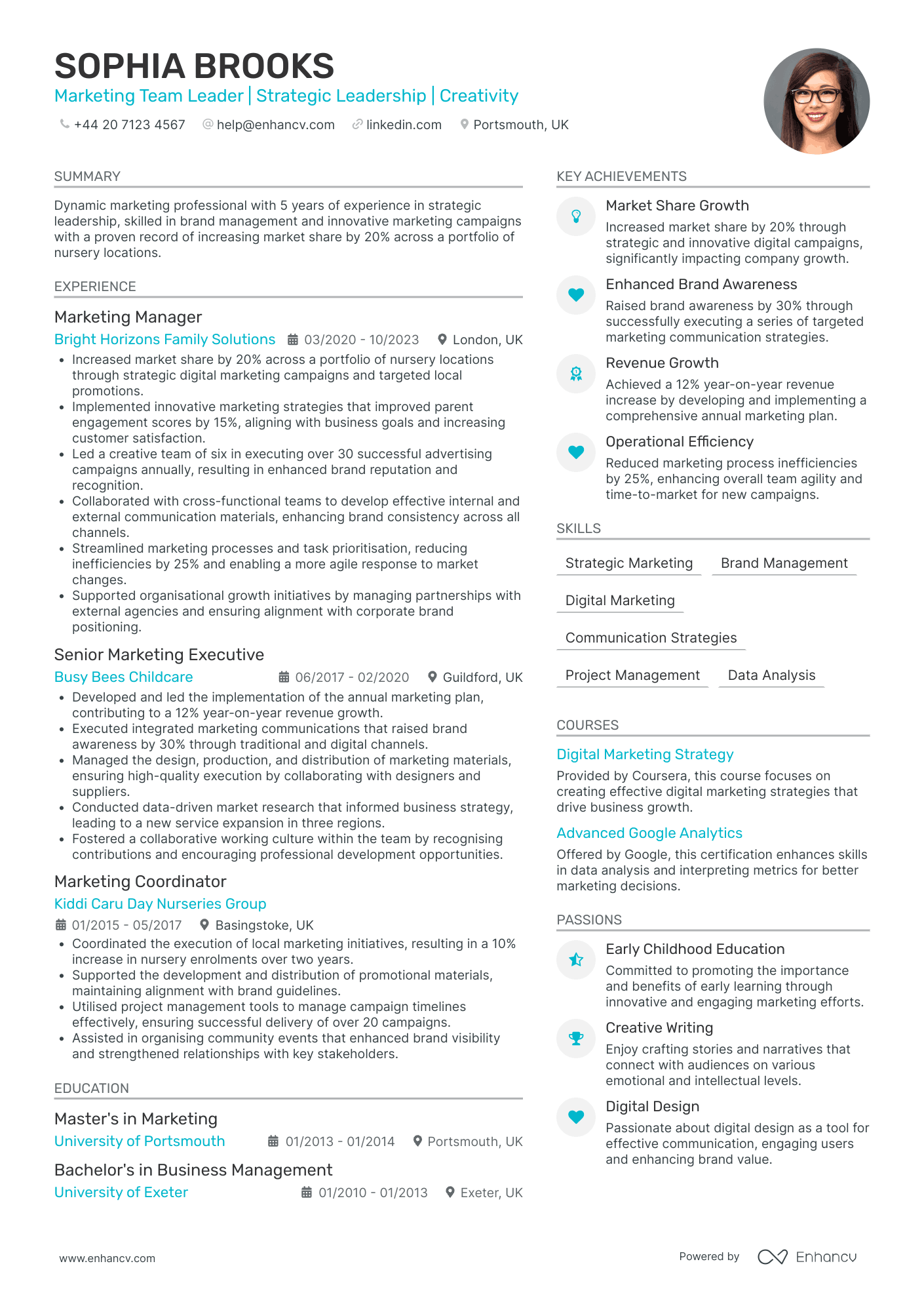
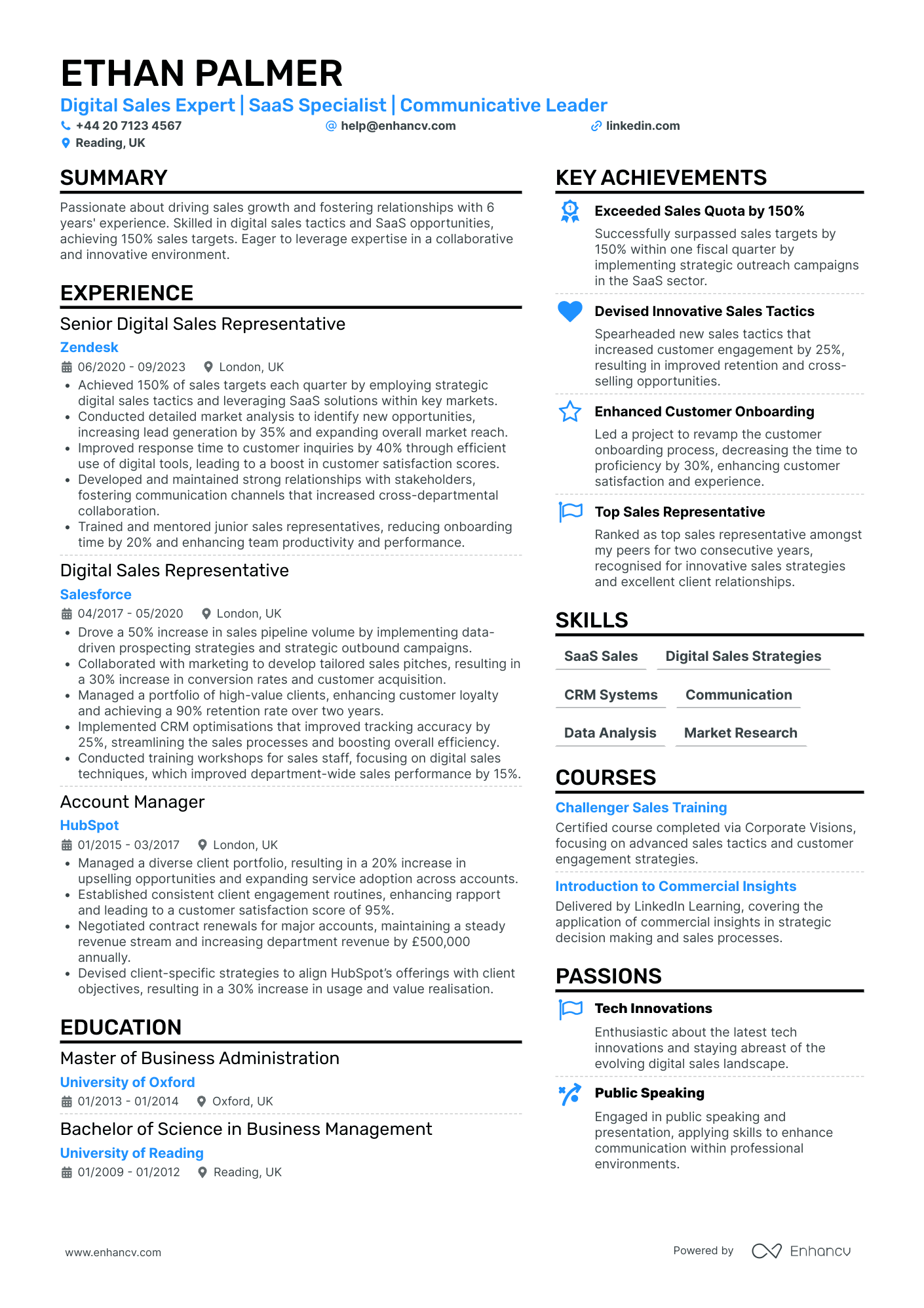
Keep it to two pages, one column, standard headings, and a readable font. Marketing leads skim fast, and a clean CV format reads quicker than a design-heavy one.
Send a PDF for direct applications so the layout holds on any screen. Keep a Word copy for recruitment agencies, which often reformat CVs into their own template. If the advert names a file type, follow it.
Digital marketing applications almost always pass through tracking software, so keep the layout clean and the headings standard for an ATS-friendly CV. Skip the multi-column infographics that break parsing.
Your header does more work on a marketing CV than on most. Alongside your name, town, phone, and email, add one clickable link: a portfolio, a LinkedIn profile, or a single campaign write-up. A reviewer who can see proof in the first three seconds reads the rest more generously.
Match the format to the employer. Agencies move fast and want to see channel breadth and client range, so a tighter, results-first layout suits them. In-house teams care more about depth in their stack, so give the relevant channel more room. The structure stays the same, the emphasis shifts.
Name the file properly before you send it. "Firstname-Lastname-Digital-Marketing-CV.pdf" looks deliberate. "CV-final-v3.pdf" does not, and it is the first thing an employer sees in their inbox.
Build it from a tested layout rather than a blank page: Enhancv's CV templates export to a clean PDF that holds its formatting through an applicant tracking system.

PRO TIP
Searching for a digital marketing CV template is fine as a starting point, but do not submit a generic one untouched. Recruiters see the same downloaded layouts every week. Take the structure, then replace every line with your own campaigns and numbers.
What the UK digital marketing market looks like
Knowing what employers actually ask for tells you which parts of your CV to push forward. Here is what recent UK adverts show.
| What | UK digital marketing roles |
|---|---|
| Where the work happens | Split between hybrid and on-site, with remote rare (across 53 UK postings in the last ~30 days, Enhancv's internal job feed) |
| Skills asked for most | Analytics and SEO lead, then email marketing, paid ads, and data analysis |
| Experience level asked for | Mostly mid-level, with a sizeable entry-level share and a run of lead roles |
| Typical pay | Varies widely by speciality, seniority, and location, so check the individual advert |
Two patterns in that table should shape your CV.
UK digital marketing postings are split between hybrid and on-site work, with fully remote roles rare, so a reviewer wants to see you can reach an office. Put your town in the header and do not lean on a remote-only pitch.
Analytics, SEO, and email marketing are the skills that recur most often across those adverts, ahead of paid ads and data analysis. If you can back those three with real results, they belong near the top of your CV rather than in a long list at the end.
Most of those roles sit at mid-level, with a healthy share of entry-level openings and a steady run of lead positions. That mix is good news at both ends: there is room to break in without years behind you, and there is a clear step up once you can show you have owned a channel and its numbers.
Top skills for your digital marketing CV
If a recruiter asked for your top three, the honest answer for most UK roles right now is analytics, SEO, and a paid or email channel you can prove you have run. Those are the demands that repeat across live adverts, so list them in the words the adverts use.
Name the specific tools under each. "Analytics" means GA4, Looker Studio, or the attribution setup you actually worked in. Hard skills like these carry more weight when they are concrete.
The soft skills that matter here are checkable, not decorative: clear communication with non-marketers, copywriting, and stakeholder management when a campaign needs sign-off. Prove each one in a bullet rather than listing it as an adjective.
Evidence beats a long list. For analytics, point to a report you built or a decision the data drove. For SEO, name the pages you ranked and the traffic they earned. For a paid channel, give the budget you managed and the return you got. Three proven skills carry a CV further than twelve unproven ones.
List only what you can defend in an interview. If you have run one Google Ads account, say so plainly. Do not claim "expert" on a channel you touched once.
Top skills for your digital marketing CV:
Analytics (GA4, Looker Studio)
SEO
Email marketing
Paid media (PPC)
Data analysis
CRM
Marketing automation
Content marketing
Communication
Copywriting
Stakeholder management
Project management
Adaptability
Writing your digital marketing personal statement
Three or four sentences at the top: who you are, the channels you own, one or two results, and the role you want. Keep it concrete. See more personal statement examples if the opening line will not come.
Skip the adjective soup. "Passionate, results-driven, dynamic" tells a reviewer nothing they can check, and every other CV in the pile opens the same way.
Lead with your specialism, then prove it. A performance marketer opens on ROAS and paid budgets. A content or SEO specialist opens on traffic and rankings. A lifecycle marketer opens on retention and email revenue. The reviewer should know within one line which kind of marketer you are.
Lead with evidence instead:
Digital marketing personal statement example
Data-driven digital marketer with four years across SEO, paid social, and email for UK retail brands. Grew organic sessions 62% year on year at a mid-size e-commerce brand and cut paid cost per acquisition by 28% through a search-campaign rebuild. Google Analytics and Google Ads certified. Looking to own full-funnel growth in a hybrid Manchester team.
Compare that with the version most applicants send:
Personal statement to avoid
Passionate and results-driven digital marketing professional with a proven track record of leveraging cutting-edge strategies to drive engagement across multiple channels and deliver real value in a fast-paced environment.
The second one could describe anyone in any marketing job. The first names a channel, a number, and a place. That is the difference between a statement and a slogan.
When we read a digital marketing CV, the first thing we look for is a number attached to a decision you made. "Managed the email channel" tells us nothing. "Rebuilt the abandoned-cart flow and lifted email revenue 34% in a quarter" tells us how you think. Name the channel, name what you changed, then name the result. Marketing is one of the few fields where you can prove impact on the page, so it is a shame when a CV lists tools instead of outcomes.
Writing your digital marketing experience section
Write each role as a dated heading, then bullets that lead with a verb and end with a result. For the mechanics, see work experience on a CV.
Marketing is measurable, so use the numbers you have: traffic, conversion rate, revenue, cost per acquisition, return on ad spend, list growth, and time saved. Vague bullets waste the one advantage this field gives you, so turn each line into a CV achievement.
Lead every bullet with a strong action verb: launched, scaled, cut, rebuilt, ranked. Watch what happens to a weak bullet when you do. "Responsible for the company email newsletter" says nothing. "Rebuilt the welcome email sequence and lifted open rates from 18% to 31% in three months" names the action, the channel, and the result.
Then tailor each application by pulling the channels and tools from the advert and mirroring the ones that are true of you. Enhancv's CV tailoring feature reads the advert and suggests the matching edits, which saves rewriting each application from scratch.
- Own the paid search and paid social budget of £18k a month, cutting cost per acquisition by 28% while holding volume flat
- Rebuilt the email automation programme in Klaviyo, lifting attributed email revenue by 34% over two quarters
- Grew organic sessions 62% year on year by leading a technical SEO fix and a content refresh across 40 landing pages
- Report channel performance weekly in GA4 and Looker Studio, presenting to the head of marketing and two founders
- Managed the organic social calendar across Instagram and Facebook, growing combined following from 4,000 to 11,000 in 18 months
- Ran monthly reporting in Google Analytics and flagged the drop-off points that shaped the next quarter's landing-page tests
- Wrote and scheduled the weekly newsletter to 9,000 subscribers, holding open rates above 30%
- Supported paid campaigns during peak seasonal trading, briefing creative and monitoring daily spend against target
PRO TIP
No numbers yet? Estimate honestly and label it. "Grew the newsletter from roughly 2,000 to 5,000 subscribers in six months" is fair. A reviewer would rather see a defensible estimate than a wall of duties with no outcome at all.
Building a digital marketing portfolio
Digital marketing is one of the few office roles where you can show the work, so a short portfolio sets you apart from CVs that only describe it.
You do not need a designer's site. Two or three case studies on a simple page will do: the brief, the channels you ran, what you changed, and the metric that moved. A slide deck or a Notion page counts.
Reference it once, in the header, as a plain link next to your contact details. Do not paste screenshots into the CV body, where they bloat the file and break parsing.
Feature the metric that matters for the role you want. Growth roles want acquisition and revenue numbers. Content roles want traffic and engagement. Lifecycle roles want retention and email performance. Pick the two or three case studies that match the advert and leave the rest off.
If your best results are under NDA, write the case study around the approach and use relative numbers. "Lifted trial sign-ups by a third" protects the client and still proves the point.
Education and certifications for a digital marketing CV
A marketing degree helps but is rarely required. What UK employers do scan for is proof you can run the tools, so your certificates often carry more weight than the degree.
List the ones that map to the adverts: Google Analytics and Google Ads certifications, Meta Blueprint, HubSpot, and the CIM qualifications for more senior roles. Put them in your education section or a short dedicated block.
Match the certification to the role. A paid-media job values Google Ads and Meta Blueprint. An analytics job values the Google Analytics certification and any SQL or data course. A senior in-house role values the CIM. Listing a certificate that fits the advert reads as intent, not filler.
Name any in progress. "CIM Level 4 in progress" signals direction, the same way a completed course signals capability. Put the date you expect to finish so it reads as a plan rather than a hope.
Writing a digital marketing CV with no experience
Digital marketing is one of the more open fields for a first role, because you can build evidence before anyone hires you. Use a skills-based structure so projects and skills lead.
Run something real and measure it. A blog you grew, a small shop's Instagram you took from 200 to 2,000 followers, a friend's business you ran Google Ads for, or a university society's campaign. Your own channels double as a portfolio, so treat them like proof rather than a hobby. See CV examples for a first job for how to frame it.
Write those like jobs, with dates, tools, and results. An internship, a placement year, or freelance work for a local business all count, and they read far stronger than a skills list with nothing behind it.
Free certifications from Google and HubSpot fill the gap fast and show initiative. Add the keywords from the advert so your CV clears the tracking software, then let your projects carry the proof that a first-timer can actually do the work.
Conclusion
Lead with results, name the channels UK employers actually ask for, and format it so a reviewer finds your best number in seconds.
Pair the CV with a short cover letter that points to one campaign you are proud of, and you turn a list of channels into a case for an interview.

Author's take - The Enhancv team
When we read a digital marketing CV, the first thing we look for is a number attached to a decision you made. "Managed the email channel" tells us nothing. "Rebuilt the abandoned-cart flow and lifted email revenue 34% in a quarter" tells us how you think. Name the channel, name what you changed, then name the result. Marketing is one of the few fields where you can prove impact on the page, so it is a shame when a CV lists tools instead of outcomes.