

U.S. job seekers using Enhancv are more likely than those in any other large market to let AI write the first draft of a tailored resume. Then they rewrite the parts that speak for them, and they save their hardest work for jobs that stretch them.
We found this in 70,639 resumes tailored to specific job ads between August and October 2026 by 12,365 job seekers, 3,029 of them in the U.S. We didn’t ask people how they tailor. We looked at what they changed, section by section, before downloading the resume they planned to send.
Most tailoring advice stops at “tailor your resume.” These numbers show how much people actually change, what they hand to AI, and when they dig deeper, which gives anyone tailoring a resume a benchmark to work from.
AI hasn’t taken over tailoring. People use it to get started, then make the resume their own.

Key takeaways
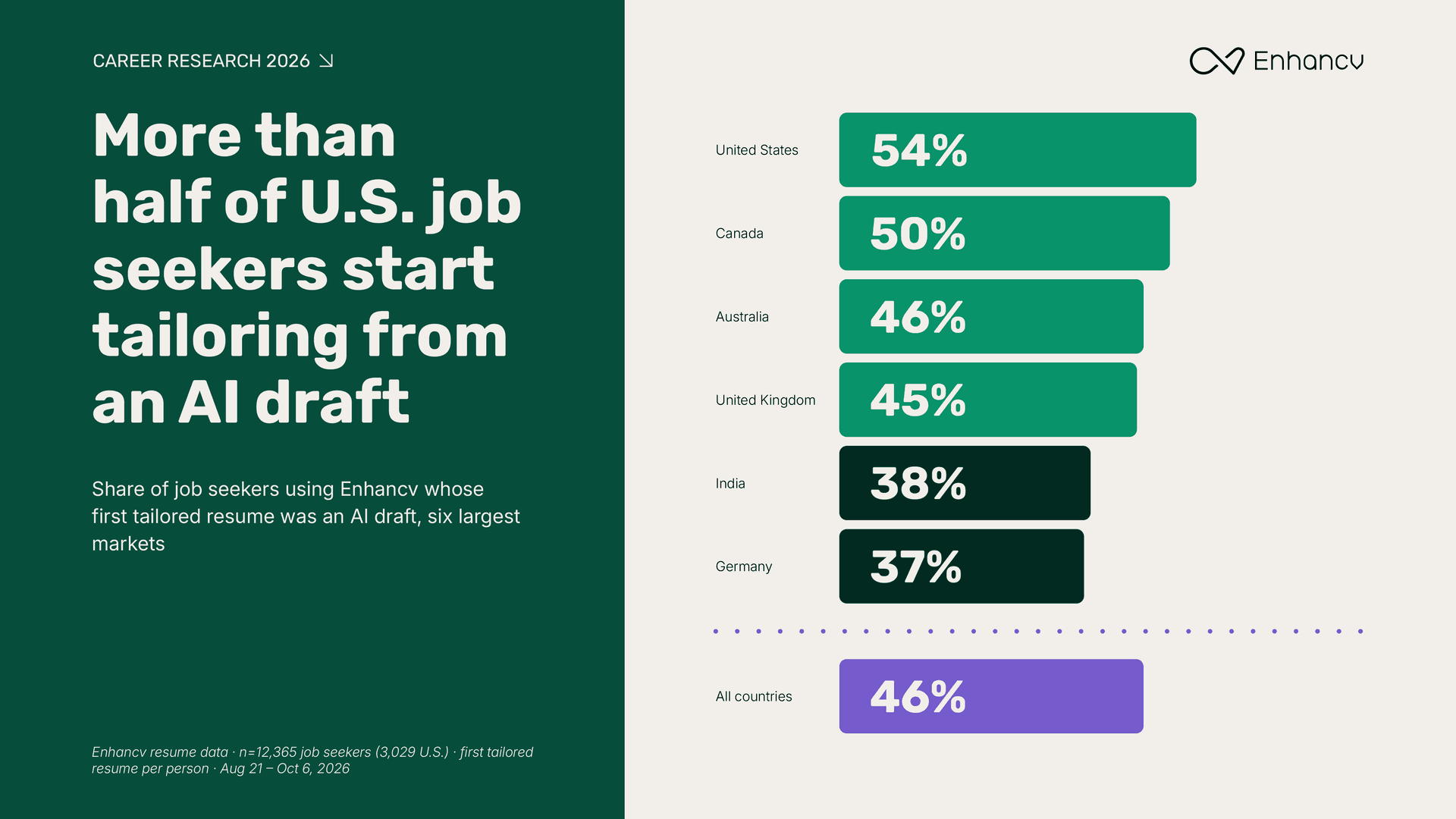
- More than half of U.S. job seekers (54%) started their first tailored resume from an AI draft, the highest share among the 11 largest markets. In France, Germany, and India, it was 36–38%.
- AI drafts, people decide: the AI's summary survived untouched only about a third of the time (34%), in the U.S. and worldwide alike.
- Americans aim close. Of the jobs they tailored for, 64% were an excellent fit for their background, though only 41% of the jobs they viewed were. Outside the U.S., the share was 54%.
- Stretch jobs take longer. In the U.S., tailoring for one took a typical 15 minutes, against 9 for a close fit.
- Experience works differently in America. Tailoring climbs from 46% at three to five years of experience to 55% at 21 to 30 years. Worldwide it stays flat, and in India and Germany it falls.
- Volume costs depth in nearly every market. The busiest U.S. applicants changed only the headline or summary on 39% of their hand-tailored resumes, vs. 14% for people who tailored once. The pattern held in 10 of the 11 largest markets.
All figures come from resumes tailored by job seekers using Enhancv, not from job seekers in general. U.S. figures lead, with other markets for comparison.
Why does this matter now?
AI now sits on both sides of hiring, and each side is wary of the other.
Employers lean on it to manage volume. In a late-2025 Greenhouse survey, 70% of U.S. hiring managers said AI helps them make faster, better hiring decisions, and 65% said they had caught applicants using AI deceptively. LinkedIn reported 11,000 applications a minute in 2025, up 45% in a year.
Candidates use it too, with little trust in the process. In the same survey, 74% of American job seekers said they use AI, but only 8% think AI makes hiring fairer.
Those surveys tell us what people say about AI. Much less is known about what job seekers really do with AI-written text before they apply. That's the gap this analysis looks at.
What do job seekers hand to AI, and what do they keep?
They let AI write the first draft, then take control of how they come across.
How many start tailoring with AI?
Just over half. For 54% of U.S. job seekers using Enhancv, the first resume they tailored started as an AI draft.
"First" means the first resume a person tailored within this window, which isn't necessarily the first they ever tailored. We compared each person's first tailored resume so that everyone counts once.
That's the highest share among the 11 largest markets in the data. Canada follows at 50%, and France, Germany, and India trail at 36–38%. Worldwide, the figure is 46%, and 55% of job seekers used an AI draft at least once in the seven weeks we analyzed.
Why does the U.S. lead?
Language explains part of the gap. In Germany, France, and Mexico, people writing their resume in the local language started from an AI draft less often than people writing in English: 31% vs. 39% in Germany, 31% vs. 44% in France, and 38% vs. 54% in Mexico.
It doesn't explain all of it. Among English-language resumes only, the U.S. still leads at 54%, and India and Germany still trail at 38–39%.
What do people do with the AI's draft?
They edit it. Worldwide, nearly nine in 10 job seekers (87%) changed at least one of the headline, summary, experience bullets, or skills after the AI was done.
The AI rewrote the headline and summary in almost every draft, and about four in 10 experience bullets. People kept 62% of those bullets word for word.
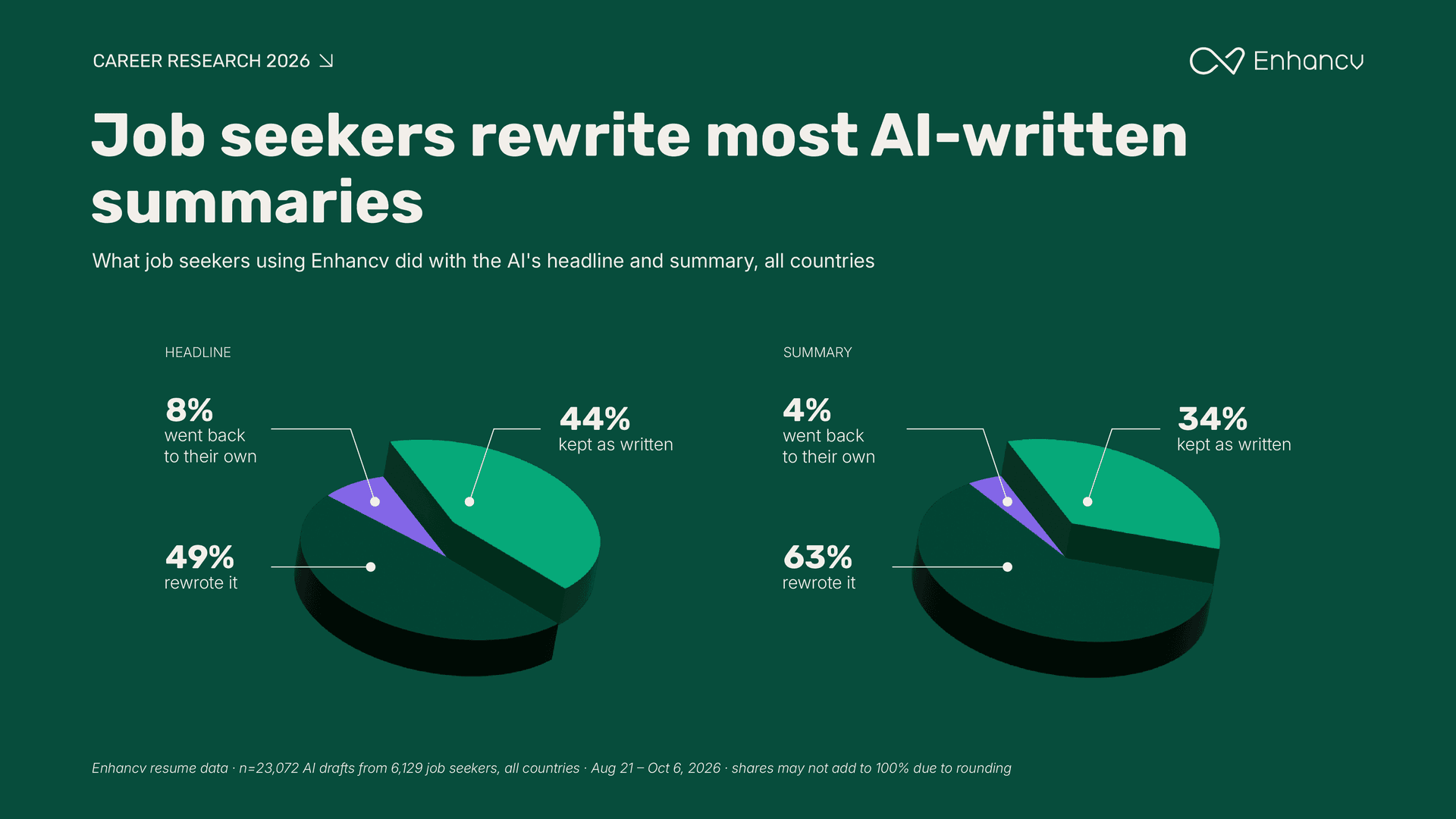
The summary got the most attention. U.S. job seekers kept the AI's summary as written only 34% of the time. Worldwide, people rewrote 63% of the AI's summaries and went back to their own original in another 4%.
For the headline, 49% were rewritten, and 8% went back to the original. In most cases, people edited the AI's version rather than discarding it.
The summary is the first thing a recruiter reads, and sometimes the only thing, so it has to sound like the person behind it. It's refreshing to see people trust AI to rephrase a bullet about a project they ran but insist on writing the pitch themselves. To me, that's a sign of maturity: people who understand how AI works use it as a co-writer and keep the final say.
Doroteya Vasileva, Certified Professional Resume Writer (CPRW) at Enhancv
Which jobs do U.S. job seekers tailor for?
Mostly jobs they already fit, which runs against the idea that job seekers spray resumes at every opening.
Of the jobs U.S. job seekers tailored a resume for, 64% were an excellent fit for their background, 27% a good fit, and 8% a fair or low fit. Among all the jobs they viewed, only 41% were an excellent fit. So people pick the jobs they put work into.
The more requirements a resume was missing, the less likely people were to tailor for the job. Compared with jobs where their resume lacked one listed requirement or none, U.S. job seekers were 20% less likely to tailor for jobs missing two or three, 42% less likely with four or five, and 69% less likely with six or more.
The pattern is weaker outside the U.S., where 54% of tailored jobs were an excellent fit. Worldwide, it was 58%, vs. 38% of jobs viewed.
Do people rewrite more for stretch jobs?
Yes—in our data, tailoring a resume for a stretch job took a typical 15 minutes in the U.S., against 9 for a close fit, about 1.7 times as long. These times include reading the job ad.
Stretch jobs also get more writing. We compared 160 U.S. job seekers who tailored for both kinds of job: a stretch job, where their resume started with under a quarter of the hard skills in the ad, and a close fit, where it started with half or more. For the stretch job, the same people added a median of 46 words, compared to 25 for the close fit. They also went beyond the headline and summary more often (75% vs. 64%).
Worldwide, the pattern held in 10 of the 11 largest countries.
Outside research points the same way. In a 2022 online experiment with 10,468 working-age adults, the Behavioural Insights Team found that willingness to apply rose with the share of requirements people felt they met, and participants typically wanted to meet a little over half before they'd apply. Employers see the result: in a 2025 LinkedIn survey, 73% of HR professionals said fewer than half of the applications they receive meet all the listed criteria.
The takeaway’s simple: people are choosy about which stretch jobs they go for, and when they do go for one, they put in almost twice the writing.

PRO TIP
Go past the headline. Mirror the job ad's language in your experience bullets where it truthfully describes your work. For a stretch job, expect to write more, and describe your real experience in the ad's terms without claiming skills you don't have.
How much do people change when they tailor by hand?
It goes beyond the headline swap. Among resumes U.S. job seekers tailored themselves, 70% got a new headline, 76% a reworked summary, 66% reworked experience bullets, and 51% changed skills. Only 20% stopped at the headline or summary.
Section changed when tailoring by hand
| Section changed when tailoring by hand | United States | Worldwide |
|---|---|---|
| Headline | 70% | 68% |
| Summary | 76% | 71% |
| Experience bullets | 66% | 62% |
| Skills | 51% | 47% |
| Only the headline or summary | 20% | 20% |
The changes inside the experience section were targeted. Worldwide, people rewrote, added, or removed about one in five experience bullets (22%), so most of their work history stayed as it was.
AI drafts work differently: they rewrite the headline, summary, and bullets in nearly every case (97–100%) and the skills in 88%.
Job seekers in the Netherlands and Switzerland reworked their bullets most often (69–71%), and those in India least often (49%).
Does tailoring close the skills gap?
Partly. Before tailoring by hand, the typical U.S. resume had a third (33%) of the hard skills the job ad listed. By the time it was downloaded, it had 44%. Worldwide, the median went from 33% to 50%, so U.S. job seekers left more of the gap open than average.
PRO TIP
In practice, the typical U.S. resume still went out missing more than half of the hard skills the job ad asked for. Some of those are skills people don't have. Others they do have but never wrote down, and a recruiter or screening tool can't credit what isn't on the page. That's the cheapest gap to close.
So, compare the job ad's hard skills with your resume before you send it. If you have a skill the ad asks for and it isn't on the page, add it where you used it, ideally in an experience bullet.
How does experience change tailoring?
In the U.S., experience brings more tailoring, not less.
46% of U.S. Enhancv users with three to five years of experience tailored a resume to a specific job, against 55% of those with 21 to 30 years. Australia (51% to 62%) and Switzerland (50% to 59%) show the clearest rise. Worldwide, tailoring stays flat at 52–54% across experience levels, and in India and Germany it falls with experience.
Do seasoned professionals lean on AI more?
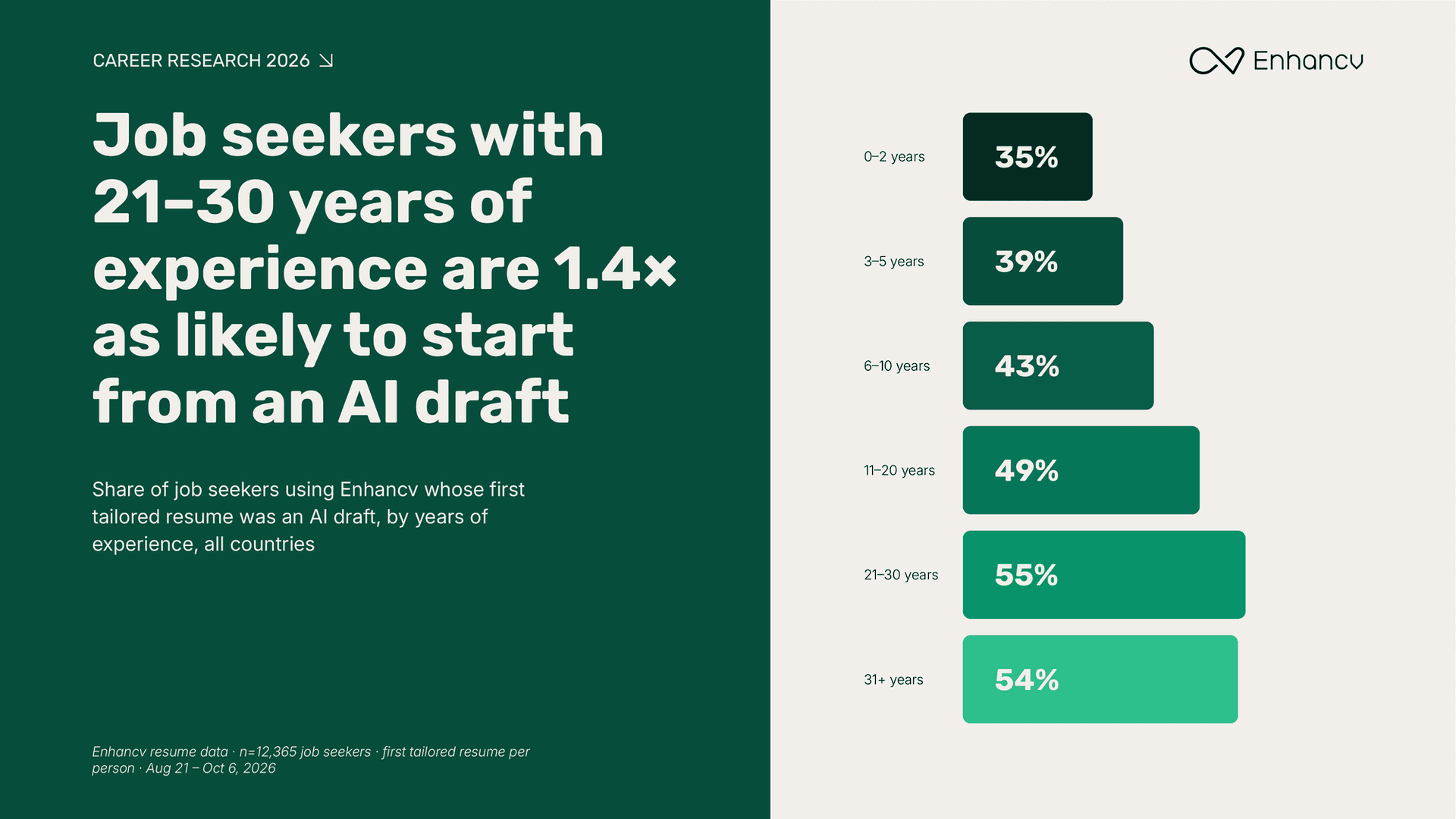
U.S. job seekers with more than 20 years of experience were about 1.2 to 1.4 times as likely as those with three to five years to start from an AI draft. Worldwide, the gap is even clearer: 55% of job seekers with 21–30 years started from an AI draft, compared to 39% of those with three to five years (about 1.4 times as likely). The direction held in nearly every large market.
Worldwide, they also kept more of the AI’s headline. People with 21 or more years kept the AI's headline as written 59% of the time, vs. 45% for those with up to two years.
Engineers went the other way. Worldwide, among job seekers with six to 20 years of experience, 37% of engineers started from an AI draft, against 49% of other professionals. Engineers tend to be younger in this data, but the gap appeared at every career stage.
After 20 years, people have more career than fits on two pages. An AI draft gives them something to cut down instead of a blank page, and they know their own history well enough to judge what to keep.
Doroteya Vasileva, Certified Professional Resume Writer (CPRW) at Enhancv
Where does tailoring wear thin?
The more resumes people tailor, the lighter their edits get. About one in 10 job seekers using Enhancv made 13 or more tailored resumes in seven weeks, roughly two a week, and together they produced more than half (58%) of all the tailored resumes we looked at.
They also changed the least. In the U.S., 39% of their hand-tailored resumes changed only the headline or summary, against 14% for people who tailored a single resume.
Worldwide, the share rises step by step with volume: 14% for one resume, 20% for two to four, 24% for five to 12, and 38% for 13 or more. The pattern held in 10 of the 11 largest countries.
This small group is the closest thing in the data to the flood of lightly edited applications recruiters describe. Most job seekers tailor fewer resumes and go deeper.
Volume and depth pull against each other. When someone sends dozens of resumes, the headline is often the only thing that changes, and a recruiter who reads past the top of the page will notice.
So, choose depth over volume. Fewer, better-matched applications give each resume more of your attention, including the experience section a recruiter reads after the headline.
Doroteya Vasileva, Certified Professional Resume Writer (CPRW) at Enhancv
When do people tailor their resumes?
In the U.S., job seekers using Enhancv spent 54% of their tailoring time Monday to Wednesday and 15% on weekends. Tuesdays and Wednesdays were 2.7 times as busy as Saturdays.
Across 20 countries, the midweek peak was flatter: 52% Monday to Wednesday, 18% on weekends, and Tuesdays and Wednesdays about twice as busy as Saturdays.
Sunday evenings stood out everywhere. In the U.S., 32% of Sunday tailoring started after 6 pm. Across countries, the share ranged from 29% to 49%.
How does resume tailoring in the U.S. compare with other countries?
U.S. job seekers using Enhancv start from an AI draft more often than Enhancv users in any other large market, but they tailor in much the same way once they start.
The table below compares the U.S. with six other large markets on three measures: how often people started their first tailored resume from an AI draft, how often people who tailored by hand reworked their experience bullets, and how often people kept the AI's summary without changes.
AI use varies most. It ranges from 54% in the U.S. to 36% in France. How deeply people edit varies less: in most countries, about two in three hand-tailored resumes got reworked experience bullets, and people kept the AI's summary as written only about a quarter to a third of the time. India is the exception on both. People there reworked their bullets least often (49%) and kept the AI's summary most often (48%).
Resume tailoring in the U.S. vs. other countries
| Country | Started first tailored resume from an AI draft | Reworked experience bullets when tailoring by hand | Kept the AI's summary without changes |
|---|---|---|---|
| United States | 54% | 66% | 34% |
| Canada | 50% | 66% | 35% |
| Australia | 46% | 64% | 30% |
| United Kingdom | 45% | 65% | 30% |
| India | 38% | 49% | 48% |
| Germany | 37% | 60% | 25% |
| France | 36% | 64% | 24% |
| All countries | 46% | 62% | 34% |
What does typical tailoring look like?
Put together, the data gives a benchmark for tailoring a resume, based on what job seekers using Enhancv did. It describes common practice, not what leads to interviews.
How much to tailor your resume: benchmarks from 70,639 tailored resumes
| Situation | U.S. job seekers | Worldwide |
|---|---|---|
| Starting point | 54% started from an AI draft | 46% started from an AI draft; 87% edited it further |
| Working with an AI draft | Kept the AI's summary as written 34% of the time | Kept 62% of its experience bullets word for word and rewrote 63% of its summaries |
| Tailoring by hand | Headline 70%, summary 76%, experience bullets 66%, skills 51% | Headline 68%, summary 71%, experience bullets 62%, skills 47% |
| Choosing jobs | 64% of tailored jobs were an excellent fit | 58% of tailored jobs were an excellent fit |
| Stretch job vs. close fit | About 15 vs. 9 minutes; 46 vs. 25 words added | About 16 vs. 9 minutes; 46 vs. 22 words added |
| Job ad's hard skills on the resume | 33% before, 44% after | 33% before, 50% after |
| Timing | 54% of tailoring Monday to Wednesday | 52% Monday to Wednesday (20 countries) |
There's a lot of worry that AI is filling recruiters' inboxes with generic resumes. The data shows something different. Most U.S. job seekers let AI write a first draft, then rewrite the parts that speak for them, especially the summary. Tailoring thins out among a small group sending the most applications, and they change the least on each one.
If job applications have a quality problem, it starts with volume, not AI.
Volen Vulkov, Co-Founder & CEO at Enhancv
Methodology: What this data can and can't tell us
This is behavioral data from job seekers using Enhancv, not a survey and not a representative sample of all job seekers. It shows what people did. It doesn't show why they did it, or whether a tailored resume led to an interview.
What we analyzed: 70,639 resumes tailored to a specific job ad and downloaded at least once, from 12,365 job seekers in all countries (3,029 job seekers in the U.S.), August 21 to October 6, 2026. Timing, job-fit, tailoring time, and tailoring rates by experience come from product analytics for job seekers using Enhancv, August 12 to October 6, 2026.
How we told AI drafts from hand tailoring: Every tailored resume starts as a copy of one the person already had. If the first version already differed from the original in three or four of the headline, summary, experience bullets, and skills, we counted it as an AI draft. If it matched the original exactly, we counted it as tailored by hand. The 8% in between were left out of those comparisons.
How we counted: Shares are per person. We averaged each person's resumes first, so the few people who tailor dozens of resumes don't outweigh everyone else. Most comparisons use the version that was downloaded and not edited afterward. Times are medians and include reading the job ad.
Fit: A stretch job is one where the resume had under 25% of the job ad's listed hard skills before tailoring. A close fit had 50% or more. "Excellent fit" comes from an automated rating of how closely a listing matches the resume. A missing requirement is one not found on the resume, so some people may have the skill but not list it.
Other limits:
- Country comes from the location on the resume in the resume data (about eight in 10 tailored resumes could be placed) and from the IP address in product analytics.
- Profession comes from the latest job title. About six in 10 could be classified.
- We can't tell a typed change from an accepted suggestion.
- Comparisons across experience levels use a consistent group of job seekers, so that differences in how groups use Enhancv don't pass for differences in behavior.
About Enhancv
Enhancv is anAI resume builder used by job seekers worldwide to write, tailor, and check resumes and cover letters. Its career tools include job search, a Job Application Tracker, and AI Interview Help.
Make one that's truly you.