



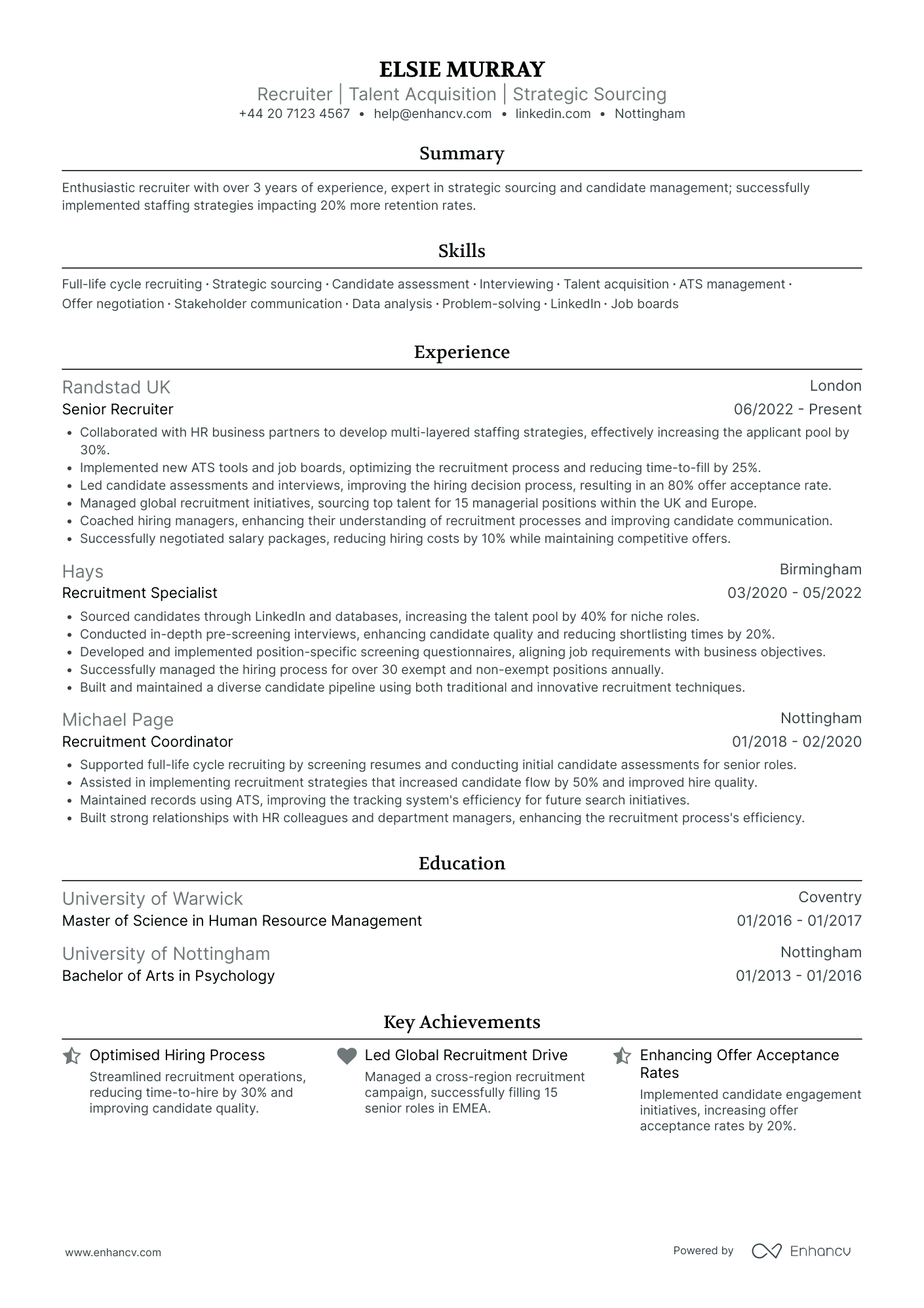
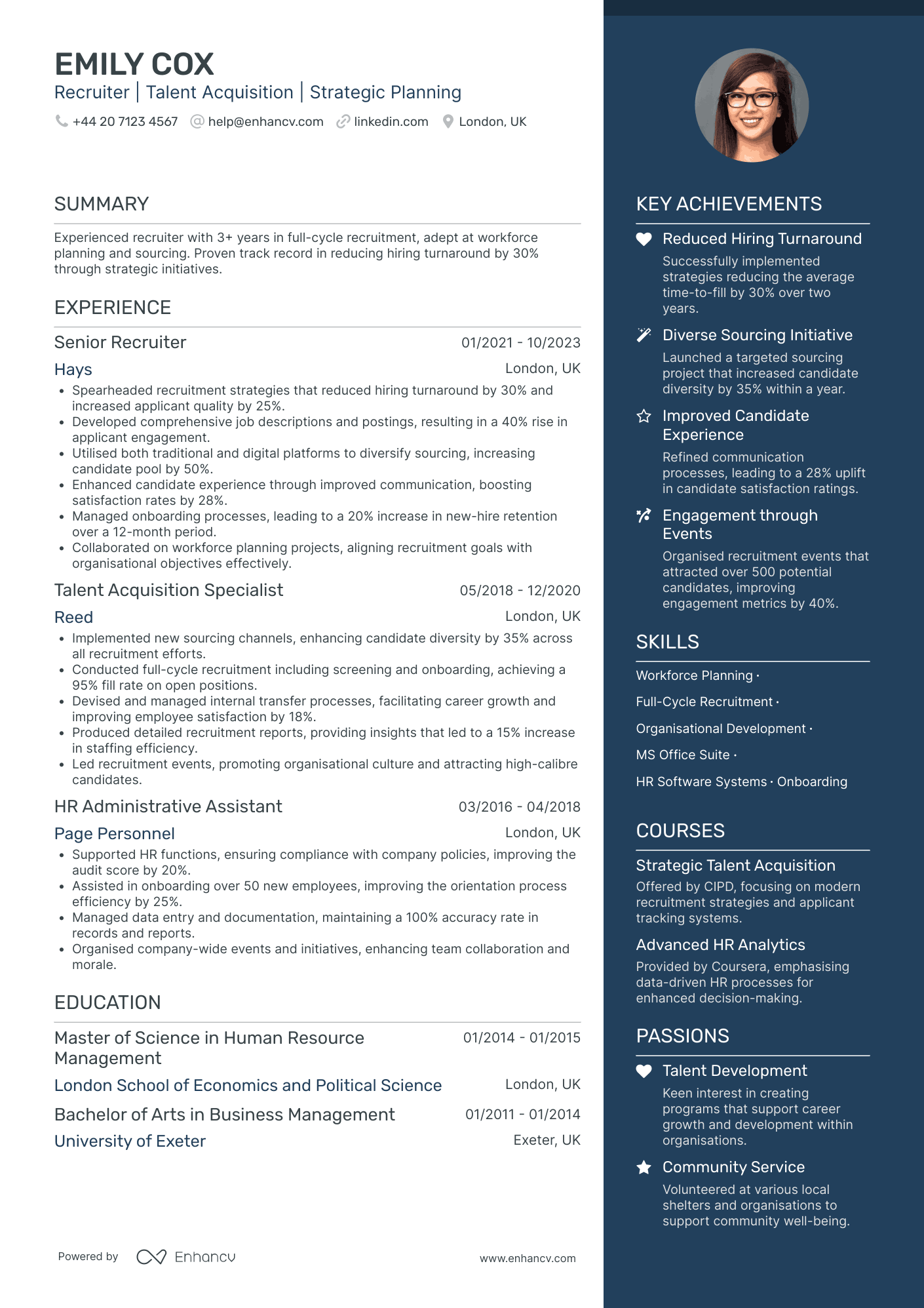
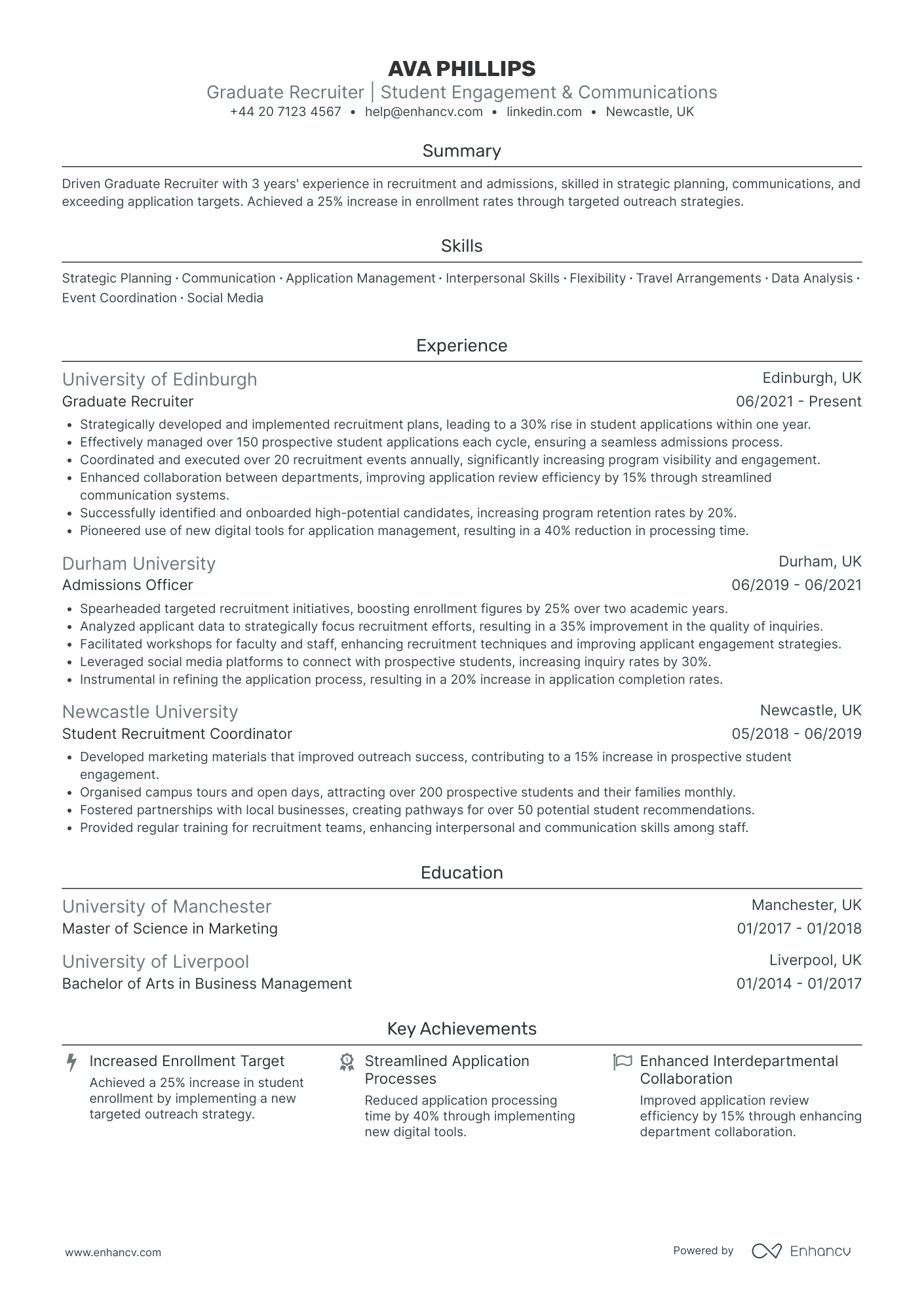
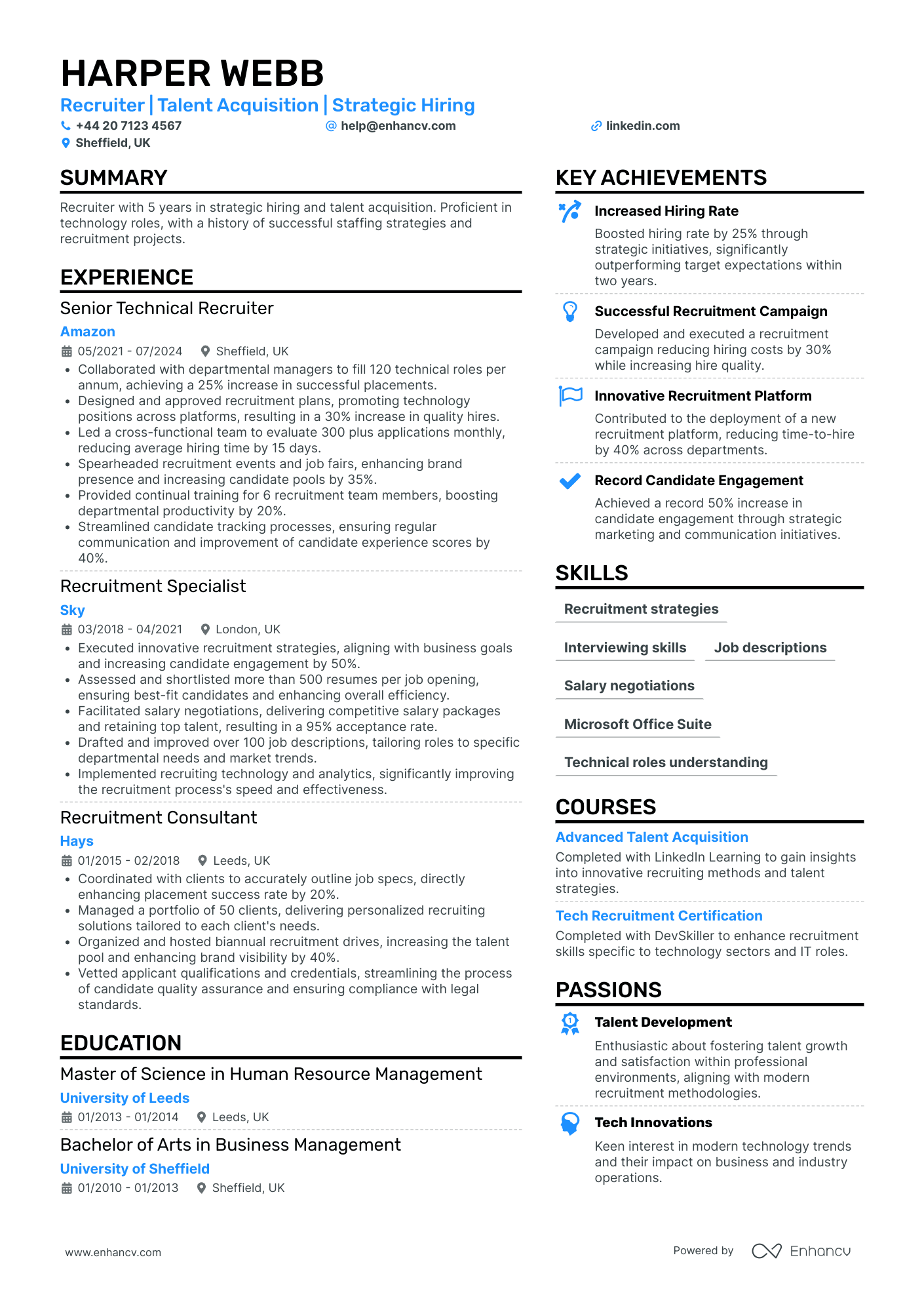
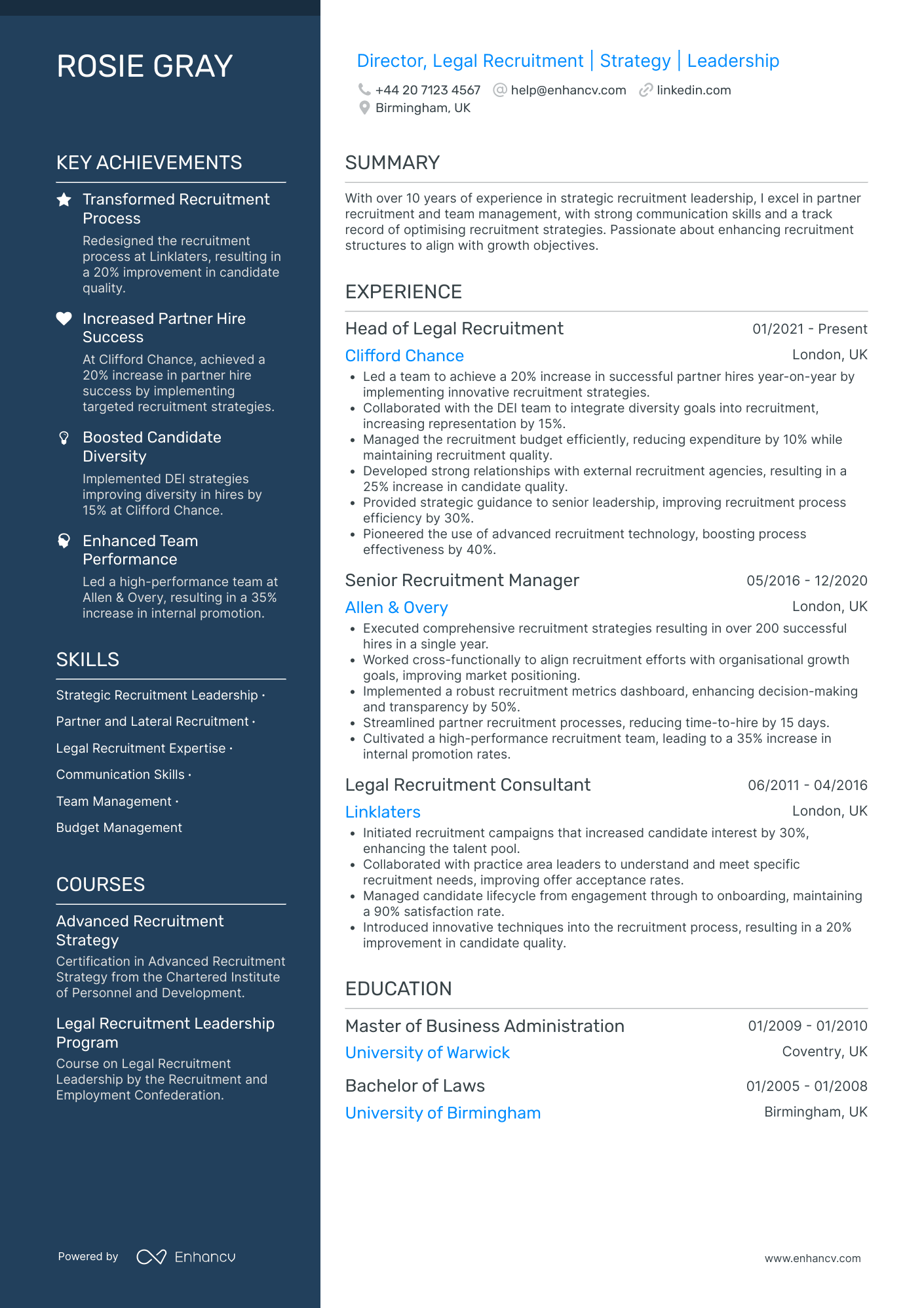
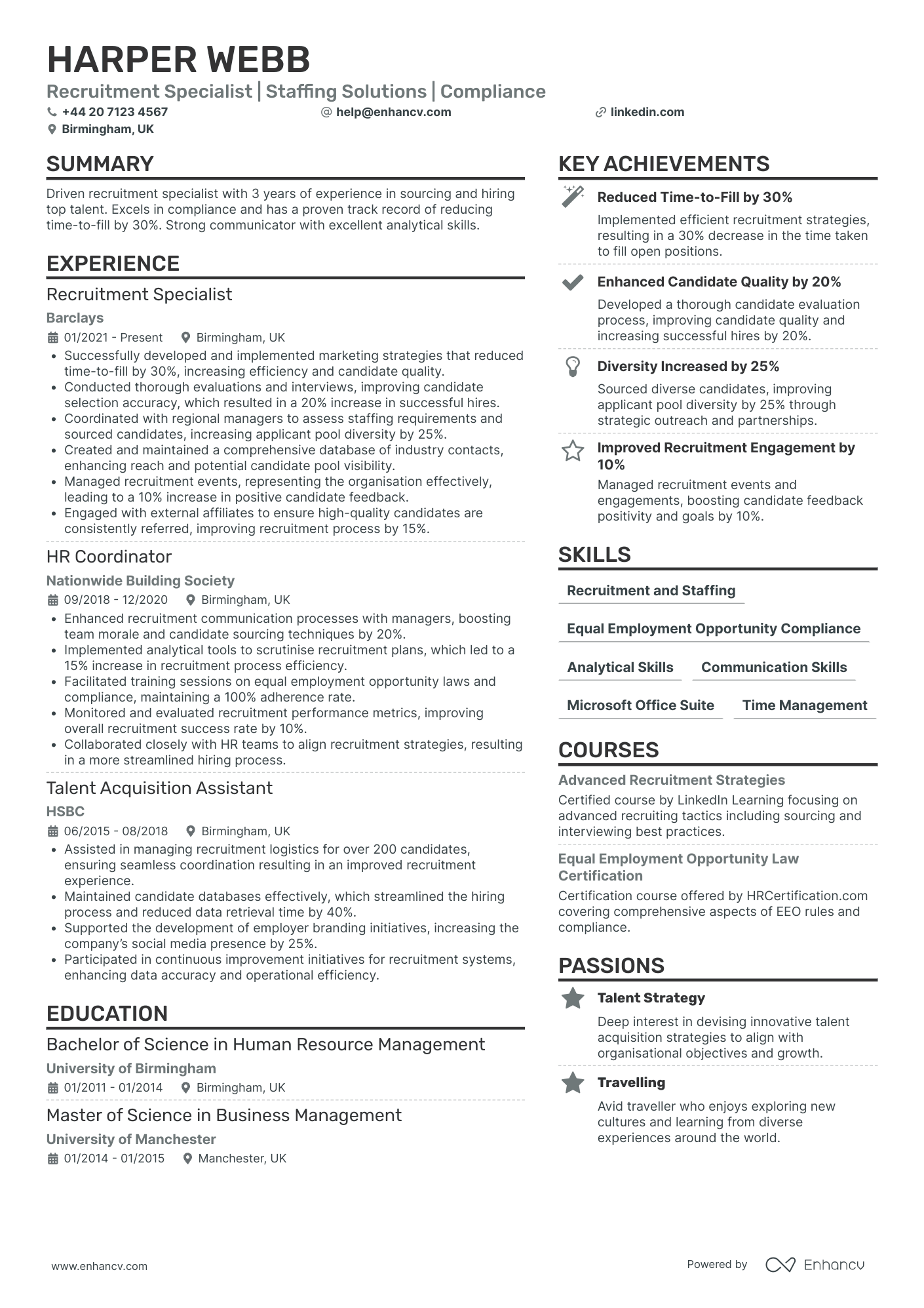
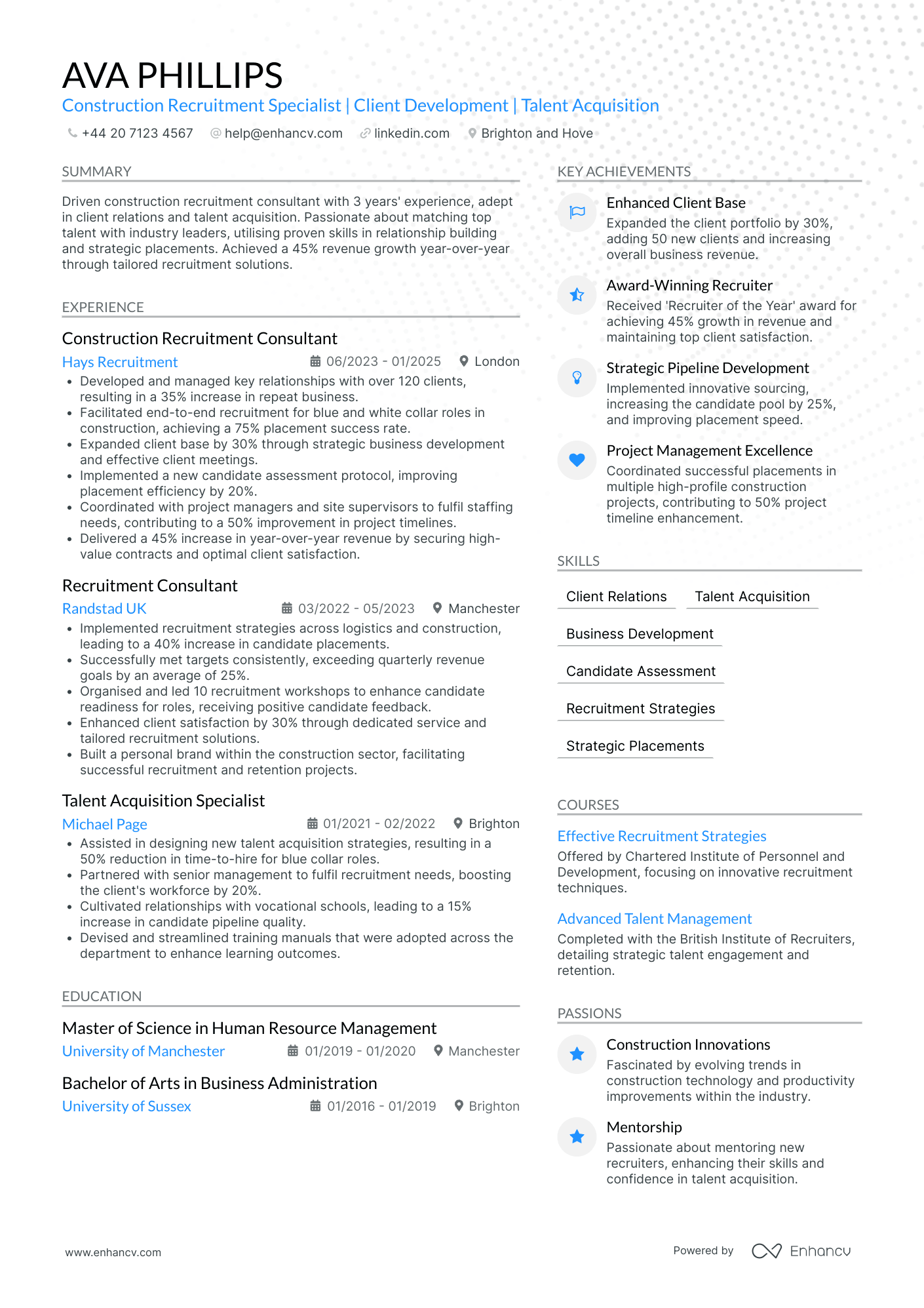
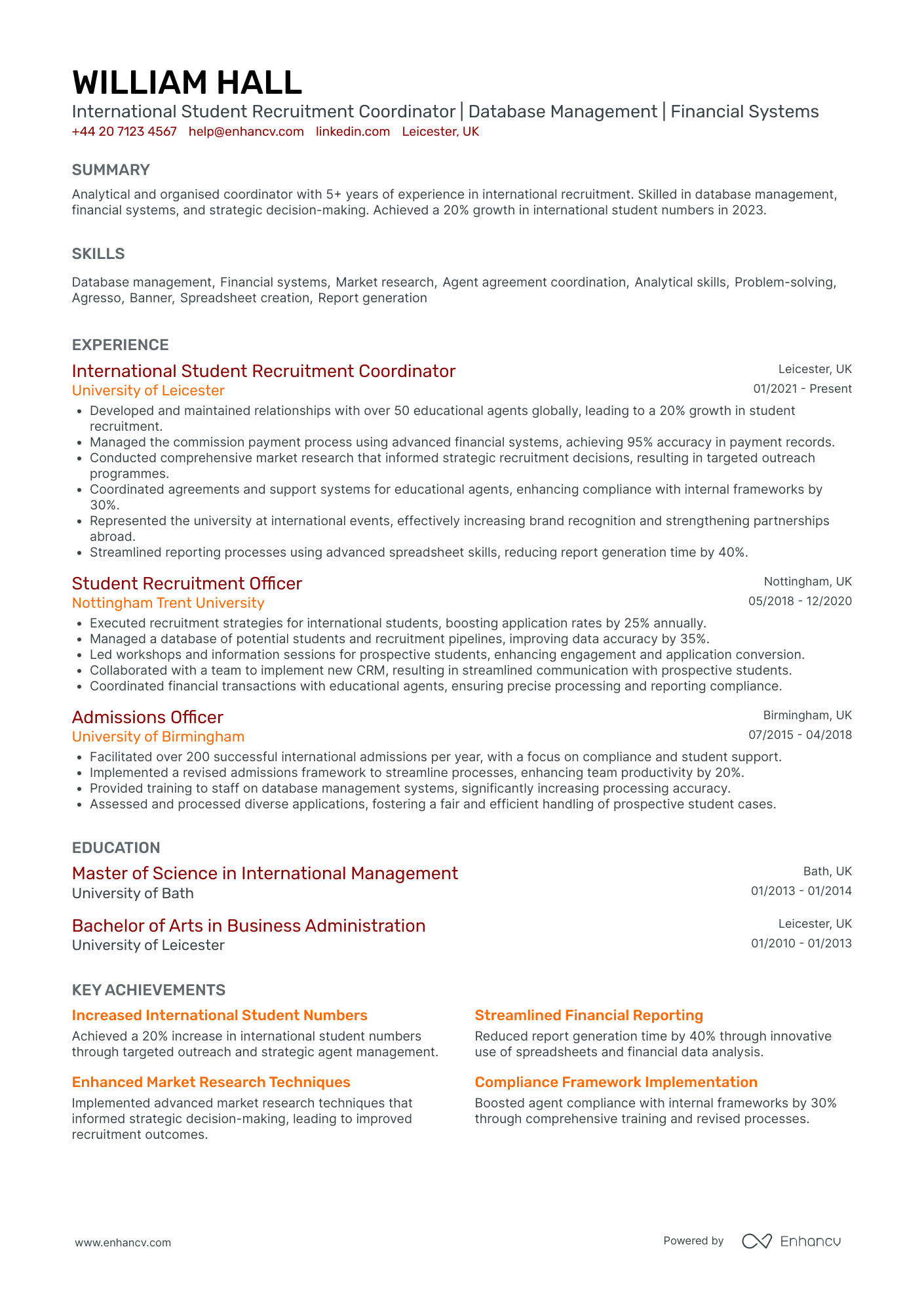
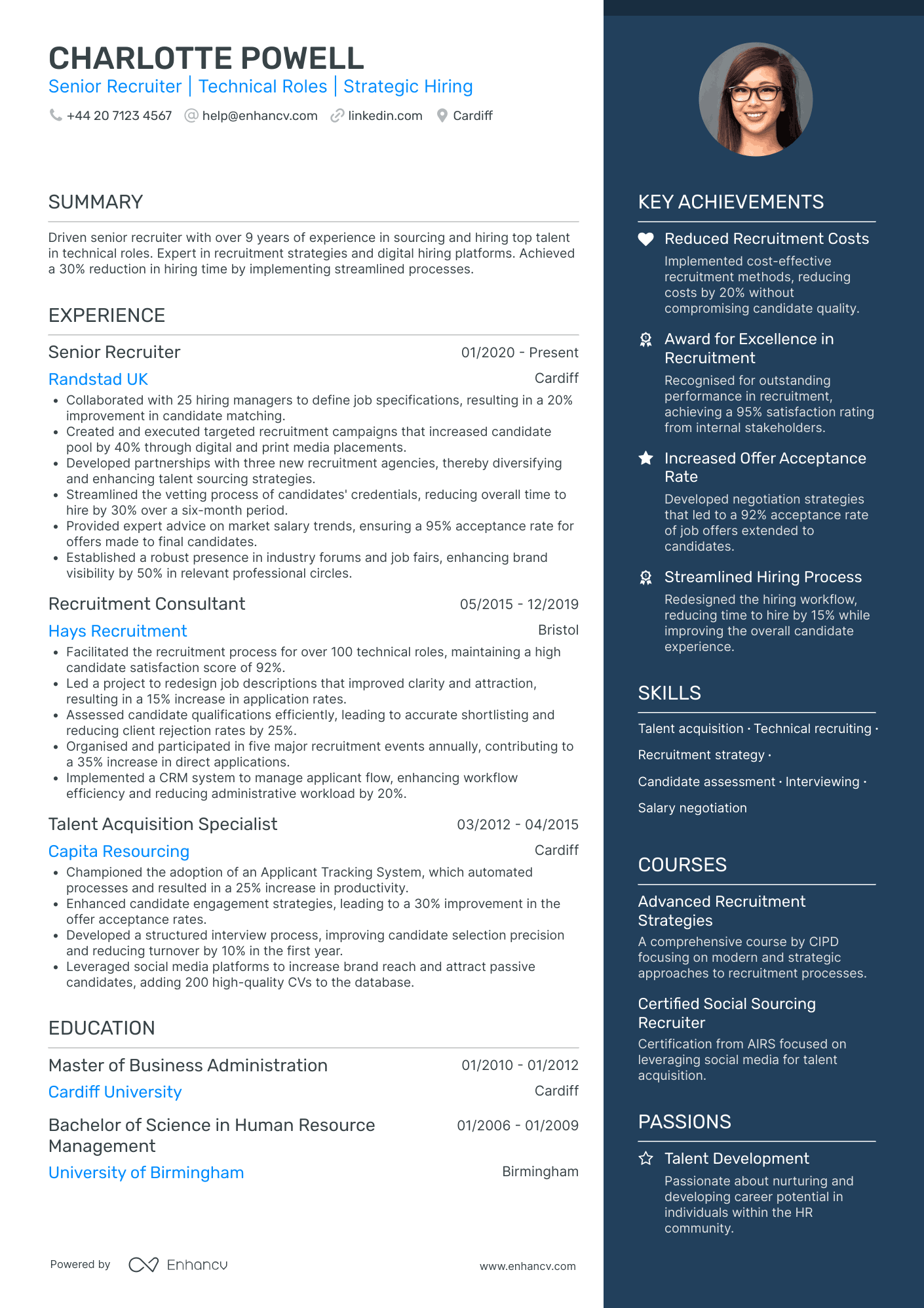
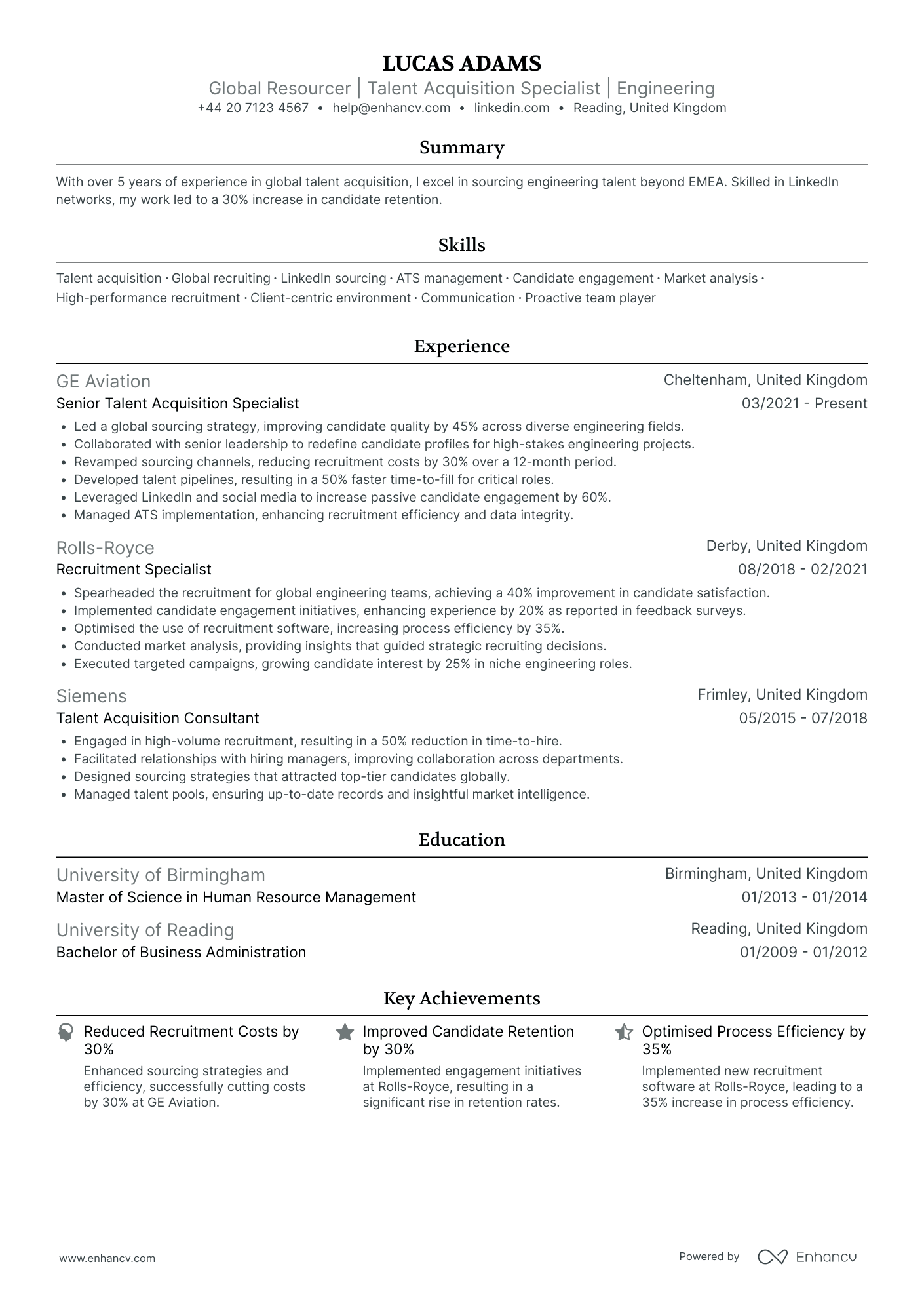
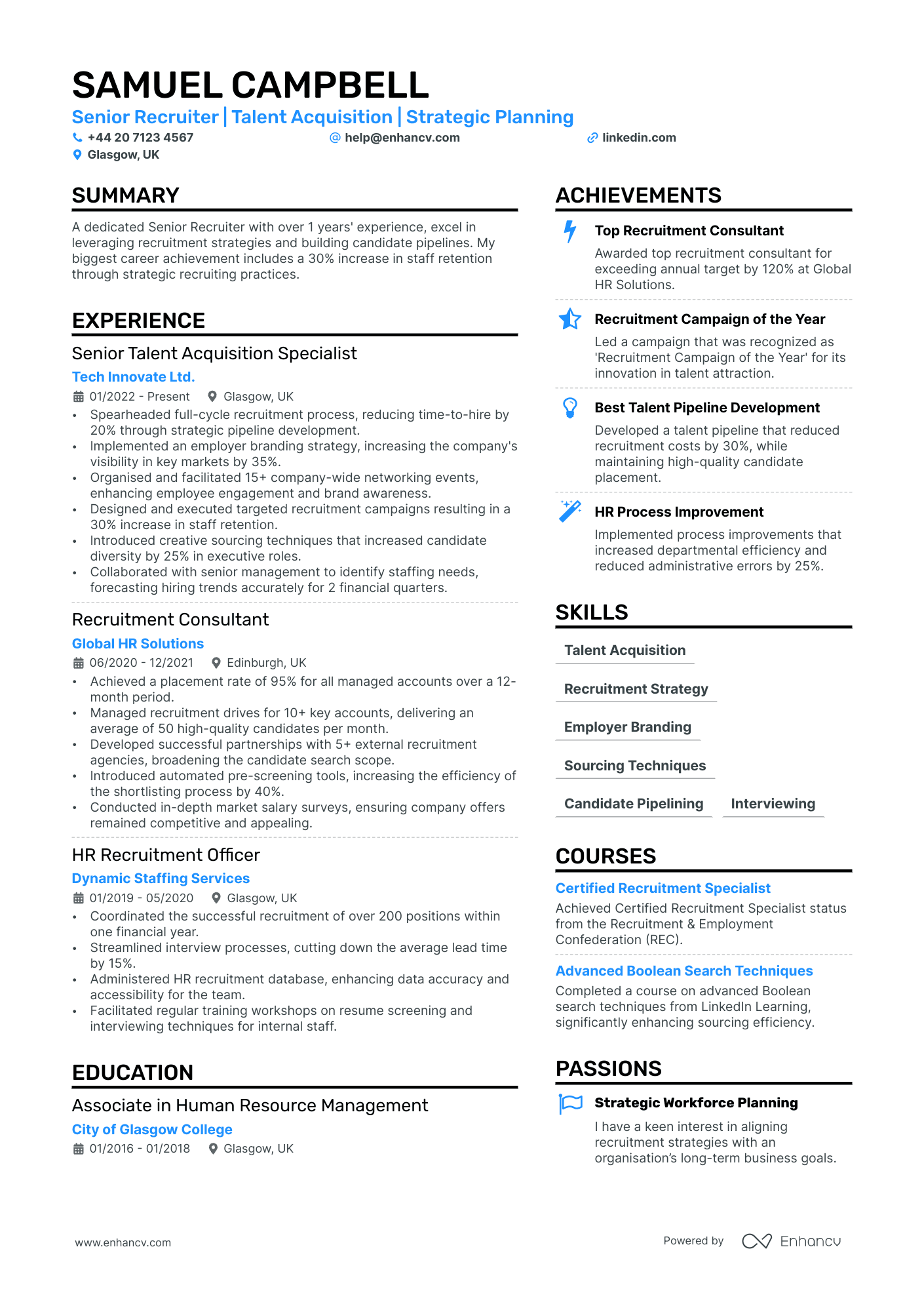
You read CVs for a living, so yours lands in front of the one audience that judges them all day. A recruiter reviewing a recruiter's CV spots a padded bullet or a vague metric in seconds, because they wrote the rulebook you are being measured against.
So lead with proof you can bill and place: roles filled, time-to-hire, and the desks you have run. Get the format right first, because a recruiter who reformats CVs for a living will notice the moment yours does not hold its layout. If you want the fundamentals before the role-specific detail, start with how to write a CV.

Key takeaways
- Lead with numbers a hiring manager can check: roles filled, time-to-hire, and fees or targets hit. Recruiters are judged on output, so put it up front.
- Two pages, reverse chronological, sent as a PDF unless the advert asks for a Word file.
- Name the tools as they appear in adverts: the ATS you have used, LinkedIn Recruiter, and your sourcing channels.
- On-site still leads UK recruiter roles, so make your location and any hybrid flexibility easy to find in the header.
- Write a four-line personal statement built on a desk you have run and a number you have hit, not adjectives.
- Mirror the advert. Agency, in-house, and RPO recruiters are screened against different words.
Formatting your recruiter CV
You reformat other people's CVs all day, so yours is held to your own standard. Sort the format before you touch a single bullet.
Use a reverse chronological CV. Recruiters and hiring managers expect your most recent desk first, and any other running order reads as hiding something.
Keep it to two pages, one column, standard headings, and a readable font. A recruiter skim-reads dozens of CVs a day, and yours has to give up its best lines fast.
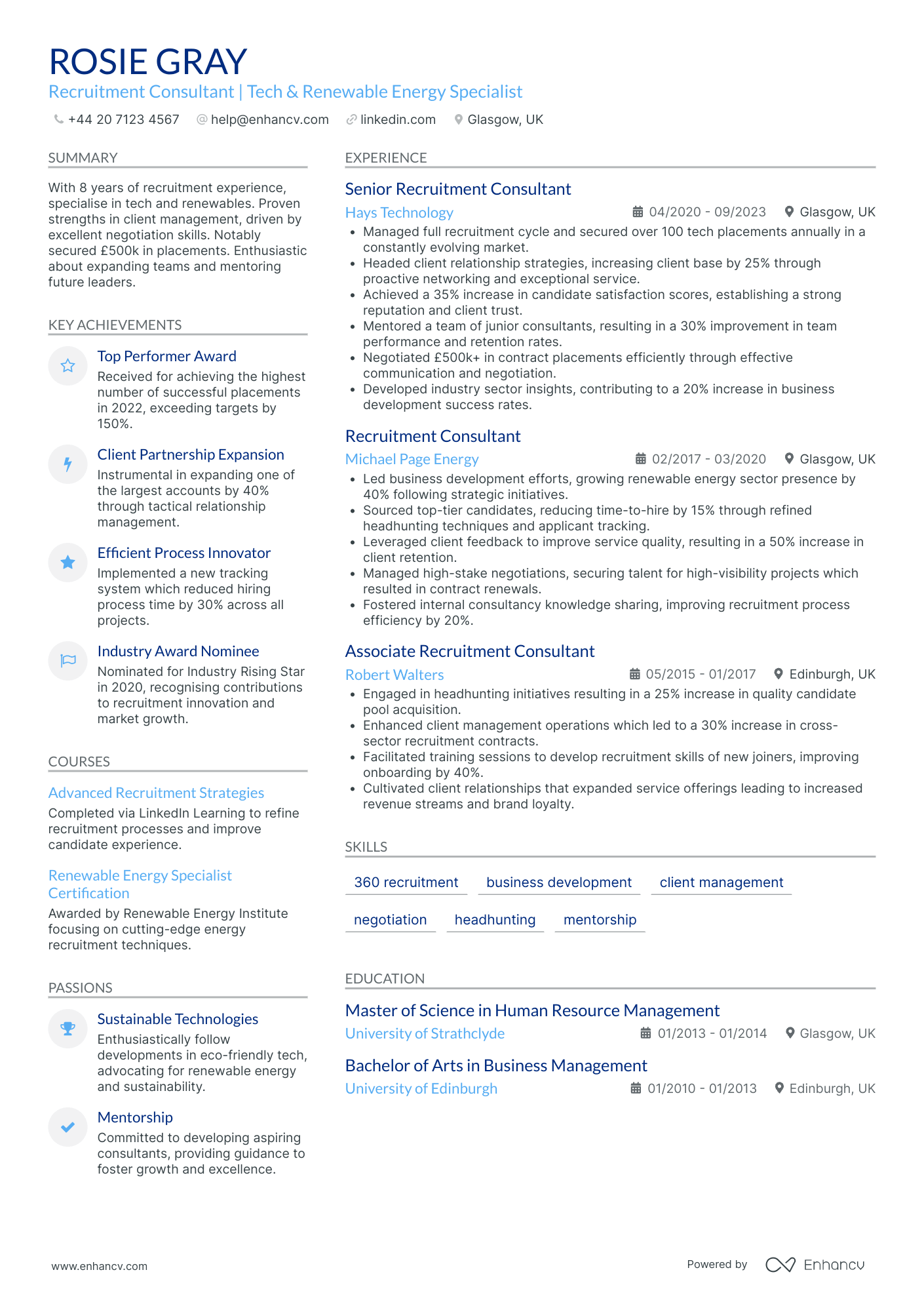
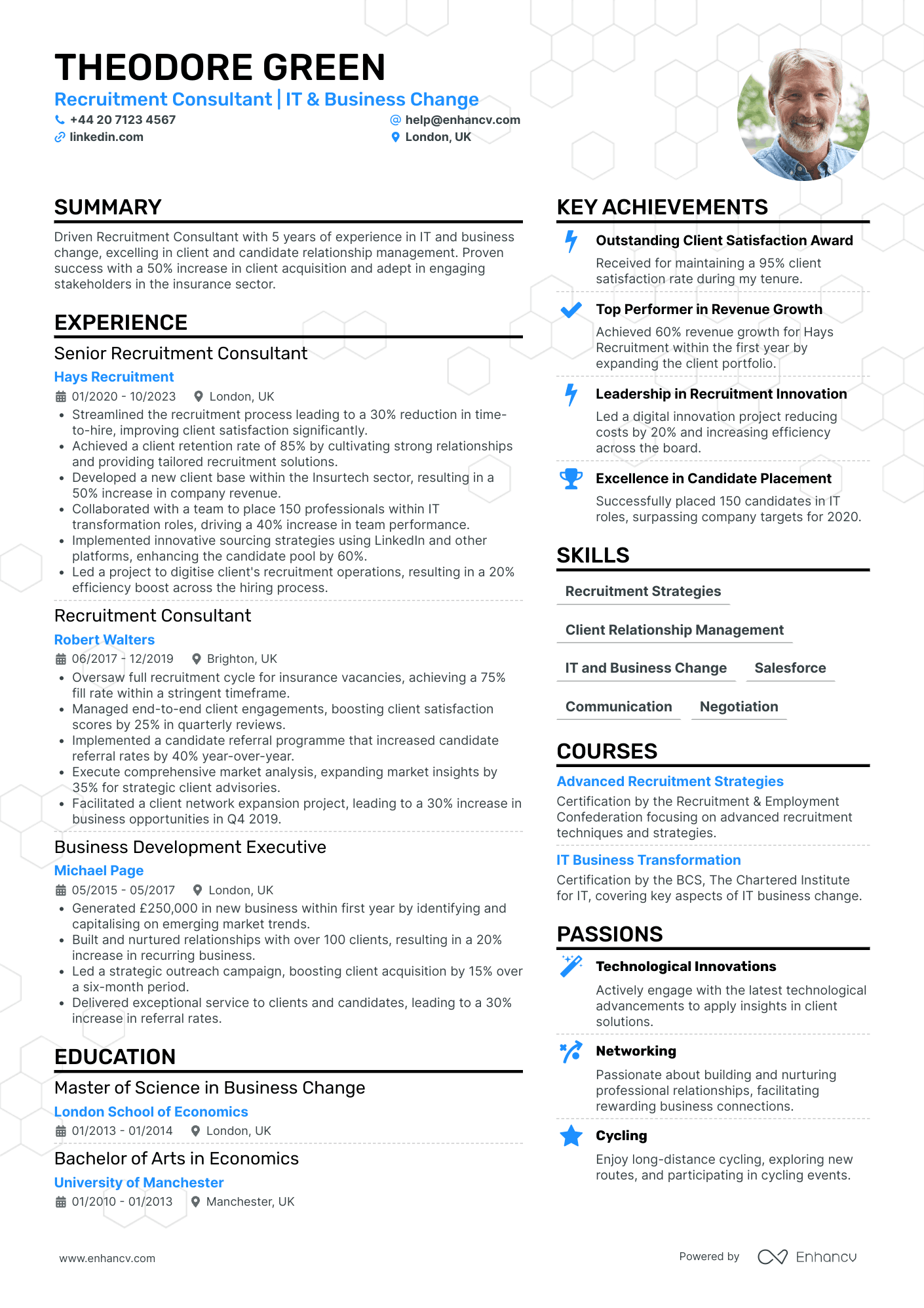
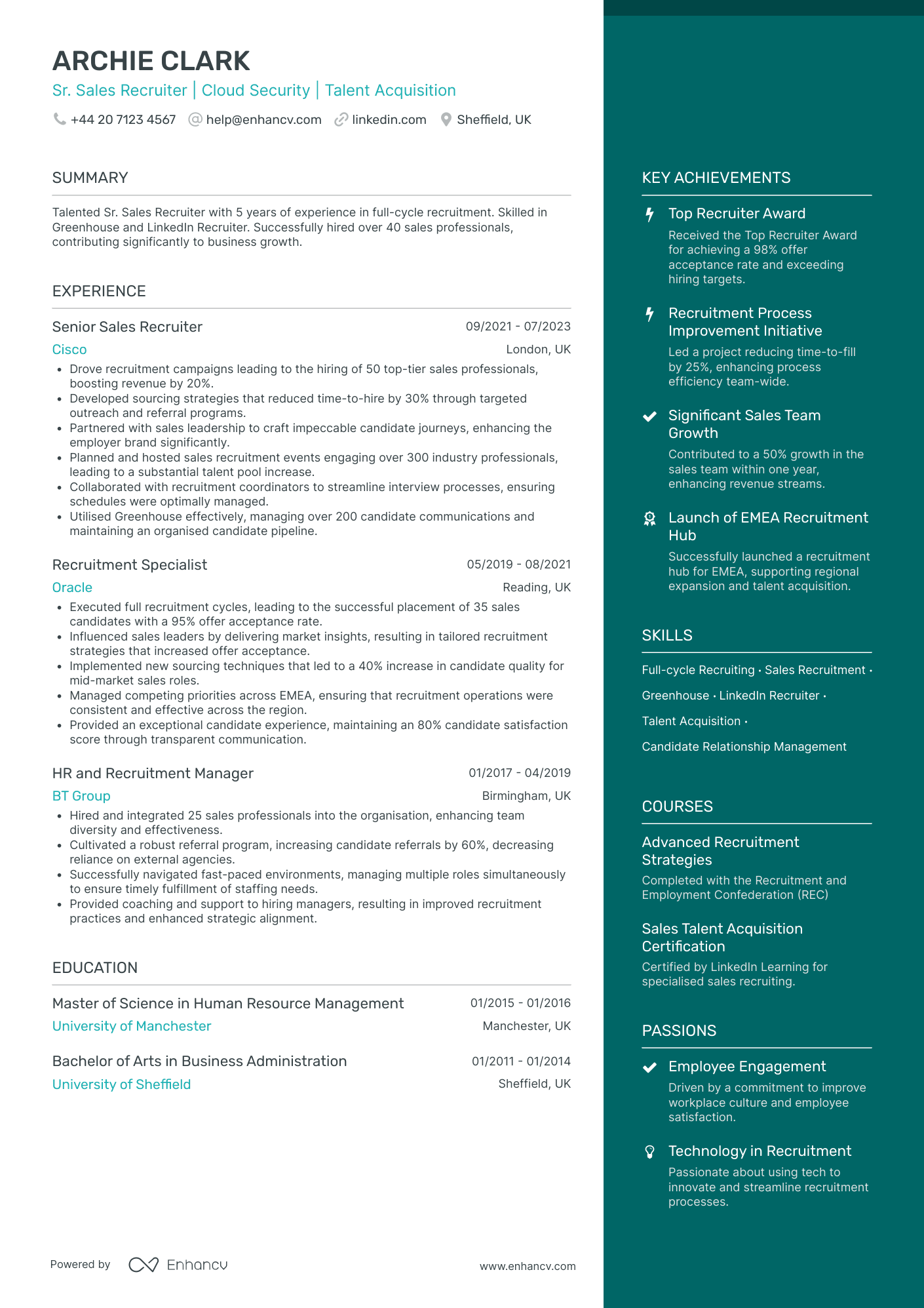
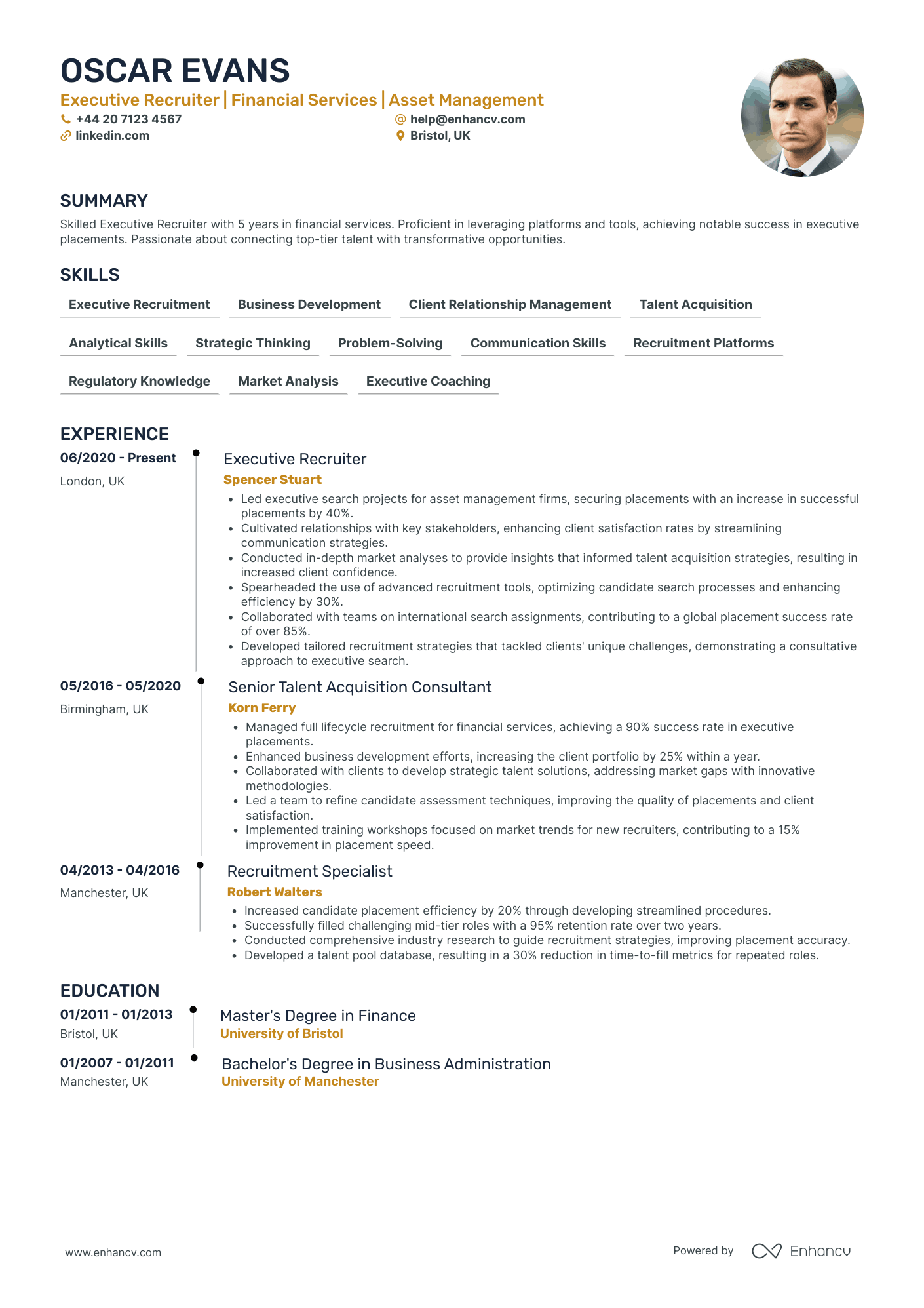
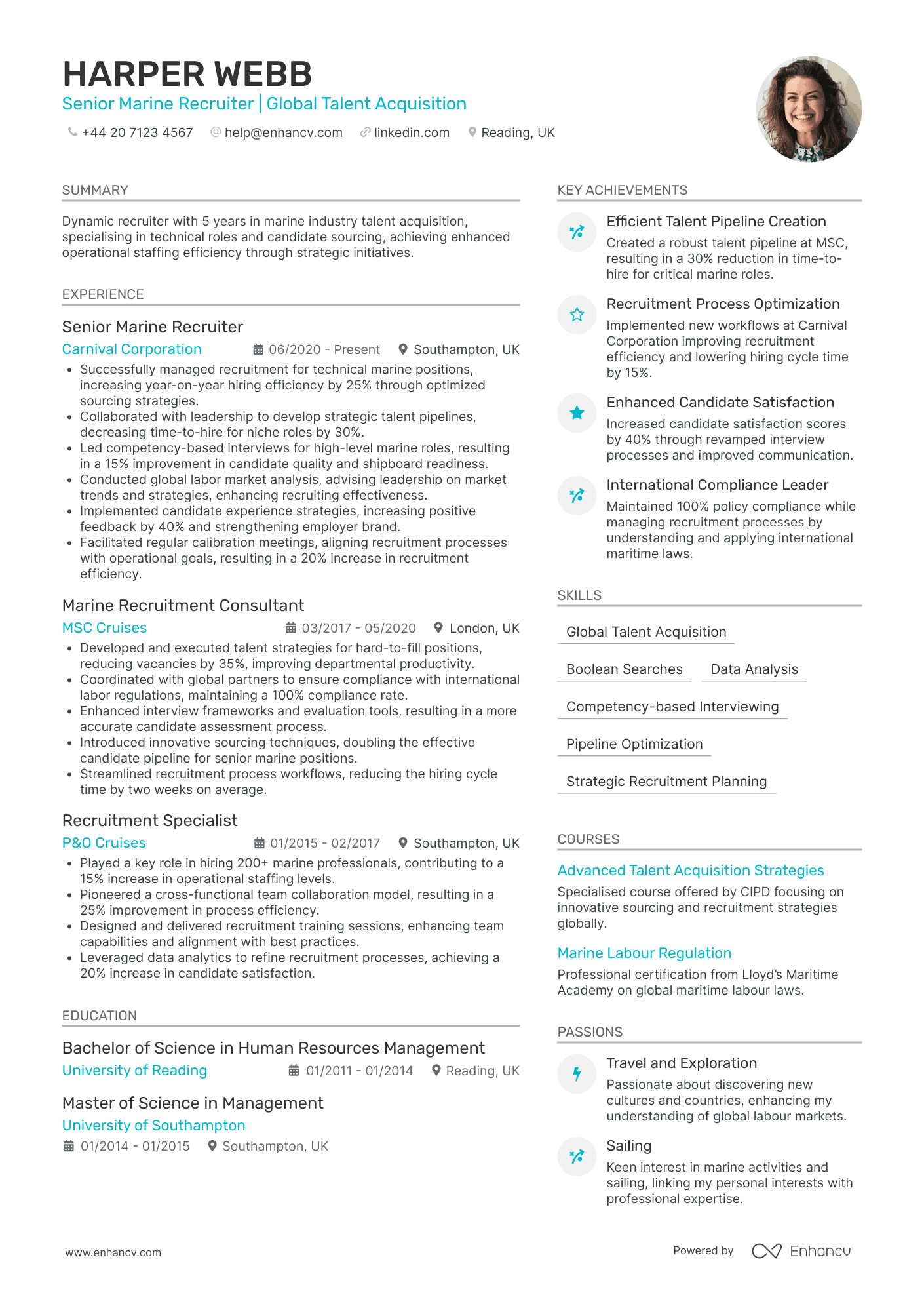
A recruiter CV template is simple by design. One column, clear section headings, consistent date formatting, and enough white space that a tired reader can scan it in one pass. Skill-rating bars, headshots, and heavy graphics are the first things you strip from candidate CVs, so leave them off your own. If the structure is fighting you, a clean CV layout does more than any design flourish.
The header carries your name, the job title you are applying for, your location, a phone number, a professional email, and your LinkedIn URL. Recruiters live on LinkedIn, so a bare or half-finished profile behind that link quietly undoes the CV.
Send a PDF for direct and in-house applications so the layout holds on any screen. Keep a Word copy for agency portals that parse or reformat CVs into a house template. If the advert names a file type, follow it.
Your CV will pass through the same tracking software you use to screen candidates, so keep the layout clean and the headings standard for an ATS-friendly CV. Skip the text boxes, tables, and columns that parse badly, the exact things you flag on candidate CVs.
Build it from a tested structure rather than a blank page. Enhancv's CV templates export to a clean, single-column PDF that reads the same to a person and a parser.
Agency recruiters can add a short billing snapshot under the personal statement: last year's billings, your target, and your placement count in three or four lines. It hands a hiring manager the headline before they reach your experience.
Order the sections the way a recruiter reads: header, personal statement, key skills, experience, then education. See how to arrange the sections in a CV if you want the full running order.

PRO TIP
The seven-second rule is real, and you enforce it on other people daily. Front-load each role with the result first: desks run, roles filled, and fees billed against target. If your best number is buried in bullet four, a busy hiring manager never reaches it.
What the UK recruiter market looks like
Know the market you are applying into, because it tells you what to put near the top. Here is what UK recruiter adverts ask for right now.
| What | UK recruiter roles |
|---|---|
| Where the work happens | On-site leads, hybrid is the common alternative, and fully remote is rare (across 58 UK recruiter postings in the last ~30 days, Enhancv's internal job feed) |
| Experience level asked for | Mostly mid-level, with a strong band of lead and senior briefs and almost nothing at entry level |
| Skills that recur most | Applicant tracking systems (ATS), data analysis, and LinkedIn Recruiter, then sourcing and stakeholder management |
On-site still leads, so a hiring manager wants to see where you are based and whether you can be in the office or on client site. Put your location and any hybrid flexibility in the CV header.
Most roles sit at mid-level, with a strong band of lead and senior briefs and almost nothing at entry level. The market rewards a track record, so your CV has to prove billing and delivery rather than potential.
Agency, in-house, or RPO: tailor your recruiter CV
Recruiter is one job title covering three different jobs, and a hiring manager can tell in seconds whether you have understood which one they advertised.
Agency and RPO recruiters are measured on billings, placements, and time-to-hire. Lead with money and volume: fees booked against target, roles filled, and the sectors and seniority you cover.
In-house and talent-acquisition roles care more about stakeholder management, hiring-manager relationships, candidate experience, and the quality of the process. Lead with the funnels you built, the hiring managers you partnered, and the offer-acceptance rates you protected.
Read the advert for the tell. A billing target means an agency desk, while headcount plans and stakeholder groups mean in-house. Pull the exact CV keywords either way and mirror the ones that are true of you.
Writing your recruiter personal statement
Four lines at the top: the desks you run, the sectors you know, one number that proves you deliver, and the kind of team you want to join next. Concrete beats polished, so see more personal statement examples if the opening line is fighting you.
Match the statement to the desk. If you are moving from agency into an in-house team, say so directly and frame your billing as proof you can deliver rather than the only thing you measure.
Skip the adjective soup you reject on candidate CVs. "Results-driven, passionate recruiter with excellent communication skills" tells a hiring manager nothing they can check.
Lead with evidence instead:
Recruiter CV personal statement example
Agency recruiter with six years on permanent technology desks across London and the South East. Billed £310,000 last year against a £250,000 target, at an average time-to-hire of 24 days. Fluent in LinkedIn Recruiter and Bullhorn, and known for keeping hiring managers and candidates warm through long processes. Looking to bring a full desk and a strong client network to an in-house talent role.
What to avoid
A results-driven and passionate recruitment professional with excellent communication and interpersonal skills. A team player who thrives in fast-paced environments and is dedicated to finding the best talent for every role. Seeking a challenging new opportunity to utilise my skills and grow.
Every phrase in the second version could sit on any CV in the pile. The first one names a desk, a number, and the tools, so it survives your own six-second scan.
When we review a recruiter's CV, the first thing we look for is a number we can trust. "Managed the full recruitment lifecycle" describes a job description, not a person. "Filled 40 permanent roles in a year at a 22-day average time-to-hire" tells us how you work and how good you are at it. Recruiters sell candidates on evidence every day, so it is strange how often their own CV falls back on adjectives. Lead with the desk you ran and the results you booked, and the rest of the CV has something to stand on.
Writing your recruiter experience section
Write each role as a dated heading, then bullets that pair what you did with the result. Lead every bullet with a verb and put the number early. For the mechanics, see how to write work experience on a CV.
Recruitment is one of the easiest roles to quantify, so there is no excuse for vague bullets. Roles filled, time-to-hire, fill rate, fees against target, offer-to-acceptance ratio, and pipeline size are all fair game. These are your CV achievements.
Pair every number with the action that produced it, because a figure on its own reads as a boast a hiring manager cannot verify. "Cut time-to-hire to 24 days" is a claim, while "cut time-to-hire from 38 to 24 days by rebuilding the screening stage" is a method they can picture you repeating for them.
Tailor every application. Pull the exact language from the advert, agency versus in-house, permanent versus contract, and the sectors and ATS named, then tailor your CV to the parts that are true of you.
Enhancv's CV tailoring feature reads the advert and suggests the matching edits, which saves rewriting your desk from scratch for each role.
Give your current desk the most room, three to five bullets, and taper older roles to one or two. A hiring manager cares most about what you are billing now, not a placement from 2016. Open each bullet with a strong action verb such as billed, placed, sourced, negotiated, or reduced.
- Run a permanent technology desk billing £280,000 to £320,000 a year, consistently 15% to 20% above target
- Reduced average time-to-hire from 38 to 24 days by rebuilding the screening process and the LinkedIn Recruiter pipeline
- Placed 42 permanent hires across engineering and data roles in the last 12 months, at a nine-in-ten offer-acceptance rate
- Managed 12 live vacancies at a time and mentored two trainee consultants to their first placements
PRO TIP
You know the red flags because you screen for them: unexplained gaps, vague duties with no numbers, and a different job title in every line with no thread. Account for any employment gaps in one honest line, and give every role a metric. You would bin a candidate CV that did neither.
Skills to put on a recruiter CV
Read a dozen live recruiter adverts and the same demands repeat. Applicant tracking systems, data analysis, and LinkedIn Recruiter come up most often, followed by sourcing and stakeholder management, across UK recruiter postings on Enhancv's internal job feed in the last ~30 days. Those are the hard skills a hiring manager scans for.
List the tools by name. "ATS" is weaker than "Workday, Greenhouse, and Bullhorn", because a hiring manager searching for a specific stack is searching for the exact word.
The soft skills that matter here are checkable through your results: stakeholder management, negotiation, and relationship building. Prove each one in an experience bullet rather than listing it as a claim.
Data has quietly become a recruiter skill. If you report on pipeline and conversion, name that analytical skill, because it separates a modern recruiter from a CV-forwarder.
Keep the key skills section tight and scannable, six to ten items a hiring manager can match to the advert at a glance. Put the tools first, then the capabilities. A crisp block near the top does the ATS work without keyword stuffing.
Top skills for your recruiter CV:
Applicant tracking systems (ATS)
LinkedIn Recruiter
Boolean sourcing
Data analysis and reporting
Candidate screening
Interview coordination
Recruitment CRM (Bullhorn, Greenhouse)
Employer branding
Stakeholder management
Negotiation
Relationship building
Communication
Resilience
Education and certifications for a recruiter CV
Recruitment is not a degree-gated field, so keep education short unless you are early in your career. A degree in any subject, with the classification, is enough for most roles.
Certifications carry more weight here than the degree. Name any you hold: the REC's Certificate in Recruitment Practice or a Level 3 qualification, CIPD for in-house and talent roles, and any ATS or sourcing certifications.
List them where a hiring manager expects them, in a short education or professional development block near the foot of the CV.
If you are early in your career and light on placements, education does more work. Move it above experience, name relevant modules or a dissertation with a commercial or people focus, and add any sales, customer service, or student-ambassador work that shows you can talk to strangers and hit a target.
Conclusion
Get the format right first, then lead with the numbers only a recruiter can produce: roles filled, time-to-hire, and fees against target.
Pair the CV with a short cover letter that says why this desk and this employer, and you turn a strong track record into interviews.

Author's take - the Enhancv team
When we review a recruiter's CV, the first thing we look for is a number we can trust. "Managed the full recruitment lifecycle" describes a job description, not a person. "Filled 40 permanent roles in a year at a 22-day average time-to-hire" tells us how you work and how good you are at it. Recruiters sell candidates on evidence every day, so it is strange how often their own CV falls back on adjectives. Lead with the desk you ran and the results you booked, and the rest of the CV has something to stand on.